This Backdoor Legislative Tool Could Unravel Public Lands
How the Congressional Review Act is being used to erase protections for America’s shared lands and waters
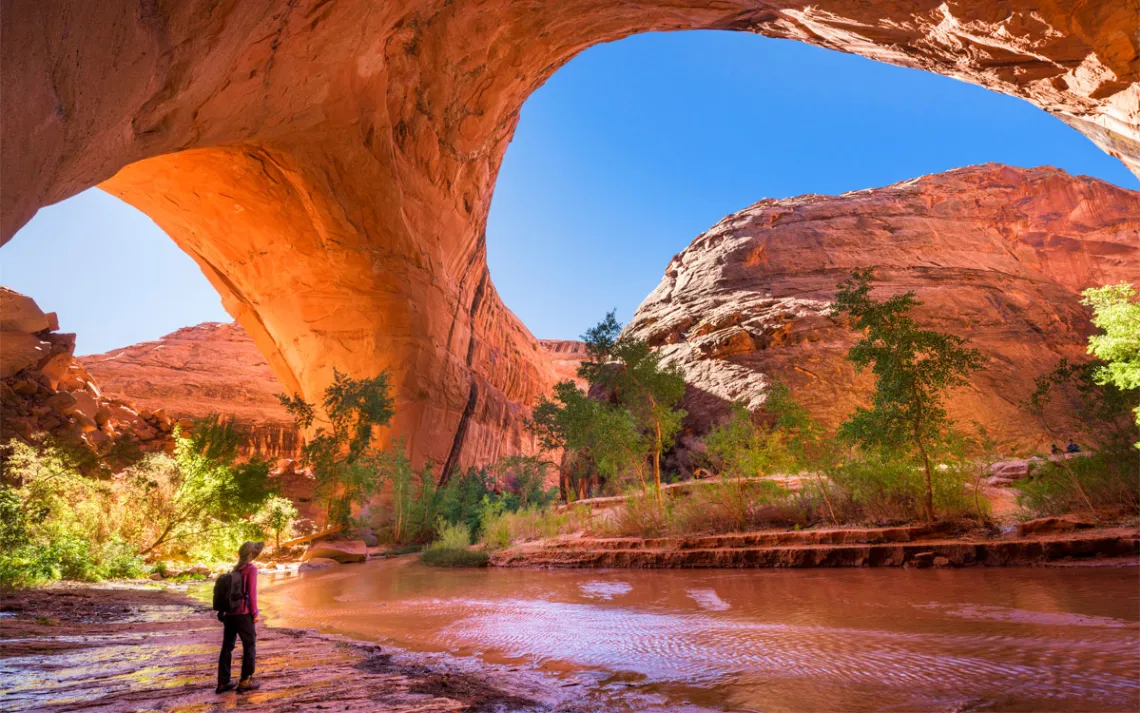
A hiker at Jacob Hamblin Arch in Coyote Gulch, Grand Staircase–Escalante National Monument. | Photo by Wildnerdpix/iStock
Lawmakers in Congress are deploying an obscure legislative tool to upend America’s most beloved wild spaces. In the last few months, Republicans have overturned land-management plans in Alaska, North Dakota, Montana, and Wyoming. Conservation groups fear they’ll target national monuments and wilderness areas next.
On January 15, the Government Accountability Office (GAO) issued an opinion asserting that the management plan for the Grand Staircase–Escalante National Monument could be revoked. These plans, called resource management plans (RMP), are like road maps for how the Bureau of Land Management, which oversees the monument, sets its priorities, said Kristen Brengel, the senior vice president of government affairs at the National Parks Conservation Association.
At issue is whether they count as “rules” under the Congressional Review Act (CRA), a legal statute that allows lawmakers to overturn a regulation within 60 legislative days of an administration submitting it to Congress. Conservation groups expect that legislators will put forward a bill to roll back the monument’s plan within days. That bill, called a resolution of disapproval, would then start the 60-day clock.
The GAO memo was prompted by Utah Republican Representative Celeste Maloy, who last year asked the agency if the monument’s RMP could be considered a rule under the CRA. The agency’s response came just two weeks after Minnesota Republican Representative Pete Stauber submitted a resolution to cancel a mining ban within the watershed of the Boundary Waters Canoe Area Wilderness. A Senate version of Stauber's bill is expected to come out as early as next week.
Both cases are unprecedented—never has a monument’s plan been undone using the CRA, and never has Congress rescinded a mineral withdrawal using the statute. If these measures pass, said Rachel Kondor, a staff attorney with The Wilderness Society, it will have the potential to severely undermine public land management.
“This is bigger than what we've seen before,” Kondor said. “It's kind of an unchecked way for Congress to go after plans that take decades sometimes to revise or to create.”
Conservation vs. resource extraction
The Grand Staircase-Escalante National Monument covers almost 2 million acres in southern Utah and is famous for being the last mapped place in the lower 48 states. It’s home to over 20,000 archaeological sites, and researchers have discovered nearly two dozen new dinosaur species within its borders. Between 2001 and 2015, one analysis found that jobs in the two counties surrounding the monument grew by 24 percent and personal income grew by nearly a third.
Steve Bloch, the legal director for the Southern Utah Wilderness Alliance, said going after a national monument using the CRA is a dangerous escalation in the attempt to weaken public lands. Lawmakers have recently taken the unprecedented step of using the CRA to allow mining and oil and gas exploration in protected areas of Alaska, North Dakota, Wyoming, and Montana. Bloch explained that those plans govern multiple-use lands where managers have a mandate to mix development and conservation.
“Grand Staircase-Escalante National Monument is different,” Bloch told Sierra. “The fact that it's a national monument means that it's managed to a much higher standard. It's managed to safeguard and protect the irreplaceable cultural, paleontological, biological resources that are in that monument.”
In 2021, President Biden restored the monument's previous boundary after the first Trump administration attempted to shrink the protected area by nearly half. If the current RMP is revoked, management would revert to the one put forward by the Trump administration, which reduced protections. However, because the monument was established by a president, the current boundary would remain the same, creating a sort of legal gray area for much of the land within its borders, Bloch said.
“I think the biggest risk is the confusion on the ground.… We're all very worried that this is the tip of the iceberg,” Bloch said. “I think everybody—from the Bureau of Land Management to local government to permittees to the visiting public—won't know how to behave inside of the monument.… When you're in a place that's as fragile as the Grand Staircase, that confusion results in on-the-ground impact.”

Kekekabic Lake in the Boundary Waters in Minnesota. | Photo by Wildnerdpix/iStockphoto
In the case of the area near the Boundary Waters Canoe Area Wilderness, Representative Stauber is contesting a public lands order (PLO), not a management plan. A Chilean mining company called Antofagasta had two federal mineral leases that had gone through a legal ping-pong. In 2016, the Obama administration terminated them and started the process to withdraw the area from mining. They were then reinstated during President Trump’s first term, and his administration halted an environmental analysis looking at the impact of mining in the region.
The Biden administration followed up by canceling them again, and in 2023, Interior Secretary Deb Haaland issued a public lands order precluding over a quarter of a million acres from mining. The area is replete with wetlands, islands, marshes, and boreal forests, and it is the most visited wilderness area in the country. Its watershed runs into the Superior National Forest and toward Voyageurs National Park. Ingrid Lyons, the executive director of Save the Boundary Waters, said that the risk of mining in the headwaters of the Boundary Waters is too great for such an interconnected ecosystem.
To successfully acquire copper, Antofagasta’s US subsidiary, Twin Metals Minnesota, would need to dig holes in the ground, bring the material to the surface, and then crush it. Twin Metals has said what’s not used would be left in a tailings pond or used as backfill. A report from Earthworks found that similar copper mining projects have a 100 percent failure rate at preventing spills.
This has not been enough to dissuade Representative Stauber. On January 6, the Trump administration, taking the position that the order is a rule under the CRA, sent it to Congress, starting the 60-day clock. Stauber submitted a resolution of disapproval two days later. He’s claimed the mine is needed to strengthen America’s national security and revive the state’s mining legacy, but Lyons said the company sends most of its copper to China, and that the temporary jobs provided would pale in comparison to what the outdoors industry brings into the state.
It’s “a really significant part of our revenue, our culture, who we are as people,” Lyons told Sierra, speaking of the Boundary Waters region. “Regionally, it's 17,000 jobs that rely on this. And statewide, outdoor recreation is a huge piece of our annual revenue. So we get $13.5 billion from the outdoor recreation industry in the state … compared to $1.2 billion for extractive industries.”
Sowing chaos
Addie Haughey, the legislative director for Earthjustice, said that Congress has already created a pathway for managing public lands—the Federal Land Policy and Management Act (FLPMA). This has guided management across the Bureau of Land Management since 1976. More important, Haughey noted that it requires public notices, comment periods, and environmental reviews, something the CRA does not.
Under FLPMA, changes to management plans have included tribal consultations and National Environmental Policy Act procedures, which mandate an evaluation of environmental impacts. While the process includes numerous stakeholders, it has ensured a robust planning process that looks at how the land is used and by whom. For every user—including forestry, the oil and gas industry, recreationists, and conservationists—she noted, these plans provide certainty.
Under the CRA, the term rule has a very specific meaning—“the whole or a part of an agency statement of general or particular applicability.” But because resource management plans are for individual areas and not entire agencies, many policy experts have concluded they should not qualify as rules.
“RMPs have never been considered rules by the Department of the Interior or any reviewing court,” Robert T. Anderson, the Interior Department’s solicitor, wrote in January 2025. “The BLM manages approximately 247 million acres of surface land and 700 million acres of mineral estate, but each individual RMP governs the particular resources and uses in a well-defined and smaller geographic area.”
On February 3, nearly three dozen groups urged Senate leaders not to pass a Senate version of Representative Stauber’s bill, noting similar procedural objections. “This PLO is being challenged under the CRA, despite the fact that no PLO has ever been deemed a 'rule' subject to the Act,” noted the letter. “Instead, statutory requirements for PLOs have always been dictated by the Federal Land Policy and Management Act.”
“[Republicans are] just kind of in a frenzy to use it on any of these places that they want to see opened up for industrial development,” Haughey said. “I do think [the CRA] is being interpreted in ways that no one ever expected, definitely ways that it never was before.”