Federal and State Leaders Turn Their Backs on Pollution Monitoring
Local community members are stepping in to fill the void left by federal and state governments
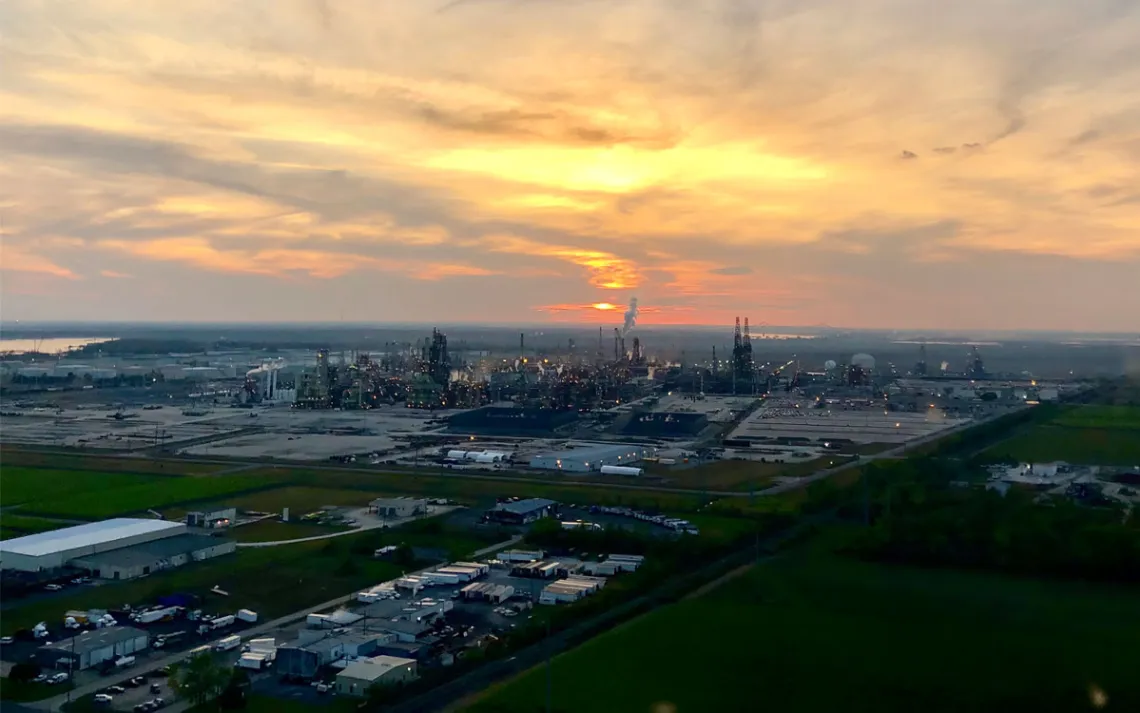
The Marathon Petroleum Refinery in Reserve, Louisiana. | Photo courtesy of AP Photo/Gerald Herbert, File
Long before Diamond Spratling became an environmental advocate, she had witnessed the harmful effects of prolonged exposure to industrial pollution. She was raised in Detroit, the heart of the automotive industry, where factories and incinerators surrounded communities. For her family, that proximity came at a cost. Several of her relatives, including uncles who worked in automotive plants, passed away as a result of years of exposure to volatile organic compounds (VOCs) and fine particulate matter, otherwise known as PM2.5.
She told Sierra that there were limited protections in place to shield residents and workers from harm. In the years that followed, the US government stepped in to create federal regulations, such as the Clean Air Act, to curb the worst impacts of polluting facilities. Now, these safeguards are at risk.
This past February, the Environmental Protection Agency, which has long regulated air pollutants, rescinded its 2009 Greenhouse Gas Endangerment Finding and certain parts of the Clean Air Act. As a result, the EPA has started to relax enforcement on some pollutants, including carbon monoxide and nitrous oxide. Research has shown that these toxins can lead to asthma attacks, hospitalizations, and premature deaths.
“It made sure industries were abiding by permits designed to protect human health,” Spratling, a climate activist and founder of Girl Plus Environment, said. “It’s also giving the green light to other local policies to feel like, ‘[I]f our federal government isn't going to set a good example, why do we have to care about the health of community members?’”
For those already living on the front lines of industrial pollution, the implications are stark. Decades of discriminatory zoning have concentrated polluting facilities in the most vulnerable neighborhoods, where residents already face higher exposure to harmful pollutants. For example, in Louisiana, a heavily industrialized corridor is widely known as Cancer Alley. Over 150 petrochemical plants and refineries operate along this toxic swath of the Gulf of Mexico.
St. James Parish sits at this confluence. The parish, home to predominantly Black and low-income residents, has long been at the center of concerns over toxic exposure. It’s here that RISE St. James, a community-led air-monitoring initiative, has been working to fill critical gaps in state air monitoring.
In 2021, Caitlion Hunter, the director of research and policy at RISE, worked with an air scientist and a community organizer to put together a monitoring network using PurpleAir monitors. “With PurpleAir monitors, you can pull out a map and see all the monitors operating in that area. If there are 10 monitors in a square mile, you’re getting a good data set about what the air quality is,” they said. “You can see if there are any spikes or plumes that are passing through the area.”
As Hunter and their team were launching the program, there was an ongoing lawsuit against the construction of a plastics complex proposed by Formosa Plastics. Advocates predicted that the facility would emit more than 800 tons of toxic pollution every year. RISE’s data revealed that the levels of particulate matter in the area were already high, and the group’s monitoring data formed part of a broader advocacy effort against the project.
In the neighboring area of Sulphur, Louisiana, Cynthia Roberston had also witnessed just how toxic the air was after she joined a toxic tour with scientists through the Thriving Earth Exchange program. Having grown up in West Virginia, she had seen how environmental regulations could make a difference. After Congress passed the Clean Air and Water Act, she recalled, pollution in her hometown began to ease. A creek behind her grandmother’s store that once ran black from coal pollution had been restored to the point where the rocks at the bottom became visible again.
When she moved to Louisiana, she discovered that her home was within a five-to-seven-mile radius of 17 petrochemical facilities. Not only that, state monitors rarely captured the full extent of air pollution on the ground. “The air monitors that the Louisiana Department of Environmental Quality has don't pick up any of the highway, interstate, or industry pollution,” Robertson said. “It's like they're strategically situated so they don't pick up any bad stuff.”
Through the organization that she founded, Micah 6:8, she secured an EPA grant under the Biden administration that provided funding to purchase two AQSync air monitors, adding to an existing network of PurpleAir monitors to track air-pollution spikes. The readings are color-coded—green means the air is safe, while yellow, orange, and red signal increasing danger. On the worst days, readings turn purple. Each day, organizers would raise flags outside their homes and post updates on Facebook. Some residents would use the updates to determine whether it was safe to garden.
But that access to information had been temporarily cut off after Louisiana passed the introduction of the Community Air Monitoring Reliability Act in 2024. CAMRA placed strict limits on how community-generated air quality data can be shared. An earlier version of the bill was so restrictive that it would have barred community groups from discussing their own air-monitoring results.
According to Hunter, the push for these bills is a reflection of state leaders' confidence in the industry’s self-reporting commitments. “Currently, they don't have to back up their reported emissions to EPA,” Hunter said. “They pollute, say how much they pollute, and send that data to EPA, but there's no requirement that there's monitoring data to support their emission reports. So community groups getting monitoring was very dangerous to that narrative.”
Initially, CAMRA had also imposed a $32,500 fine for publishing data. Fearing fines they couldn’t afford, Micah 6:8 stopped sharing their findings publicly. A recent court order has since prevented the state from enforcing the penalty while the case proceeds, allowing them to begin sharing their findings again without fear of fines.
CAMRA also requires community air-monitoring groups to use the same high-grade monitors that states rely on to track particulate matter. But according to Hunter, these systems are designed for long-term, fixed monitoring, not sudden spikes. “Those machines aren't designed to measure things such as ethylene oxide and chloropine, two of the most dangerous carcinogens in Cancer Alley. CAMRA puts the burden of the state on community groups without giving them the resources and then tells them they can’t use the tools that help them understand what’s in their air.”
In 2025, a coalition of organizations—including RISE St. James, Concerned Citizens of St. John, The Descendants Project, Join for Clean Air, and Micah 6:8—filed a federal lawsuit challenging CAMRA. Louisiana became the first state to enact a law like this, but since then, Kentucky has passed similar legislation, and Oklahoma has introduced it. West Virginia lawmakers had also considered their own version in early 2025. However, those efforts have repeatedly failed.
Even in states with stronger environmental protections, the outlook on community air-monitoring efforts remains uncertain. In New York, for example, where community monitoring initiatives are more established, advocates are still wary of potential rollbacks. Valentina Rojas, environmental health manager of WE ACT for Environmental Justice in New York, is concerned about efforts by Governor Kathy Hochul to weaken key environmental safeguards.
If Louisiana’s CAMRA law is eased, RISE hopes to resume air monitoring, which took a pause during Hurricane Ida. They also hope to move forward with a partnership with Lewis and Clark University to install monitors targeting other harmful pollutants, such as ethylene oxide. “Once this data comes out, I hope that it attracts the attention of larger research and advocacy communities,” Hunter said. “Once they see what is really in our air, that will hopefully allow us to effectively legislate for industrial air monitoring.”
RISE is currently backing ongoing proposed legislation that would shift the burden of monitoring onto polluting industries, requiring fence-line tracking of hazardous pollutants. They are also pushing back against a growing effort by industry-backed groups to downplay the cancer health risks in Louisiana’s petrochemical corridor.
But Rojas said that lasting accountability will depend on more than new air-monitoring data or isolated policy wins. “It’s really important to enshrine the Clean Air Act and other environmental-justice laws in a way that makes it impossible for whoever's in the president's office to easily do away with or weaken. It’s not just pointing the finger of blame at Trump and the Republicans, but also understanding who has power and who can be swayed, and this leads back to the influence that the oil and fossil fuel industry has on our politicians.”