The Magazine of The Sierra Club
Big Bend Wall Threatens Local Way of Life
Residents of border towns mount small protests to oppose wall construction
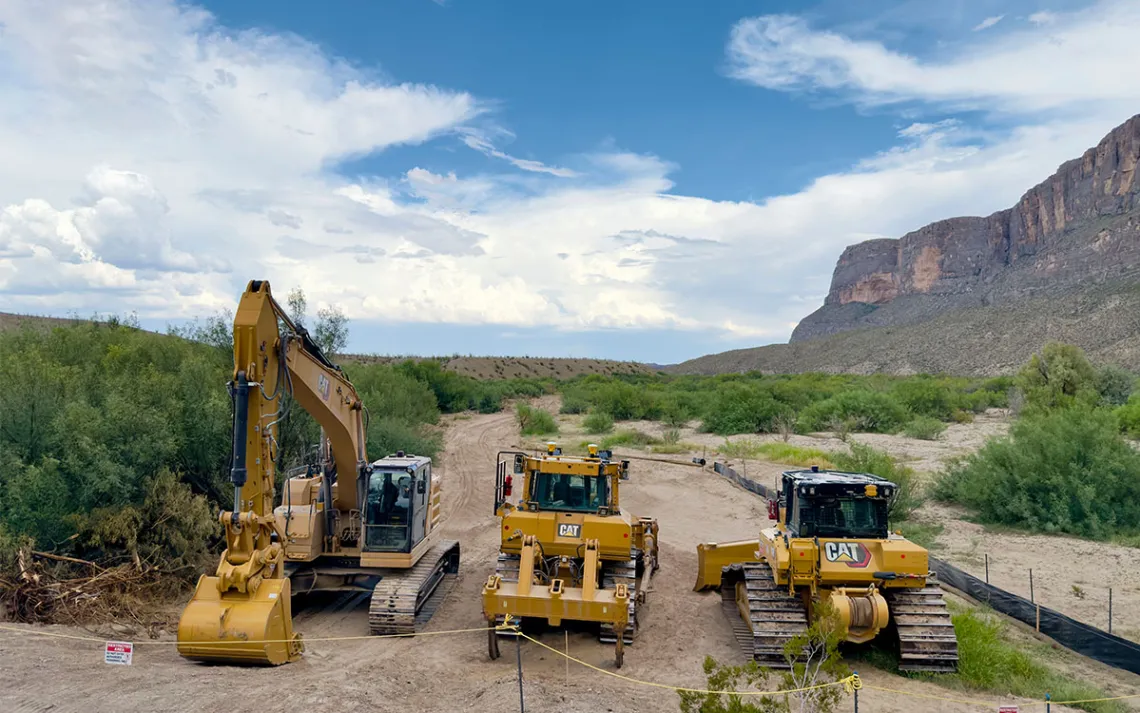
Heavy-duty construction equipment parked at Santa Elena Canyon, near Big Bend National Park in Texas, along the US-Mexico border. | Photo by FangXiaNuo/Getty Images
The conservation community cheered when the federal government paused border wall construction in Big Bend National Park last month. Videos of excavators and other construction vehicles leaving as people applauded lit up social media. But the simmering tensions and battles playing out in local communities across the Big Bend region were largely left out of view.
When wall construction began in Big Bend National Park and Big Bend Ranch State Park, workers moved in, creating man-camps that appeared on people’s doorsteps. The workers brought noise, bright lights, and traffic to this remote area. Many residents expressed their frustration by refusing to serve them. And a local hospitality business, Cigar Mountain House, compiled a list of vendors that participated in the boycott and encouraged tourists to support those businesses.
In communities that lack wi-fi, municipal services, and grocery options, this has had a profound effect, both on personal relationships and general sentiment. For those who can tolerate a financial loss, the act of refusing service is a last line of defense in what they see as an assault on their way of life. For others, it’s a sacrifice they can ill afford.
Greg Hammer, owner of Boathouse Bar, is one of the people who has no problem barring service to the workers. He has ended friendships with business owners who don’t agree with his decision. “I cannot in good conscience serve drinks to those who have come here to actively destroy our livelihoods,” Hammer said. “I won’t make it easy for them.”
He said most tourists who visit his bar are eager to hear his reasons for his position. “Most people, once they listen to the local perspective, understand why we’re doing this.” His bar features one of the many large, bright signs proclaiming “Stop the Wall.” And he has a small sign on the door with the contractors’ logos crossed out by a red line.
But the town’s only true grocery store, the Cottonwood, is still serving border wall workers. Hammer said he has to grocery shop somewhere, so he reluctantly continues to shop there. But he will no longer step foot inside other local businesses that are not in solidarity with efforts to oppose the wall.
Unlike Hammer, Lupe Baeza, who owns one of the oldest businesses in town, the Chili Pepper Café, serves border wall construction workers despite her personal misgivings. She has been working in the area for 45 years and opened the restaurant over 20 years ago. While she hasn’t turned people away, each table has a small sign saying that the Chili Pepper is opposed to the wall and to the destruction of the national park.
“I am against the wall, but I want the restaurant to stay open,” she said. “We need the business, especially this time of year.” She said that turning people away based on their place of work feels like discrimination. “They’re people like us. They have families. They have come to work. . . . Most of them are like me—Hispanic.”
Another restaurant owner, Belda Ohl, runs El Gordo’s Tacos, a family-owned taco truck known for its birria tacos. She comes from a little village across the border called San Vicente. Her kids were born and raised in the border town of Terlingua, and she still has family across the river. She is against the border wall and thinks it will negatively impact tourism, but she serves the construction workers. “Tourists may stop coming if they destroy the beauty of the land,” she said. “But I’m Christian, and they’re human.”
Some local regulars have stopped coming to both Ohl’s and Baeza’s restaurants.
Next to one of the new 275-person man-camps is the Little Burro Country Store, a convenience store that supports all the surrounding properties. Pam Gordon, one of the owners, is completely opposed to the border wall, but when the workers are there, she does not refuse them. “These people didn’t decide to put the wall here,” she said. “They have a safe place to come just like everyone else, unless they misbehave on the premises. Then we’re going to have problems.”
Several of her employees are upset about her decision, and some of the residents who rely on the store have stopped shopping there. She said she understands their position but that once the border wall is finished, residents will move on with their lives.
Yet many locals feel that it won’t just blow over. Boathouse bartender Erik “Gumby” Allgood moved to the area 24 years ago. He wishes businesses would consider what they are giving up in the name of profit. “Even after the workers are gone, we won’t forget who took them in,” Gumby said. “People have got to make money, but at what cost? What’s that money worth to you?”
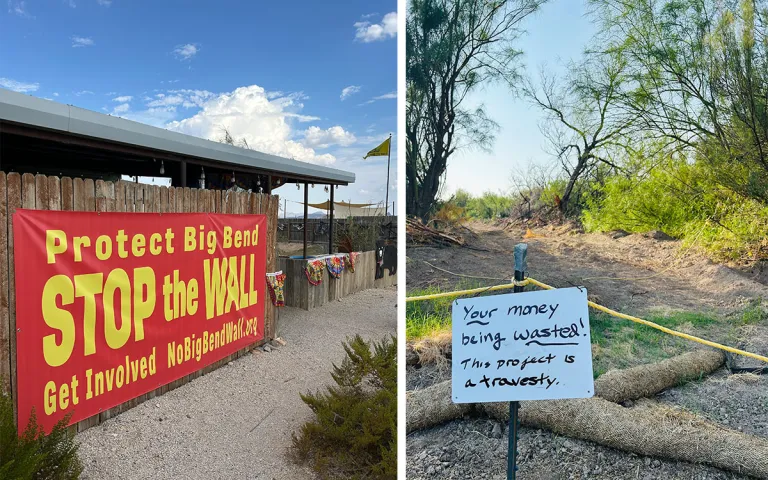
Signs that residents made opposing the border wall. | Photos by Margret Grebowicz
Upriver from Big Bend Ranch State Park, the 30-foot steel wall has started going up, not far from the town of Presidio. The wall threatens to destroy the town’s fragile levee system, used to control flooding. And yet Presidio appears to have no essential services refusing wall workers. But some still mount their own quiet protest.
Adele Jancovici, owner of The Dreamers art gallery, moved here several years ago from Paris, via New York City. Like many small business owners in the area, she also runs an Airbnb. Her property description states openly that wall workers should look for lodging elsewhere. There are many temporary workers in town, working on different construction projects, making it difficult to identify the wall workers. “So I decided to make it clear that I won’t house them,” she said. “The government is taking land away from my neighbors. I’m not just going to stand by and watch.”
Presidio is one of the oldest continuously cultivated sites in North America. Diverse Indigenous groups have lived in this region for 13,000 years. This section of the Rio Grande, called La Junta de Los Rios—the junction of the rivers—is where it meets the Rio Conchos, creating a lush floodplain where people settled and farmed. John Ferguson, the mayor of Presidio, believes the wall will damage the unique confluence irreparably.
“Anything we do to assist these people will assure that this town will be harmed,” he said. “It will survive, but it will be dramatically changed.”
But he says the businesses here, despite being against the wall, are so afraid of ICE that they refuse to draw any attention to themselves with any form of protest. Ninety-eight percent of the 3,000 people in Presidio are Hispanic, and the poverty rate is close to 40 percent. In addition, Ferguson said, economic pressures make people lose sight of the bigger picture.
“It’s hard to compete with the contractors,” he said. They offer “immediate jobs and money in exchange for land, sand, gravel, and water.”
Ferguson said that everything hangs on the November election. “The federal government has the power to end this,” he said. “If nothing else, bring the waived regulations back. If those were back in effect, we would discover that this project is impractical, destructive, and unnecessary.”
On the other side of Big Bend Ranch State Park, in Terlingua, Scott Wright has his sights similarly set on November. His family owns Wright’s Hardware, the only hardware store in the region. He is completely opposed to the wall and has both a big “Stop the Wall” sign outside and a smaller sign stating “No wall contractors or subcontractors” on the door.
Wright’s serves all the local homeowners, all the Airbnbs, the national and state parks, and the Lajitas Golf Resort. The community could not function without his business. He often opens after hours when people have emergencies. And many patrons have his personal cellphone number.
He is also a registered Republican. This November, he says, he’ll vote for the Democratic state candidates. “We need someone who cares about the people,” he said. “Some of us have everything invested in this place, and it runs entirely on the tourist economy. . . . The national park is sacred to me.”