 The Magazine of The Sierra Club
Bridger Pipeline Is the Latest Attempt to Revive the Keystone XL “Zombie Project”
Its proposed expansion could impact fragile ecosystems and Indigenous rights
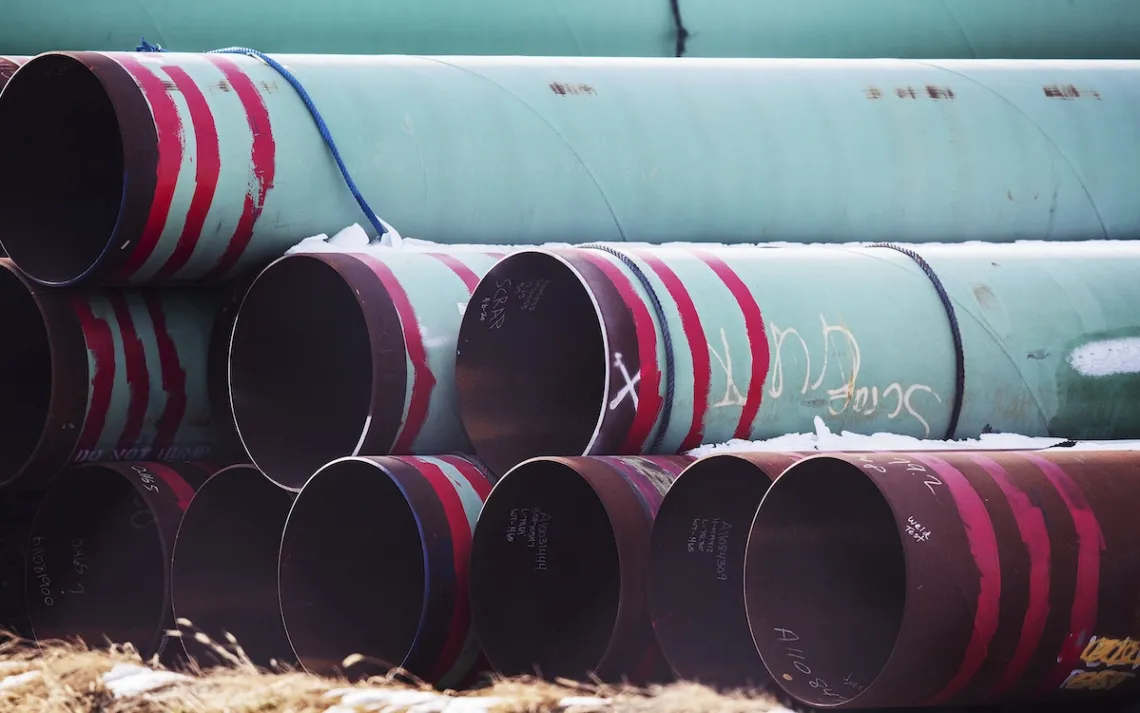
Pipes to be used for the Keystone XL Pipeline are stored in a field in 2020. | Photo by Chris Machian/AP
Some have nicknamed it “Keystone Light.” But this fossil fuel pipeline, if it becomes a reality, would not be small by comparison.
If approved, the newly proposed expansion of the Bridger Pipeline through Montana would transport 1,047,000 barrels of tar sands oil—a heavy crude that’s among the most environmentally destructive of fuels—per day. Years of opposition, including Indigenous and environmental movements, slowed down the construction of Keystone XL, only to see it come back to life across successive administrations, leading some to call it a “zombie project.” Then in 2021, President Biden canceled Keystone XL for good on his first day in office.
The Bridger Pipeline is the latest attempt to revive Keystone XL now that Donald Trump is in power.
Bridger would be capable of sending up to 1.13 million barrels daily of Albertan bitumen-derived oil flowing through Montana toward a yet-undisclosed location (presumably the Gulf Coast). Opponents argue that the project would threaten local ecosystems, endanger Indigenous lands and key watersheds, and contribute to the greenhouse gas emissions fueling the climate crisis.
On April 30, Trump issued presidential authorization for the pipeline’s construction and maintenance across the international boundary between Phillips County, Montana, and Canada. The president approved the required cross-border permit without completing an environmental analysis, nor consulting with tribes that would be impacted.
“It’s all risk and no reward for Montana,” said Shannon James, campaigns and advocacy director with the Montana Environmental Information Center. “Pipelines break—it’s not a question of if, but when. And when they do, it’s Montana’s fishing and agricultural economies that pay the price.”
The Bridger Pipeline is known for pipeline spills; notably, the burst that dumped 50,000 gallons of Bakken crude into Montana’s Yellowstone River in 2015 and a 45,000-gallon diesel spill into Wyoming ranchland in 2022.
James and the MEIC—along with tribal nations, local landowners, and conservation groups including Montana’s Sierra Club chapter—are calling for the Montana DEQ and BLM to take a harder look at the Bridger Pipeline project’s impacts before moving forward, “and asking them to allow for a meaningful public participation process,” said James.
Charting a course through tribal lands and sensitive watersheds
In late January, True Companies applied for federal and state permits for the 647-mile pipeline. In April, the BLM published a notice of intent to prepare an environmental impact statement (EIS). Public filings and agency notices reveal several possible scoping meetings in mid-April. Afterward, the agencies set a short public-comment window, which closed on May 1, offering limited opportunities for public engagement.
“Those couple public meetings didn't allow for any oral comment,” James told Sierra, explaining that the agencies would only accept written comments. “There was maybe a five-minute presentation from BLM and DEQ about the proposed pipeline, and then it was basically a tabling opportunity for industry.”
One route cuts straight through the Fort Peck Reservation. Multiple routes skirt culturally significant lands including unceded hunting territory that was guaranteed to the Lakota, Northern Cheyenne, Arapaho, Gros Ventre, Assiniboine, Mandan, and Arikara tribal nations under 19th-century treaties.
Honor the Earth’s executive director, Krystal Two Bulls, told Sierra it’s “highly odd” to propose a route straight through reservation land, as it’s “obviously a violation of people’s rights.” The favored Bridger Pipeline route would also traverse key watersheds, Two Bulls said, “more than five of which would affect Indigenous communities’ drinking water.”
The Bridger Pipeline would likely cross the Missouri River, which feeds the lake supplying water to the Fort Berthold Reservation, home of the Mandan, Hidatsa, and Arikara Nations. Further downstream, the Missouri is a primary water supply for the Standing Rock Sioux and Cheyenne River Sioux Tribes. The pipeline would likely also cross the West Fork of the Poplar River, immediately upstream of the Assiniboine and Sioux Tribes, as well as the Belle Forche and Cheyenne Rivers, which surround South Dakota’s Black Hills—sacred to the Lakota, Cheyenne, and Arapaho tribal nations.
“On federal lands in Montana alone, it would cross water features like streams and rivers over 150 times,” said James, adding that the Bridger Pipeline would impact the habitats of numerous sensitive species—including the black-footed ferret, northern long-eared bat, Preble’s meadow jumping mouse, piping plover, whooping crane, and pallid sturgeon—all of which are protected under the Endangered Species Act.
Even before performing a full analysis, BLM’s notice of intent admits potential impacts to habitat for whooping cranes, northern long-eared bats, pallid sturgeon, and sage grouse.
On-the-ground response
Lance Fourstar, a Wolf Point city council member and Democratic candidate running to represent Montana’s District 31, described the pipeline plans to Sierra as “another attempt at colonialism without our consent.”
Fourstar, the co-director of the American Indian Movement Montana, calls the Fort Peck Reservation home. He said he speaks on behalf of the 25,000 northeastern Montanans who depend on the Sioux Rural Waters Supply System, which he said isn’t equipped to filter the pollutants found in tar sands oil after it “gets into our groundwater, our irrigation systems, and our crops and food.” He noted that bitumen oil is highly carcinogenic, especially when diluted with benzene—which is frequently necessary to keep oil flowing through pipelines in climates as cold as northeastern Montana’s.
Fourstar added that all three routes highlighted in Honor the Earth’s maps would carry grave impact. “They all cross our waterways, so none are preferred. We want this project shut down.”
Public information officer for the Montana DEQ Madison McGeffers told Sierra that the agency dispatched letters requesting comments and consult from local tribal governments that “may be directly impacted by the project.”
But James noted that company disclosures for the project are incomplete on points central to risk assessment. That lack of transparency, James said, impedes meaningful assessment of downstream greenhouse gas impacts and local vulnerabilities.
Drilling after fossil fuels’ peak?
In a letter to the BLM expressing support for the Bridger Pipeline, Yellowstone County commissioner Mark Morse wrote, “It's a win for Montana. It's a win for America,” citing construction jobs, supply contracts, and “energy independence.”
But global trends toward renewable energy show that massive fossil fuel projects are not necessary for “energy independence.” According to an Ember report released in April, global renewable sources grew fast enough last year to meet all new electricity demand in 2025, and fossil fuel generation fell for the first time since the pandemic.
“This project is nothing more than an attempt to resurrect the unpopular Keystone XL Pipeline and further erode tribal rights while doing nothing to actually impact energy affordability,” said Sierra Club Montana Chapter director Caryn Miske. “These policies aren’t about fair or free markets; it’s welfare for corporations and pollution for everyone else.”
Even if fossil fuels weren’t on their way out entirely, James said, the Bridger Pipeline would fail to offer Montanans lasting jobs or energy sovereignty. “This oil isn't meant for our state; we're being treated as a flyover. It’s putting our land and water at high risk to just fill the pockets of Big Oil.”
Tar sands, or bitumen, oil is more carbon-intensive over its life cycle than many conventional crudes. “It’s going to lead to direct emissions from operations, upstream emissions from extraction, and downstream emissions from the burning of the fuel,” said James.
What happens next
The Bridger Pipeline now faces overlapping reviews: The major facility siting act application (MFSA) process in Montana, and a BLM EIS on federal lands.
James, who estimates that the developer cumulatively needs “at least 30 permits,” describes the schedule the agencies have floated as “extraordinarily fast” for a project of its size. “They’re anticipating a draft EIS in the fall, a final EIS in the spring, a decision made next May, and shovels in the ground next July,” she told Sierra. “That in and of itself is a big red flag.”
A BLM spokesperson told Sierra that the current projected EIS completion time will be “sometime next year.”
Further legal thresholds await, notably Army Corps permits for major river crossings, tribal consultation requirements, and endangered species evaluations. Even if the EIS and MFSA process fully evaluate life cycle emissions and meaningfully incorporate tribal concerns and route alternatives, opponents may still challenge the outcome in court.
For a region with interwoven treaty rights, vital rivers, and communities reliant on them, Bridger presents a test of whether review and consultation standards will be enforced—and of whether a new pipeline can be built without triggering years of legal and political conflict.
Fourstar recalls the power of the “water walks” and related ceremonies his community held in opposition to Keystone XL. “Back in 2016, we walked 110 miles from the Canadian border down to the Missouri River, stopping at every waterway, our first medicine, to offer water, tobacco, prayer, and song,” he said. “We’re willing to do that again.”
Said Two Bulls, “If you're a human being and you need access to clean drinking water to survive, then this is a call for you to take action as well.”