 The Magazine of The Sierra Club
An Accidental Activist Takes On a Pipeline in New York
Courtney Williams learned how to push back on the oil and gas industry
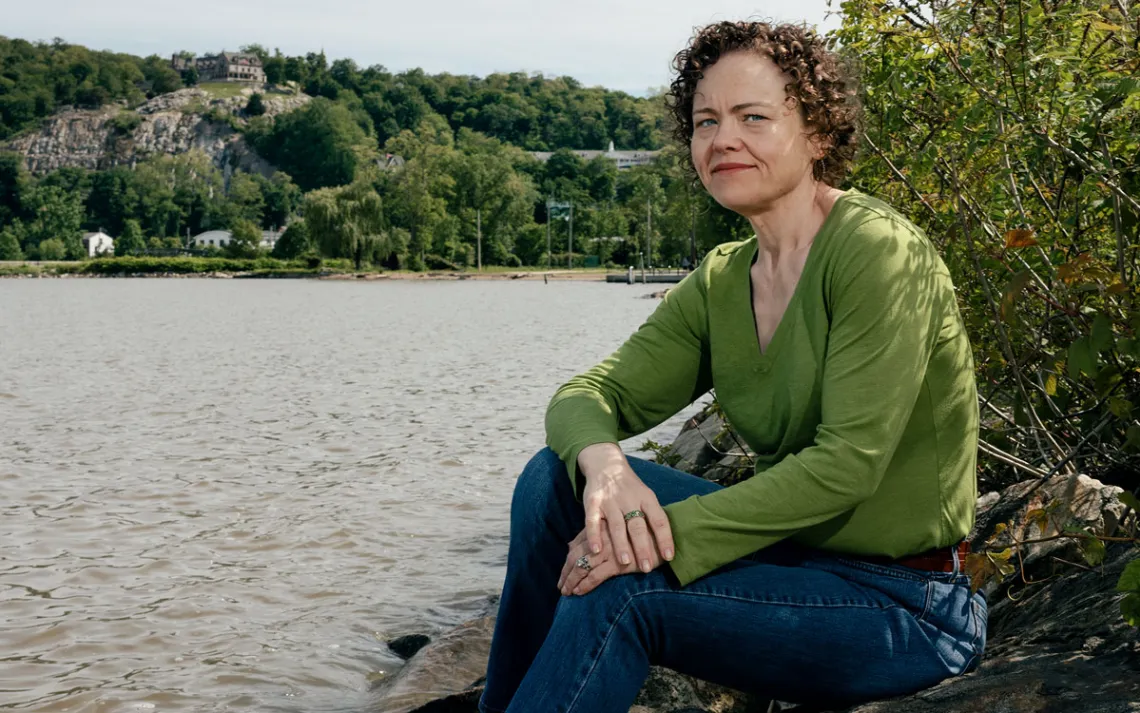
Photo by Adrienne Grunwald
When Courtney Williams moved to Peekskill, New York, in 2011, she had no idea that one of the country’s largest fracked-gas pipelines, the Algonquin, ran just 400 feet from her new home. It wasn’t until a few years later, when she learned about a proposal to expand the pipeline’s route, that Williams fully realized her family might be in danger. She considered moving, but she was also inspired to act. The cancer researcher was soon digging into the details of the planned expansion, attending public meetings, and organizing protests.
“My life entirely changed,” Williams said of her decision to pour her energy into resisting the project, which involved replacing much of Algonquin’s 26-inch-diameter pipeline with a 42-inch pipeline. It would run alongside her kids’ elementary school and under the nearby Indian Point nuclear power plant. Despite the grassroots efforts of Williams, her neighbors, and the broader Peekskill community, the pipeline expansion moved forward.
“It really opened our eyes to the fact that no one is looking out for you,” Williams said. “This system is built to allow these corporations to do what they want, and people need to be shaken out of their complacency.”
The movement to prevent the pipeline’s expansion sparked a sense of environmental activism that continues to this day. Peekskill resident Tina Volz-Bongar, who met Williams during the Algonquin pipeline fight, praised Williams’s dedication to spotlighting injustice. “She calls things out as she sees them—as a scientist and a researcher would—and she pisses people off. I completely appreciate that.”
These days, Williams is leading a movement to quash another environmental hazard in her Westchester County community: WIN Waste Westchester, a 40-year-old trash incinerator. Originally touted as a sustainable waste-to-energy solution, WIN Waste has become the county’s largest industrial air polluter, according to Williams. It processes about 2,200 tons of garbage every day. The facility serves some of the wealthiest municipalities in the nation but mainly pollutes Peekskill, a predominantly Black and brown community of about 25,000 people, many of whom earn significantly less than their Westchester County neighbors. Because of the excessive pollution in the area, the EPA and the New York State Department of Environmental Conservation have formally designated Peekskill an environmental-justice community. What’s more, Peekskill is a “disadvantaged community” under New York’s Climate Leadership and Community Protection Act.
Williams, who can see the WIN Waste smokestack from her window, estimates that over the past four decades the facility has spewed more than a ton of lead, 40,000 tons of nitrous oxide, and 840 pounds of mercury. In addition, the incinerator generated 8 million tons of toxic ash and 31.8 million tons of greenhouse gas emissions. The Peekskill area is also home to a sewage treatment plant, a chemical plant, and a gypsum plant—all located along the polluted Hudson River and its tributaries. Meanwhile, a proposal for another Algonquin pipeline expansion is in the works, and the radioactive wastewater stored at the now-retired nuclear plant is a looming threat to residents.
“She calls things out as she sees them—as a scientist and a researcher would—and she pisses people off.”
Owing to these compounding hazards, Peekskill has an asthma rate far higher than that of Westchester County and New York state. Heart-related diseases are also more prevalent here.
Westchester County extended WIN Waste’s contract for another 10 years in 2019, but its operating permit under the Clean Air Act, which sets enforceable pollution limits for such facilities, expired in 2021. According to state law, the incinerator is allowed to continue operations while it seeks a renewal of that permit.
Now Williams is leading the charge to shut down the incinerator through her grassroots organization, Westchester Alliance for Sustainable Solutions (WASS). She attends hearings and meetings and educates both lawmakers and the public by gathering and sharing data. In addition to scouring public records, Williams documents the facility’s jet-engine-level noise and monitors real-time spikes in air pollution using a PurpleAir sensor she installed on her property. She is often able to link these spikes to events at the incinerator.
Williams believes that by adopting zero-waste strategies, such as reducing single-use items like plastics, composting food scraps, and recycling other materials, Westchester County could close WIN Waste. Wet and heavy food scraps are expensive to haul and difficult to burn; they make up about a fifth of the waste at the facility. That’s why WASS is pushing the county to implement curbside composting across all its municipalities.
Last year, Westchester County invested $90,000 in a waste-reduction study, a step in the right direction, according to Williams. With WIN Waste’s contract expiring in 2029, she is urging elected officials to begin planning for a closure now.
Williams’s fellow advocates credit much of the group’s progress so far to her dedication. “This is something that most people in the environmental field may not have the strength and courage to do on their own—carrying the banner,” said Paul Presendieu, chair of the Ecology & Natural Resources Advisory Committee in New Rochelle (southern Westchester County) and the political and conservation co-chair of the Sierra Club’s Lower Hudson Valley Group. “It’s easy to just be in the middle of the marching band, but when you’re in the front—the person that’s actually in meetings with the county executive and state senators—that takes a lot of courage,” he added.
Williams said that her kids, now 13 and 15, don’t remember a time when they weren’t protesting the many injustices in their community and the broader world. “The pipeline was my radicalization, my awakening to all of it—and now we’ve got all of it to fight.”