 The Magazine of The Sierra Club
From Burning Trash to Zero Waste
South Baltimore residents tackle polluting facilities and fight for a cleaner future
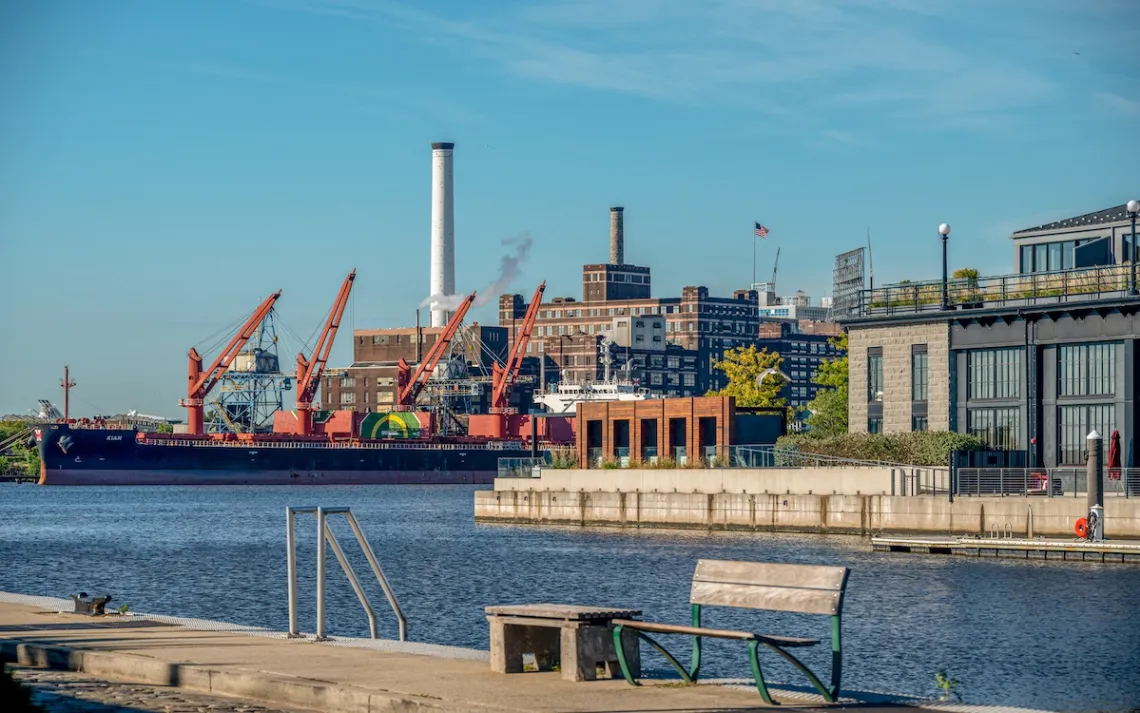
A smokestack at the Domino Sugars facility in Baltimore. | Photo by Amy Sparwasser/iStock
Community members in South Baltimore have, for over a decade, made it clear to local officials that they don’t want polluting industries in their neighborhoods. But in 2020, the city renewed its contract with WIN Waste Innovation’s Baltimore Refuse Energy Systems Company (BRESCO) incinerator, which burns trash to make electricity.
Pollution from incineration includes lead, mercury, nitrous oxide, carbon monoxide, and formaldehyde, all of which pose risks to human health. The combustion process also produces toxic ash, which can be as much as 30 percent of the weight of the trash burned. In 2023, BRESCO burned 617,488 tons of trash and generated 158,151 tons of ash, according to the nonprofit Clean Water Action (CWA).
In May 2024, the South Baltimore Community Land Trust (SBCLT) escalated its efforts to keep air pollution out of its neighborhoods. It filed a 39-page complaint with the federal government against the City of Baltimore, arguing that by failing to transition away from waste incineration to produce energy toward cleaner alternatives, the city was disproportionately harming predominantly Black and Latino communities. According to the complaint, which falls under Title VI of the Civil Rights Act of 1964, officials have extended waste diversion deadlines, classified waste-to-energy as renewable, and scaled back contract termination goals.
“We've always gotten the same promise [from the city] … which was, ‘We'll end the contract. We'll move away from incineration. We will no longer pollute the community,’” Carlos Sanchez, a youth outreach specialist for the land trust, said. “That's what really pushed the communities to file the Title VI complaint. And that was a huge milestone, because it was accepted by EPA.”
The Baltimore City Department of Public Works said it could not comment directly on the complaint. And the mayor’s office failed to respond to multiple requests by press time.
Trash incineration doesn’t just plague Baltimore, which is a majority Black city, with higher asthma rates than the national average. A 2019 report from the Tishman Environment and Design Center at New York City’s New School found that 79 percent of all municipal solid waste incinerators are located within three miles or less of low-income and/or majority Black and brown neighborhoods, also known as environmental-justice communities.
Aiding in the effort to close Baltimore's Incinerator, also called the Wheelabrator, is Maryland’s chapter of Clean Water Action. Organizers from CWA are advocating for a transition away from trash incineration and toward “better alternative infrastructure and programming that the city and the counties need,” Jennifer Kunze, CWA’s Maryland organizing director, said.
“We want local governments to follow the zero-waste hierarchy that's been internationally established by the Zero Waste International Alliance,” Kunze said. This framework prioritizes keeping materials out of the waste stream before repurposing and then recycling. CWA is advocating for infrastructure that can address three different material types: municipal composting for organic waste, a construction and demolition debris repurposing facility, and improved recycling programs.
Sanchez’s vision for the future of Baltimore is a place where elected officials put “public safety and public health first … a place where we will have zero-waste infrastructure, compost facilities, recycling facilities, compost pickup … clean air [and] safer communities,” he said.
In an email to Sierra, Mary Stewart, a public relations officer from the Baltimore City Department of Public Works, said that the department’s strategic plan prioritizes action in single-family residential waste and is focusing on two core efforts: “improving participation in the City’s single-stream recycling program and piloting organics diversion strategies, which lay the groundwork for citywide composting programs in the future.”
Baltimore’s incineration fight began in earnest in 2012, when a group of students, teachers, and families rallied against a prospective trash incinerator. At the time, city officials were planning to build the Energy Answers incinerator less than one mile from Benjamin Franklin High School in South Baltimore. If built, it would have burned up to 4,000 tons of waste per day. The city ultimately rejected the proposal.
“I remember marching with my teachers, my principals, my mom, my friends, my peers,” said Shashawnda Campbell, then a high school student and now a community organizer with SBCLT. “It was just a very powerful moment.”
Campbell and her fellow organizers have been fighting polluting facilities ever since, using a range of tactics to pressure the city to close them down and create alternative pathways for waste. “We see the ramifications of it when it comes to health,” Campbell said. “People were sharing asthma pumps in school. [The teachers] talk about how students couldn't last running on the court for a long time.”
On July 25, a few dozen residents and community activists stood outside BRESCO and announced findings from a study released in June. The study’s authors found that on an annual basis, pollution from BRESCO and the nearby Curtis Bay Medical Waste Incinerator were responsible for between $60 million and $100 million of costs associated with “health impacts” from respiratory disease, cardiovascular disease, and more. Roughly 30 to 33 additional cases of asthma were associated with the pollution from the facility, as well as between two and four mortalities.
The study’s lead author said that all their findings were likely conservative. Researchers only looked at air pollution in Maryland, but it probably reaches as far north as Massachusetts. The analysis also considered only four pollutants: particulate matter, nitrogen oxides, sulfur dioxide, and carbon monoxide.
WIN Waste Innovations shared with Sierra a study prepared by two environmental health experts for the company that found there were no “statistically significant associations between … emergency room or hospital discharge rates for asthma in relation to annual average PM2.5, NO2, or SO2 air concentrations due to emissions from the [BRESO] facility during 2011, 2012, and 2013.” The study did find statistically significant associations between hospital discharge rates for asthma and social determinants, such as median family income.
Despite the company's denial of responsibility, SBCLT, CWA, Progressive Maryland, and other community groups have had multiple milestones on the path to cutting Baltimore’s waste, including a campaign to get the state legislature to remove trash incineration from its renewable portfolio standard. SirJames Weaver, Progressive Maryland’s environmental-justice organizer, said that the state’s approval of incineration in 2011 as a renewable energy source was "financial exploitation” of Maryland ratepayers, whose utility bills go toward renewable energy subsidies.
“Frontline community members … have been dealing with decades of pollution from WIN Waste Innovations,” Weaver said. “To … pass a law that [required] them to pay into the wealth of an incinerator that was causing the demise of their community was … egregious.”
The groups argued that while incineration can produce electricity, it should not be considered renewable. “Let's define renewable energy as clean renewable energy, because … ultimately, trash incineration is not clean and it's not renewable,” Sanchez said.
Kunze said that Baltimore County, which is distinct from the city of Baltimore and is responsible for 45 percent of the waste sent to BRESCO, has its own contract with the company. It expires in 2026, and Kunze said advocates are poised to campaign against contract renewal.
“[This] is a really big opportunity for the county to do the right thing, both for the city and for itself, because the city, and especially South Baltimore, is harmed first and worst by the emissions from the incinerator, but the emissions travel,” Kunze said.
The city’s BRESCO contract ends in 2031. Stewart, from the Department of Public Works, said in a statement to Sierra, “[We] believe the future of waste management lies in minimizing waste generation and maximizing resource recovery—not in disposal.”
Kunze said that Baltimore’s city council needs to put the money behind developing infrastructure for municipal compost and for construction and demolition debris recycling and repurposing. Clean Water Action’s testimony on the fiscal year 2026 proposed budget points to areas that her organization says need to be addressed. Among them are the lack of funding for zero waste in the operating budget and backsliding on infrastructure funding in the capital budget.
“Zero-waste infrastructure simply needs to be one of [the city’s] priorities, because if we don't build it now, we'll be in a very, very difficult position in 2031 when our current contract is up,” Kunze said. “However, even if the city [hasn’t] built any new infrastructure come 2031 for composting and recycling or construction and demolition debris, even then, not signing a new contract would be the right thing to do.”