 The Magazine of The Sierra Club
Life Beyond the Grave
These morticians are both conservation heroes and undertakers

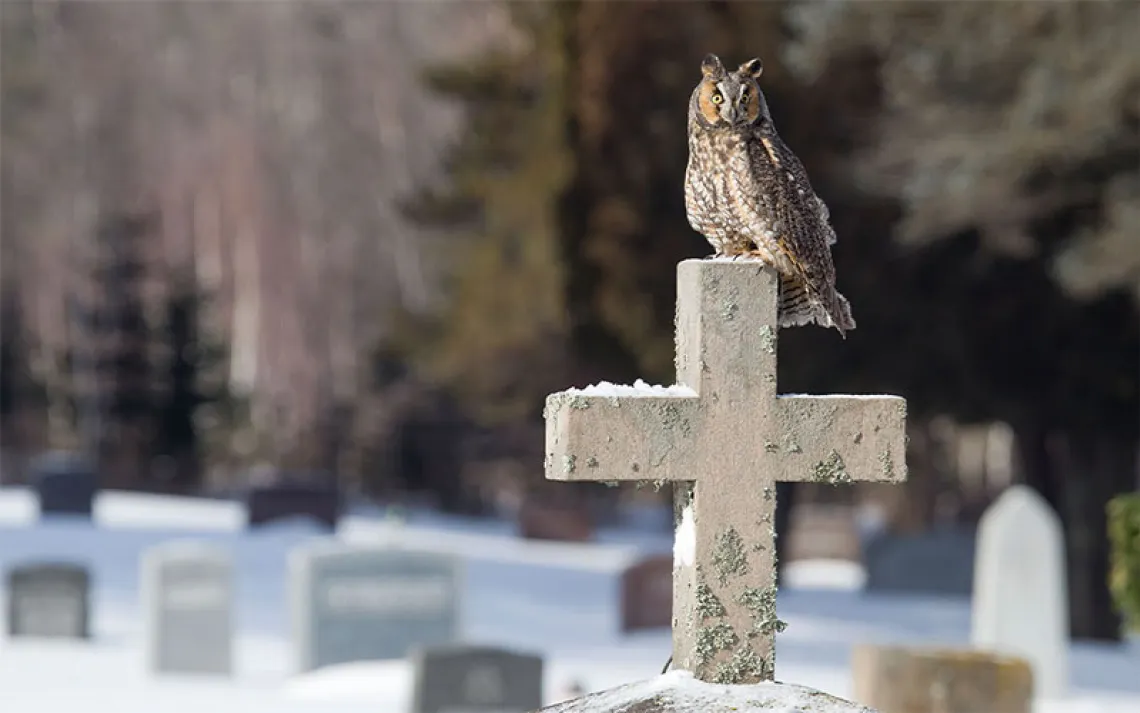
Photo courtesy of Sjo/iStock
Freddie Johnson could never see himself lying in a traditional cemetery. The idea of being buried with concrete, metal, and wood—materials that would stay in the ground forever—didn’t sit right with him. Cremation, the other conventional end-of-life option, also seemed jarring.
“For me, philosophically, energetically, emotionally, everything about those two choices [was] not aligned with what I felt like was the best thing that I could do for the earth, not to mention what felt right for me as a human being,” Johnson said.
Still, he figured he had no other choice, and he chose cremation, a practice that’s skyrocketed as American households have become increasingly secular. Everything changed when he learned about natural or “green” burials while attending a community potluck more than 15 years ago. The relatively niche end-of-life movement uses entirely biodegradable products in the burial process and aims to connect human death to the natural world by restoring and protecting nature.
The approach resonated deeply with Johnson, and just a couple of years later, he opened the Prairie Creek Conservation Cemetery in Gainesville, Florida. It’s a wild space filled with forest and flowering meadows. Through the cemetery, Johnson has collaborated with a local land conservation trust to create a conservation easement, which protects the land from private development. That relationship between nature conservation and human death is at the heart of the natural burial movement, Johnson said.
“To save this land is a forever thing, a very valuable thing,” he said. “And to have a burial, to have someone’s body go into the ground—both of these are sacred.”
In traditional end-of-life care, when a person dies, the body is typically embalmed with formaldehyde (a highly toxic carcinogen used in various products like fertilizers and food preservatives) to delay decomposition. Bodies are then placed in a casket made from steel, wood, or bronze and lowered into the ground by a concrete vault. All these materials, including the body embalmed with toxic chemicals, break down over time and seep into the surrounding soil and groundwater. Across roughly 109,000 registered cemeteries in the United States, more than 2.5 million gallons of toxic chemicals are buried every year.
In a natural burial, the entire end-of-life process, from pre-death to post-burial rituals, is designed to be as nonintrusive on the earth as possible, said Emily Miller, the founder of Colorado Burial Preserve, a 65-acre cemetery that doubles as conservation land in Florence, Colorado.
“It's all just simple, back-to-the-earth burials with everything biodegradable. We're planting and monitoring native habitat (shortgrass prairie) all around the final resting place,” Miller said. “It's meant to be kind of everything you would expect from a nature preserve and everything you would need from a cemetery.”
At Colorado Burial Preserve, natural burial goes something like this: Immediately after death, the person’s body is not embalmed but kept cool with refrigeration or topical ice packs until the day of the burial. The body is then covered in a shroud made of natural fibers, such as cotton, linen, hemp, silk, or wool, or put in a container made of renewable materials, such as sea grass or willow. Graves are dug about three to four feet deep, just big enough so that oxygen can begin the microbial process of returning the body to the soil. People are buried with organic materials, including grass or weed cuttings, and the grave is backfilled manually with shovels.
Loved ones can be as involved as they want. They are invited to help plant a blend of native seeds that help reduce erosion and benefit birds, pollinators, and other native wildlife. Colorado Burial Preserve also offers smaller plots where cremated ashes can be buried in biodegradable urns. The plots are filled with native prairie plants, wildflowers, cacti, and bushes.
“It's really meant to be an immersive, participatory experience where … the loved one gets returned to the earth,” Miller said. “The gathered guests can see the ecosystem that's going to benefit from this gift of the body, back to the earth.”
Before the mid-19th century, most Americans died at home surrounded by family. The burial process was intimate and usually done by family members at nearby churchyards or family burial plots. But during the Civil War, hundreds of thousands of soldiers died on battlefields far away from their homes; returning bodies back to families safely and sanitarily spurred the widespread adoption of embalming for preservation.
After the war ended, many battlefield embalmers continued their end-of-life care services back home, which eventually led to the creation of the modern-day funeral industry. Today, bereaved family members hand over the entire death process to the funeral industry, which has significantly altered how humans grieve and mourn, said Colleen Corrigan, a life transitions doula and coordinator at the Spirit Sanctuary, a three-acre burial ground and protected habitat for native plants, birds, and other animals in Essex, New York.
“We kind of short ourselves because we think that comfort and convenience is the way, but we miss these key elements of participation,” Corrigan said “And over the generation since the funeral industry has kind of been built up … there's this total forgetting that we have the capacity to lean into these times in such an engaged way.” That disconnection has led to a “one size fits all” approach often seen in traditional funeral services, she added.
At Spirit Sanctuary, end-of-life care begins early through conversations and engagement with loved ones, and each process is highly tailored to each individual. “We really kind of explore with people and encourage them to honor their loved one in a way that feels like it is reflective of that person,” Corrigan said. That participation, and, in turn, the connection to nature that natural burial offers, gives people the chance to access “the wisdom of grief,” she added.
Across the United States and Canada, there are now nearly 500 cemeteries that offer natural burials, 20 of which double as conservation land. As the movement continues to grow, Johnson hopes natural burial can destigmatize and rebuild our connection to death through the natural world.
“It's really important and valuable for human beings to have a healthy connection with death,” Johnson said. “I think that conservation burial, particularly, is in a position of making that connection, because it's in nature. And the connection with nature is sacred, because it brings out in us the recognition of this reverence for life.”