 The Magazine of The Sierra Club
Louisiana Residents Score Major Legal Win for Clean Air and the Climate
Residents cross their fingers after judge orders Chevron to pay a local community for pollution caused by oil and gas
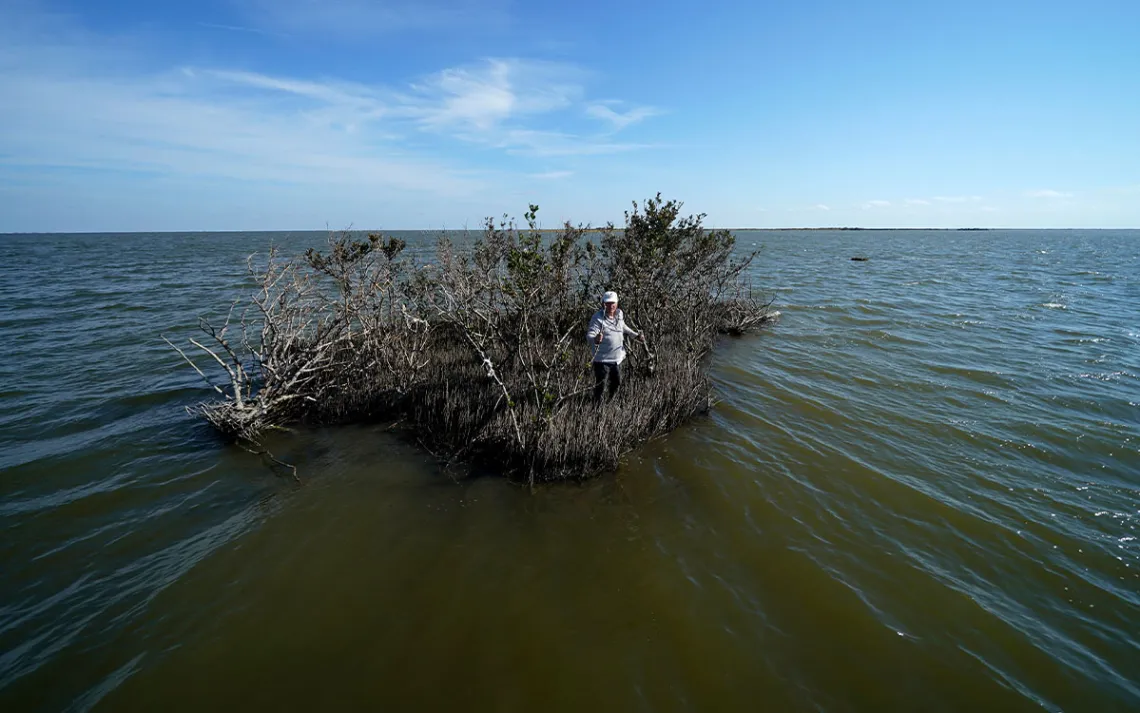
PJ Hahn, an environmental consultant and former Plaquemines Parish coastal zone manager in Louisiana, on a small patch of land with mangroves—all that remains after the land around it eroded away. | Photo by Gerald Herbert/AP
In Delacroix, Louisiana, it’s easy to see how the land disappears. Houses here are scattered across thin streaks of land, while in every direction, the marsh’s brackish water encroaches onto what was once solid earth. Across Plaquemines Parish, where Delacroix is located, areas that maps show as green land are in fact submerged. Over the last 90-odd years, Louisiana has lost land area the size of Delaware.
Experts have tied the increased rate of land loss to the same oil and gas industries that have made this region ground zero for liquefied natural gas exports. As a result of the dredging, erosion, saltwater intrusion, and warming seas caused by burning fossil fuels, Plaquemines Parish—and the rest of coastal Louisiana—loses a football field worth of land every 48 minutes on average. In 2013, six Louisiana parishes and state offices began filing dozens of cases against 98 oil and gas companies that operated around the coast, alleging that their activities were a major contributor to this land loss.
The first of these multiyear lawsuits came to a head in April, in Plaquemines Parish, when a jury in Pointe à la Hache ordered Chevron to pay the parish $744 million. The case, which focused on an area known as Bayou Gentilly oil field next to Delacroix, found that oil companies were responsible for erosion and land loss caused largely by the canals they dredged through the marsh. Since oil companies began working in Bayou Gentilly, the marsh has shrunk from 21,000 acres to just 8,000 acres.
When the Pointe à la Hache jury read out “guilty,” it set a striking precedent for other communities across this fragile coastline—and the fight for accountability at large. The lawsuit is only the first of 42 ongoing suits filed by local governments across coastal Louisiana against major oil and gas companies. Together, the lawsuits, known as legacy lawsuits, are seeking billions of dollars due to land loss and pollution.
The case’s attorney, John Carmouche, who is arguing many of the lawsuits, asserted that Chevron was in violation of a 1978 law requiring companies to clean and restore oil exploration sites to their original condition. Chevron’s lawyers countered that the law doesn’t apply to anything they did before 1978—and some of the damage goes as far back as 1941 (the original activity was carried out by Texaco, which Chevron bought in 2001). The jury, made up of Plaquemines residents who’ve watched the land around them erode, sided with Carmouche. They awarded about $9 million for abandoned equipment and $161 million for contamination, but $575 million is specifically for land loss. Looked at another way, the jury decided each acre of lost land was worth about $44,000.
Now, locals are hopeful that this settlement money could be used to save some of the disappearing land by putting it toward massive restoration projects. “These are impacts from cumulative damage from industrial development,” said Richie Blink, a former local official who now runs an ecotourism company near the mouth of the Mississippi River. “We’re staring these things in the face,” he continued. “And there’s a lot that could be done.”
Cautious but hopeful
Like many Plaquemines residents, Blink is hopeful that this is the beginning of accountability for oil and gas companies. Initially, he feared Chevron was “untouchable.” He was relieved by the verdict, though he points out that “the jury award is probably pennies on the dollar compared to what the real damage is.”
Together, the dozens of remaining legacy lawsuits could secure large sums of money for communities across the Louisiana coast. Blink pointed to an earlier $100 million settlement with Freeport-McMoRan, a company responsible for only 4 percent of the wells drilled on Louisiana’s coast: “If that’s an indicator of what’s to come, there could be a lot of potential funding.”
But in light of decades of struggle against the industry, and the current conservative administrations at the state and federal level, some still harbor doubts that the money the jury awarded will actually end up in the parish’s coffers.
Reverend Tyronne Edwards, chair of Plaquemines Parish Council, is both pleased about the outcome and concerned that Chevron’s expected appeal will reverse the result. “The ruling is very good, and it would be good if we can get the money,” said Edwards, who attended every day of the trial. “It would be great because it’s clear that the funds can only be used for coastal restoration. And we could use that kind of money.” He pointed to damaged levees in need of reinforcement across the parish.
But Edwards worries that if and when Chevron appeals, it will find a friendlier jury. That’s part of why he isn’t counting on restoration funding just yet. For years, Chevron argued that the case should be heard in federal court, filing challenges and appeals that dragged the suit on. However, in a victory for advocates, the typically conservative Fifth Circuit Court of Appeals ruled that the lawsuit should remain in state court, and the US Supreme Court later affirmed that decision. That history should perhaps bolster Edwards’s hopes.
“Based on the history of the case, which bounced between state and federal courts for over a decade, I find Chevron’s chance of appealing successfully highly unlikely,” Matt Sedlar, a climate analyst with the Center for Economic and Policy Research, told Sierra. “Not impossible, just unlikely. And with the success of this case, similar cases now have a path to success.”
Strange allies and a ticking clock
The plaintiffs also have odd—but powerful—allies. Louisiana’s industry-friendly governor, Jeff Landry, and the state’s current attorney general, Liz Murrill, have sided with the plaintiffs in the suit, even as it has drawn ire from powerful industry backers.
The week after the verdict, former US attorney general William Barr sent a letter to Murrill on behalf of industry groups, urgently asking her to reconsider her position, arguing that land loss in Louisiana “has been largely attributed to federal management of the Mississippi River.” Fossil fuel enthusiasts have long blamed coastal land loss on the Army Corps of Engineers, which builds the levees that prevent regular flooding. The lack of flooding stops the river from building land through alluvial deposits. Even Landry has echoed this line of thought, which makes it all the more surprising that he followed his Democratic predecessor in supporting the suits. Murrill rejected Barr’s plea.
“The facts at trial showed Chevron’s predecessor, Texaco, illegally dumped 100 million gallons of contaminated water into the marsh and continued to do so after 1980, while also being paid by other companies to inject their wastewater into Chevron/Texaco’s saltwater disposal wells,” Murrill responded on social media. “So it knew the law, but chose profits over environmental compliance”—a somewhat startling critique from an administration that has long championed deregulation and fossil fuels.
The case isn’t completely settled yet. On July 10, parties will go back to the Pointe à la Hache courtroom to discuss the size of the final award amount. Chevron argues interest should accrue only from the day of the verdict. Plaintiffs argue interest should be dated from the start of the court case, 13 years ago. The difference would likely amount to hundreds of millions of dollars. And in Plaquemines Parish, every month counts, as Reverend Edwards makes clear.
Hurricane season began June 1, “and anything that comes in, it causes problems to the land,” he warned. Storms damage the fragile coastal marshlands, which in turn allow storm surge to advance further inland, in a destructive feedback loop: “Every time, it does damage to the ecosystem.”
Blink, too, is keenly aware of the pressure of time. He says that the flood gates near him “are closing about 100 days out of the year, whereas when I was a kid, they were closing only if a hurricane was coming the next day.”
Whatever the total amount, the funds will likely go into the state’s Coastal Trust Fund, which is used to fund restoration projects that are part of the coastal master plan. A bill passed in 2022 dictates that funds from coastal zone violations should go toward coastal protection. The state’s Coastal Protection and Restoration Authority has said that it does expect the awarded money to be deposited into the fund. Every hour, a little bit more of this fragile coast washes away. But maybe, this time, hope really is in order.