PFAS Are Silently Poisoning People’s Drinking Water
Those affected by contamination from "forever chemicals" are left with serious health issues and few answers

Farmland in Berwick, Pennsylvania, in September.
This past September, Leo and Elizabeth DeMi sat at the kitchen table of their rural Pennsylvania home and compared the results of their blood tests. Their numbers are a constant worry and a painful reminder of a global health and environmental crisis that researchers and communities are only beginning to understand. Both Leo and Elizabeth have tested positive for elevated levels of PFAS in their body.
PFAS (per- and polyfluoroalkyl substances) are man-made chemicals used in consumer products since the 1940s to resist water, heat, and stains. Waterproof outdoor gear, food packaging, nonstick pans, cosmetics, and firefighting foam have historically been produced with PFAS. These chemicals, engineered with strong carbon-fluorine bonds, have been reported in surface water, groundwater, and soils globally.
Their durability has earned them the moniker “forever chemicals.” And exposure to these compounds is linked to testicular and kidney cancer, increased cholesterol levels, thyroid disruption, liver damage, lower birth weights, immune system dysregulation, reduced vaccine response, and developmental delays in children.
“Virtually all of us have been exposed,” said Andres Cardenas, an environmental epidemiologist at Stanford University. “Likely you, me, and everyone that you know has some levels of PFAS in their blood.”
Estimates show that 97 percent of people in the United States have come into contact with PFAS, and at least 45 percent of the country’s tap water contains one or more types of PFAS—there are nearly 15,000 tracked by the US government. The percentages are likely higher, as private drinking water wells, which over 43 million Americans rely on, are not tested or regulated under the Federal Safe Drinking Water Act. For public water systems, the first legally enforceable limits on PFAS were set at the federal level in April 2024.
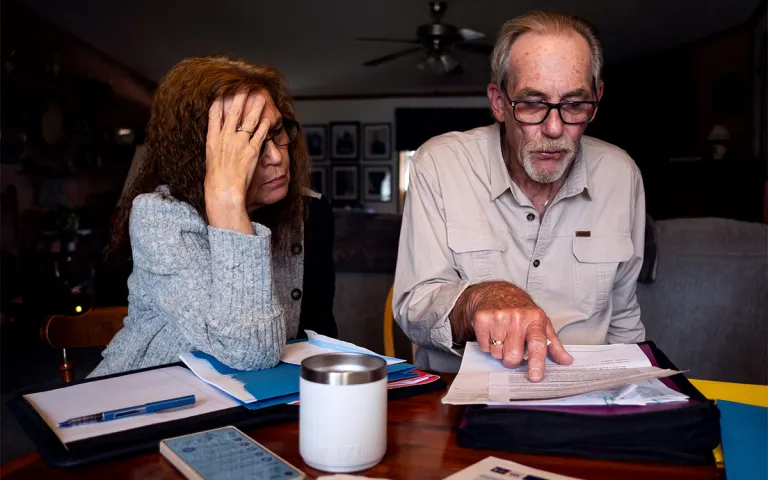
Elizabeth and Leo DeMi review a water contamination notice sent by the Brookside Village mobile home park administration at their kitchen table in Berwick, Pa. on Aug. 27, 2026.
That same year, Pennsylvania’s highest concentration of PFAS was discovered in Brookside Village, a mobile home park in North Centre Township, where the DeMis and their son, Jordan, have lived for 21 years. Levels of one type of PFAS, called PFOS (perfluorooctane sulfonate), were 525 times higher than the federal safety limit. Another, called PFOA (perfluorooctanoic acid), was 97.5 times over the federal safety limit. Both are linked to increased rates of cancer.
“When we found out what the numbers were when [the state] first put out that report, it was like, ‘You have got to be kidding me,’” Leo recalled. He firmly believes the health effects he and his family have battled for years are directly attributed to decades of PFAS exposure.
Jordan grew up with developmental delays, but like other health issues linked to forever chemicals, it may be hard to prove a connection. At 30, the younger DeMi experiences cognitive disabilities, high cholesterol, thyroid problems, and occasional seizures. His bodily concentration of total PFOA is 143 nanograms per milliliter (ng/mL). The national background average is between 1 and 2 ng/mL. The total concentration of PFOS in his body is 430 ng/mL. The national background average is under 5.
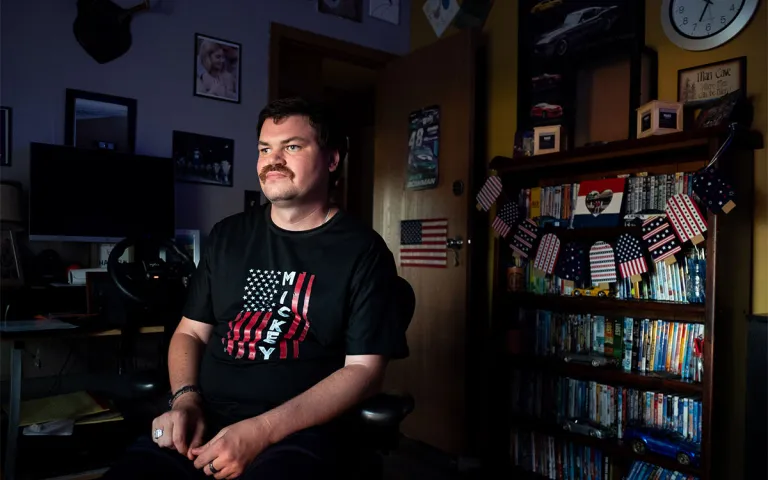
Jordan DeMi hangs out in his game room at home in Berwick, Pa. on Sept. 15, 2026.
“Even if they identified the source and stopped consuming water from the contaminated site, it will take years for the body to even clear half of the concentration of PFAS that they currently have,” Cardenas said of the DeMi family.
The DeMis aren’t the only ones affected. North Centre Township residents outside of Brookside Village rely on private wells for their drinking water. About 130 home wells in the area have PFAS concentrations over the limit for what is allowed, according to testing by the Pennsylvania Department of Environmental Protection (PADEP). In community meetings since the discovery, residents have worried about elevated levels of PFAS in their blood and struggled to make sense of the lack of answers about the future of their drinking water and health.
For Leo, a 68-year-old US Navy veteran, intense digestive issues often keep him indoors. Both his and Elizabeth’s bodily concentration of tested PFAS compounds are well above the national average. When he can get outside, worsening balance issues have kept him off his cherry-red Harley Davidson. “On a day like this, we’d be out riding,” Leo says as he points to a pale August sky and sun-beaten hills rippling into mist along the northern horizon. “One of the simplest things that I miss is being able to walk side by side with my wife, arm in arm. I can’t do that anymore.”
A messy cause
The cause of what some call “the invisible crisis” in North Centre Township is messy. To fertilize their crops during the 1980s and 1990s, local farmers used biosolids, the result of treated wastewater commonly known as sewage sludge. Biosolids often, but not always, contain durable PFAS compounds owing in part to industrial discharges entering treatment facilities, according to PADEP. By the time this was discovered nationally in 2003, the damage had already been done. Local applications of biosolids have ceased, but they are still applied to farms nationwide.
In July of this year, the Trump administration killed a proposed regulatory review of PFAS-contaminated sewage sludge that would have likely put an end to its use on agricultural lands. Going against the scientific research provided in the proposal, the Environmental Protection Agency stated that “data does not indicate that there are widespread impacts to the food supply from biosolids containing PFOA and PFOS at the national level, and the general public is not likely to be exposed to sewage sludge-impacted foods.”
Two months prior, the EPA rolled back federal limits on other PFAS compounds—such as PFHxS, PFNA, and HFPO-DA—and proposed a two-year extension on when public drinking water systems need to meet the federal PFOS and PFOA limits. “No one argues against lead regulation in drinking water,” Cardenas pointed out. “We know from other chemicals, like air pollution and lead, that policy and regulation works.”
He suggests the EPA’s move may be politically charged due to the implications it could have on reining in the pollution caused by manufacturers. “It’s the charge of the government and public health agencies to protect people from exposure,” he continued. “To go around and put the burden on people—that’s definitely not the way forward.”

A motorcyclist heads north on Lows Rd. in Bloomsburg, Pa. on Sept. 15, 2026.
The financial and psychological burden
Since their tap water is undrinkable, the DeMis have resorted to buying two cases of bottled water per week. Among the paperwork sprawled across their kitchen table is a file of grocery receipts they keep in the hopes of one day being reimbursed. The Pennsylvania Department of Environmental Protection currently provides bottled water to affected North Centre Township residents with private drinking water wells, but since the water in Brookside Village comes from a public system, the community’s 400-some residents don’t receive the benefits.
But even for affected residents currently receiving PADEP benefits, the future is unclear. “Due to the rural location and lack of proximity to public water systems, the Hazardous Sites Cleanup Act response of providing in-home water treatment will likely be the final response,” PADEP said. “There is no feasible method to remove widespread PFAS contamination from groundwater at this time.”
When the investigation into the North Centre Township PFAS contamination ends, so will the PADEP’s coverage of maintenance costs and sampling for area homeowners, posing a significant financial burden to residents. Blood tests can range from $300 to $600. Medical bills for checkups and continued monitoring add up quickly. Under-sink reverse osmosis filters, which can remove up to 99 percent of PFAS, are $200 to $600, and replacement filters are $60. Whole-house filtration systems can cost $2,000 to $15,000.
To compound the stress, the Brookside Village administration has pushed back when residents question the lack of clean drinking water and, at one point, the mobile home park operators allegedly refrained from telling prospective residents about the contamination, according to public comment hosted by PADEP in 2025. A spokesperson at UMH Properties Inc., which owns and operates Brookside Village, said they are awaiting PADEP approval to install a granular activated carbon filtration system that would properly treat contaminated water. In the meantime, it’s notifying incoming residents of the exceedingly high toxicity levels and working with the state agency to maintain compliance.

Leo DeMi raises the American flag in his front yard as the sun dips behind the hills of Berwick, Pa. on Sept. 15, 2026.
“It’s going to take communities organizing and making sure that we are asking for changes at the policy, community, and city level,” Cardenas said. “We just need comprehensive policy and regulation to be able to do this in a systematic way that protects everyone.”
In Pennsylvania, at least, comprehensive policy is on the legislature’s table. One introduced bill aims to provide funding and assistance to EMS units and fire companies, who’ve historically been exposed to PFAS through firefighting foam and protective gear. Another would give funding to the PADEP to conduct a study on PFAS chemicals in biosolids. And in July of this year, Governor Josh Shapiro’s administration announced a $306.4 million investment in upgrading 29 drinking water and wastewater facilities throughout the commonwealth to treat PFAS and other contaminants.
For the DeMis, it may be too little, too late. Leo is already looking to the future. “We have it set up in our wills that our bodies will be donated to science,” he said. “Hopefully, they can find some answers to the issues PFAS have caused us. We won’t know until it’s too late.”