 The Magazine of The Sierra Club
Puma Patrol
How cougars keep the roadways of Washington's Olympic Peninsula safe
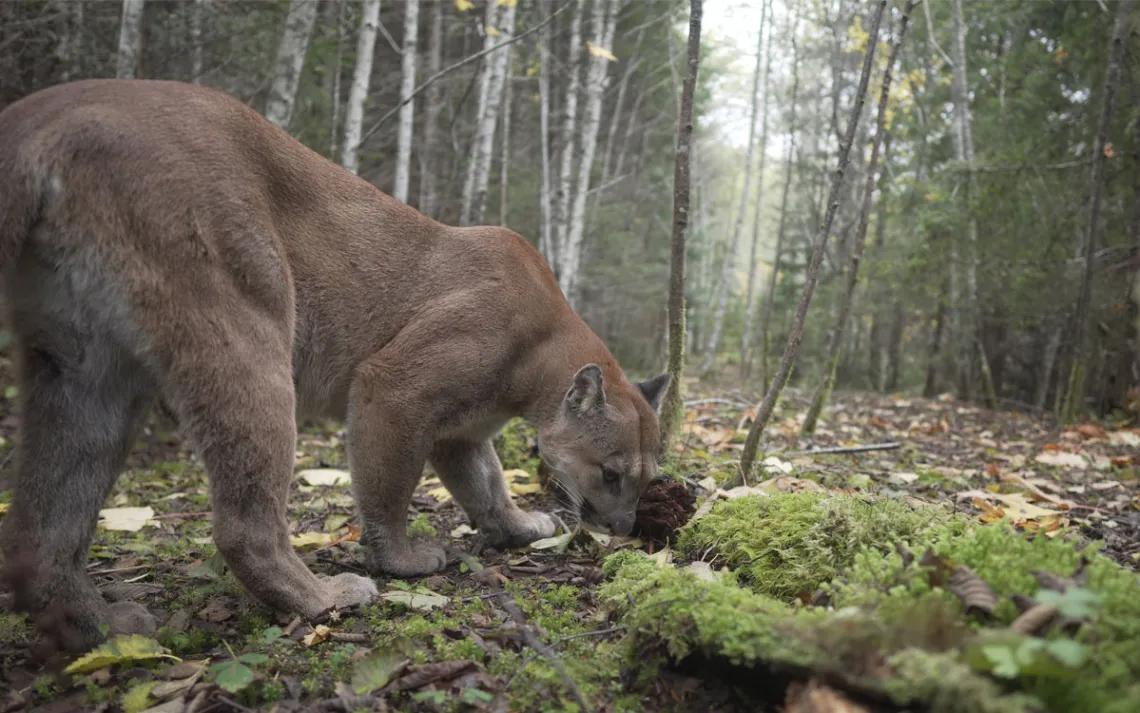
A cougar on the Olympic Peninsula. | Photo by Joe Pontecorvo
No one wants to hit a deer. But there are 1 to 2 million deer-vehicle collisions (DVCs) in the United States each year. These daily events are frequently fatal for the deer and cause millions of dollars in damage. In some cases, they can even cost people their lives. DVCs, as they’re known in academia, are some of the most dangerous encounters between wildlife and humans in the country.
While we think of predators as being dangerous, an otherwise harmless deer meandering into the road is far more likely to take you out than a bear or a wolf or a mountain lion is to stalk and eat you. Occasional news stories about pumas (Puma concolor) might suggest that they are a significant threat to humans. They are not—only around 30 deaths have been recorded since official record-keeping began in 1868.
Instead of being a major threat to human safety, research increasingly shows that large predators may be one of our best defenses against DVCs. In a paper published in August 2026 in the journal Current Biology, scientists concluded that the presence of pumas deters deer from using roadways. Specifically, they do this during the hours when DVCs are most likely to occur.
“When carnivores are present in the landscape, the prey move. They hide,” said study coauthor Mark Elbroch, who is the director of the puma program at Panthera, a wild cat conservation group. “If they know the carnivores are active at a certain time of day, they'll go there at a different time of day to minimize the risk of an encounter.”
Using 509 camera traps maintained by six tribal nations on the Olympic Peninsula in Washington state and tracking collar data for 59 individual pumas, investigators from Conservation Science Partners, a research nonprofit, and Panthera analyzed the movements of both black-tailed deer (Odocoileus hemionus columbianus) and pumas. They correlated this data to Washington State Department of Transportation records of DVCs on the peninsula between July 2020 and June 2025.
According to the study, pumas patrolling the roadways of the peninsula reduced the likelihood of DVCs by 67 percent and the number of collisions by 76 percent. This is significant given the costs calculated for the DVCs during the study period totaled $14.7 million in vehicle repairs and healthcare charges. Any reduction is welcome.
“The scale of their impact on deer-vehicle collisions was so much higher than we would have expected,” Elbroch said. “It translates into quite literally millions of dollars.”
Black-tailed deer are pumas’ main prey on the peninsula. In areas where the cats were regularly detected, deer avoided roadways at night, when their feline predators were hunting. Roadways create artificial forest edges, which are both ideal browsing habitat for deer and stalking grounds for pumas. Because DVCs are more common—and generally cause more damage—when it is dark, frightening the deer back into the forest during these hours contributed to the reduction.
Other research has found similar results in how predators reduce deer collisions. A 2016 paper modeled the hypothetical return of pumas to the eastern United States, where they have been extirpated since the early 1900s. Pumas—also called mountain lions, cougars, and panthers—are now largely restricted to 16 states west of the Mississippi River, with transient animals occasionally appearing in other states. The 2016 research suggested that an established cougar population would reduce deer densities and DVCs by 20 percent over a 30-year period.
The real-world findings in the Current Biology paper offer an important refinement. “For years we've known that cats have very little impact on the abundance of deer as long as it's a healthy population,” Elbroch said. “It's about how cougars scare prey, not kill prey.”
A 2021 study on wolves in Wisconsin aligned with the findings in the more recent puma study. The authors found that the entry of wolves into a county reduced DVCs by up to 24 percent. Similarly, these effects were due to the wolves' use of the roadways, deterring deer from using them. In short, the wolves, like the pumas, create a sense of fear that acts as a deterrent.
“The evidence is clear that predators can make roadways safer. We've previously shown that for wolves. This study finds similar effects for pumas,” said Jennifer Raynor, the lead author of the wolf study, who was not involved with Elbroch’s research. “The study cannot say whether pumas caused a reduction in vehicle collisions, but the negative correlation is consistent with the findings of prior studies,” added Raynor, who is an assistant professor of natural resource economics at the University of Wisconsin-Madison
There are some important methodological differences between the two studies. The wolf study derived its conclusions from reduced crashes when wolves entered areas where they had been absent, while the puma study leveraged the likelihood that existing puma populations were using the roadways and thus deterring deer.
“Ours is a causal inference design relying on new wolf entry into a county,” she notes. “Theirs is a correlative design relying on increases in puma occupancy probability.”
The boxy 3,600-square-mile Olympic juts into the Pacific Ocean from central to northern Washington, cupping the Puget Sound on its eastern side. At its heart is Olympic National Park. On its southern end is the Columbia River. It is further dissected from the mainland by Interstate 5, a massive highway stretching south from Seattle.
The region is, in effect, a large ecological island. And pumas prefer the lowlands ringing the central mountains. They may be able to swim narrow portions of the Columbia, but the Puget Sound is too wide, say researchers. And many stretches of I-5 are unpassable.
The limited usable habitat and isolation from other populations have had profound effects. “They have the lowest genetic diversity of any Pacific Northwest population,” Elbroch lamented. “They have the highest inbreeding coefficients.”
The population has slowly rebounded from a long period during which pumas were popular targets of hound hunters. The practice was banned statewide in 1996. To help pumas and other animals navigate the vehicle traffic in the region, the state is proposing a wildlife bridge that would eventually span the highway south of Olympia. The overpass will provide a stable connection back to the mainland. In addition to facilitating gene flow between puma populations, it will likely reduce wildlife-vehicle collisions (WVCs).
Similar structures in Washington have resulted in plummeting WVC numbers. Elbroch predicts that if the cats could move across the state more easily, an invigorated puma population would further decrease DVCs. “It's likely that we're going to see a net positive benefit to living alongside cats,” he said.