 The Magazine of The Sierra Club
What Is NEPA? Understanding the National Environmental Policy Act and Its Impact
The Trump administration and Congress are whittling away at one of the nation's most important environmental laws
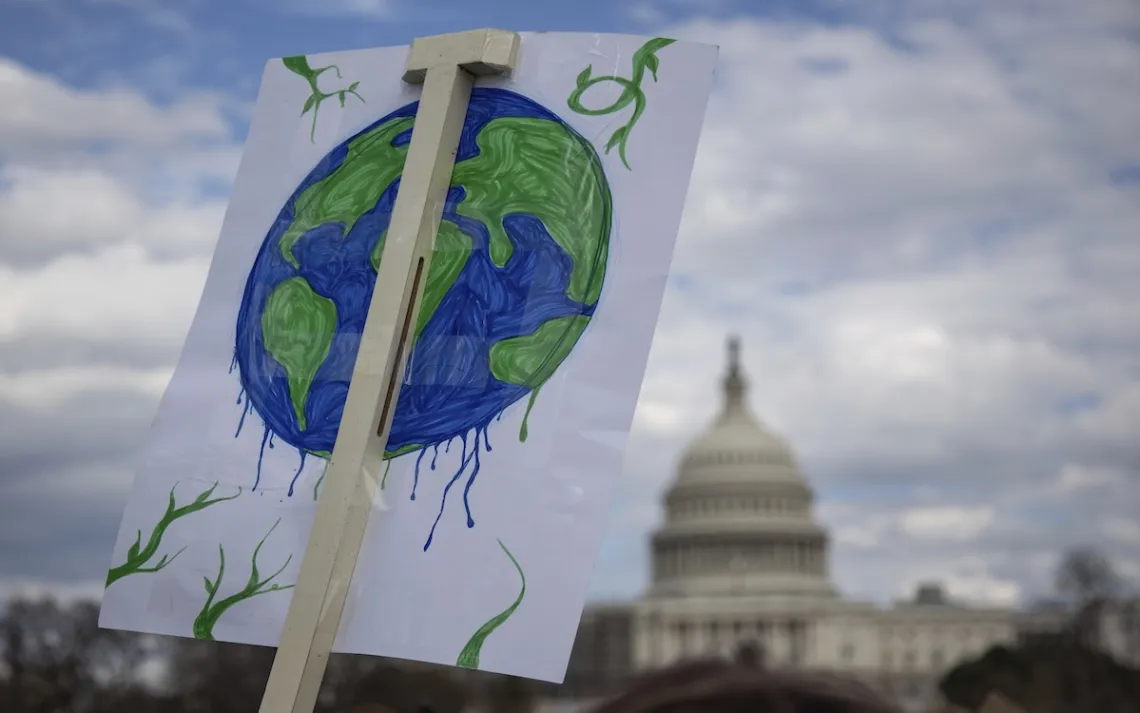
Photo by Bryan Olin Dozier/NurPhoto/AP Images
Few environmental laws are as consequential as the National Environmental Policy Act (NEPA).
Under the 1970 law, Congress required the government to assess the environmental impacts of any major federal project, regulation, or policy. The statute required public notice and environmental impact statements and analysis, and it mandated that the public have the opportunity to comment on draft plans. Federal agencies were also tasked with evaluating a range of project scenarios, leading to, most hoped, the least threatening option.
The process helped military aircraft avoid sensitive areas of Joshua Tree National Park. It kept uranium tailings out of the Colorado River, a water source for over 40 million people. And when the Montana Department of Transportation wanted to expand Highway 93, the NEPA process included input from local tribal communities, which encouraged the agency to build wildlife crossings. Today, this highway is studded with more wildlife crossings than any other stretch of highway in the country.
However, in recent years, opponents on both the right and the left have derided the law. Critics often accuse it of delaying projects, inflating costs, and causing unnecessary red tape. During the Biden administration, “permitting reform” grew into a shorthand for tweaking the law. Since 2020, it has undergone a series of regulatory updates, first from the Trump administration and then the Biden administration, which revoked the Trump rules.
But this past July, the law experienced some of the most sweeping, and likely lasting, changes in the past 50 years. “We are in the midst of a big reshaping of what NEPA is going to look like for communities,” Nathaniel Shoaff, a senior attorney with the Sierra Club’s Environmental Law Program, said. “If you care about climate change or you care about pollution impacts in your community, NEPA is often the best way, and sometimes the only way, to find out about those impacts, and that's clearly under threat.”
Cutting corners
When Congress passed the One Big Beautiful Bill Act on July 3, lawmakers included dozens of provisions that undermine environmental protections. One of them allows corporations to pay a fee to fast-track the NEPA process. Under the new law, if businesses pay 125 percent of the cost of a review, the agency conducting that review must complete environmental analyses within a year. Environmental impact statements must be finished within 180 days. Both, if done properly, can typically take years to complete.
“This bill turns NEPA into a box-checking exercise with a strict stopwatch, forcing agencies to cut corners, miss critical data, and rush to conclusions,” Jim Pattiz, a conservationist and cofounder of More Than Just Parks, wrote in a blog post. “This destroys the integrity of the entire review process and erodes public trust: Those with money will get faster, easier approvals while everyone else is left waiting.”
Just as Congress passed the spending bill, a wave of federal agencies issued regulations scaling back their NEPA processes. Some suggested that they would curtail the public comment process. Others, such as the Department of the Interior, the Department of Agriculture, which manages the US Forest Service, and the Environmental Protection Agency, announced that they no longer need to provide public notice or provide an opportunity for the public to comment. These new rules went into effect immediately.
“Procedures for implementing a purely procedural statute must be, by their nature, procedural rules,” states the Interior Department's new rule. “Surely, they cannot be legislative rules; as such, they do not need to be promulgated via notice-and-comment rulemaking.”
Capping off July, lawmakers sought to revive proposals that were stripped out of the One Big Beautiful Bill with a new law called the Standardizing Permitting and Expediting Economic Development (SPEED) Act. It would shorten the permitting process—a multistage procedure needed to build roads, dams, pipelines, transmission lines, logging operations, and energy projects. The bill allows agencies to skip the NEPA process if another agency has already conducted a review. It limits legal challenges to within 150 days of an agency’s action and excludes certain members of the public from challenging a decision. In short, the proposed law would do more to benefit oil and gas than protect the environment, warned fellow lawmakers.
“This is not a NEPA ‘tune up’ focused on building ‘things we need,' as their press release euphemistically spins,” California Democrat Jared Huffman said in a press release. “[T]his bill is a deliberate effort to shield polluters from scrutiny and bury the climate risks of massive fossil fuel projects.”
An invitation to ignore environmental concerns
These rollbacks follow months of NEPA erosion. On his first day in office, President Trump issued an executive order directing the Council on Environmental Quality (CEQ), which implements the law, to expedite the permitting process. Because of the complexity of evaluating impacts, the permitting process, like analyses, can typically take years to complete. While executive orders aren’t laws, the move set the tone that the administration would prioritize speed over effectiveness.
The CEQ followed up by revoking its own regulatory authority, opening the door for this month’s slate of agency updates. In the same ruling, the council said that it would revert to the previous 2020 Trump-era NEPA revisions. Such a move, warned conservation groups, would give agencies a free pass to omit cumulative impacts, allow project sponsors to conduct their own reviews, and cut local communities out of the planning process. A collective of over 250 groups responded by urging the council not to abandon its review responsibilities.
After the announcement, the Supreme Court issued a ruling in May that further undermined the law. In a case titled Seven County Infrastructure Coalition v. Eagle County Colorado, the judges found that the NEPA process is merely procedural. While the case centered on a short railroad intended to transport crude oil from Utah to Colorado, the ruling undercut the premise of the law. In finding that the law established no regulatory authority, it essentially allows agencies to craft their own NEPA processes, creating a patchwork of polices across the federal government, further supporting the Trump administration’s claim that agencies can interpret the law as they please.
While all these changes, in isolation, chip away at the effectiveness of the NEPA process, the totality has grave consequences for transparency and accountability, warned conservationists.
“It's supposed to be a look-before-you-leap statute,” Shoaff said. “If you take away the teeth and make meaningful remedy almost impossible to secure, then you've lost the purpose of NEPA.”