Wild About Turkeys
A word of gratitude for the Thanksgiving bird
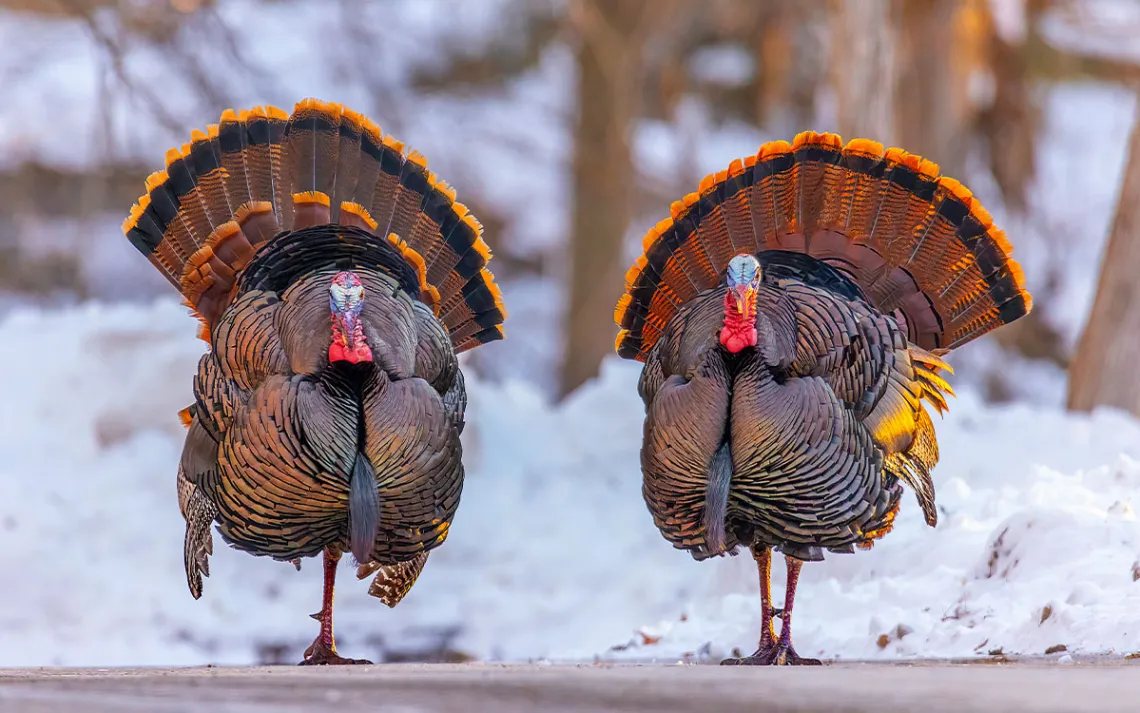
Toms give peacocks a run for their money. | Photo by JamesBrey/Getty Images
Gather round the table—let’s talk turkey.
This time of year, the birds seem to be everywhere. While their domesticated relatives are a Thanksgiving staple, North American wild turkeys (Meleagris gallopavo) are strutting through cities and pecking holes in front yards across the country. However you feel about them, these birds are probably more complex than you think.
For starters, turkeys have a lot more to say than “gobble gobble.” They communicate with roughly 28 different sounds, including purrs, clucks, yelps, “putts,” and “kee-kees.” Males do most of the gobbling—similar to a rooster crowing—to attract mates and establish dominance. That’s also why they strut: fanning their 18 tail feathers, puffing up like gym bros, and altering blood flow so their heads and necks turn a patriotic red, white, and blue. When a tom has success with the ladies in a particular spot, he may waddle back to his “strut zone” for an encore.
Why are they called “turkeys” anyway? The story goes that European settlers confused North American wild turkeys with African guinea fowl, which were imported to Europe through Turkey and known as “turkey cocks” and “turkey hens.” And let’s not forget the other, flashier turkey species. The ocellated turkey (Meleagris ocellata) roams Mexico’s Yucatán Peninsula and parts of Guatemala and Belize, sporting brilliant iridescent plumage, a multicolored head, and eye-shaped markings on its tail feathers.
Even turkey droppings have a story to tell. They’re like tiny ID cards, offering clues about the bird that left them behind. Males typically produce J shapes; females make spirals. And the larger the poop diameter, the older the bird.
When it’s time to sleep, these chunky birds, which can weigh up to 25 pounds, hoist themselves into trees with an explosion of wing flaps. Because of their poor night vision, they roost on branches to stay safe from predators. Turkeys might not be the most graceful creatures in the animal kingdom, but they’re surprisingly speedy, flying up to 55 miles an hour and clocking 18 miles per hour on the ground.
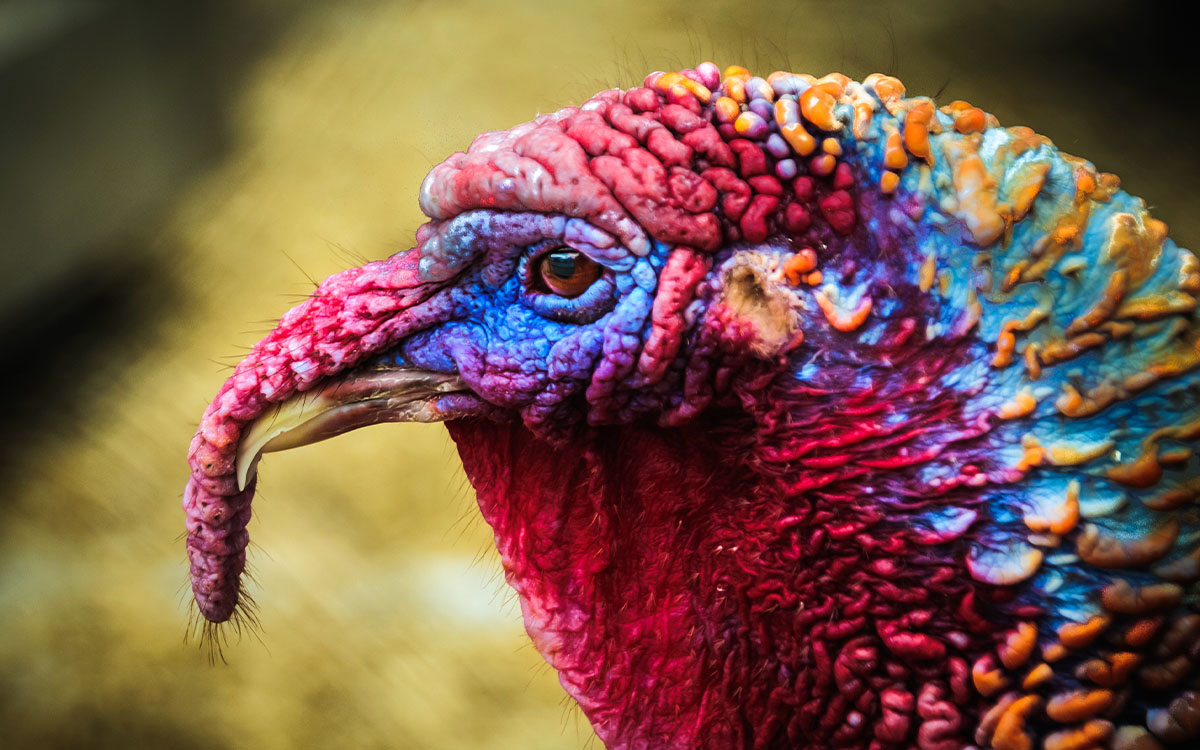
Quiz: Which of these words—snood, wattle, brimp, caruncle—is not associated with a turkey head? Answer: Brimp. The appendage over its beak is a snood. Its chin flap is a wattle. The fleshy bumps are caruncles. | Photo by KenWiedemann/Getty Images
Where I live in Northern California, as in many urban areas, wild turkeys have little reason to fly or run. There’s plenty of food within easy reach—berries, acorns, bugs, spilled birdseed—and few natural predators. It’s not uncommon to see a dozen turkeys casually strolling through a busy intersection, with cars backed up for blocks, or to spot them resting atop warm cars. But the ever-growing turkey population and aggressive males during spring breeding season have some residents in my town crying fowl. (One woman even called the police in May after two turkeys ambushed her during an evening walk.)
Not me. Living in a developed area means that nature moments can be few and far between, and that’s why I gladly make space for turkeys and welcome the sight of them trotting through town. These birds—and urban wildlife in general—challenge the notion that cities and nature are separate worlds. Benjamin Franklin also happened to be a fan, once writing that compared with the bald eagle, the turkey is “a much more respectable Bird, and withal a true original Native of America.... He is besides, though a little vain & silly, a Bird of Courage.” What better time than Thanksgiving to pay our respects to these all-American feathered friends.
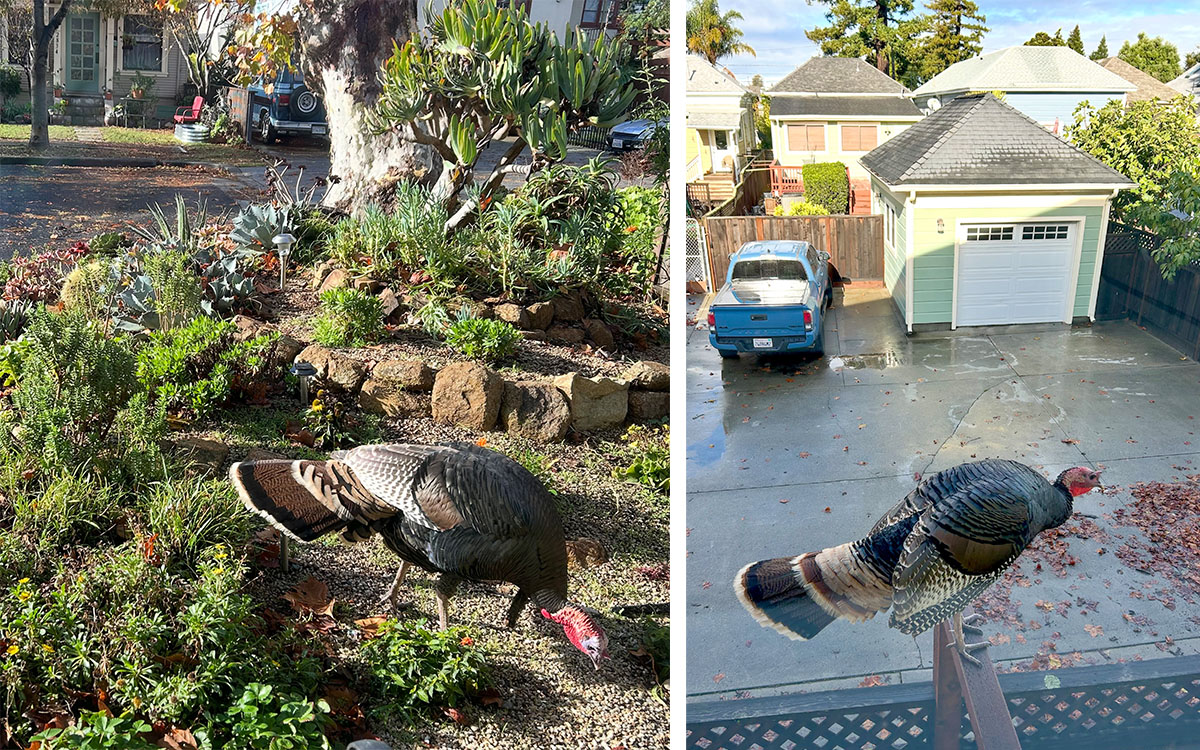
Serendipity! As I sat at my desk finishing up this turkey tribute, a tom flew up to my window, then poked around in my yard for a spell. | Photos by Suki Gear