On Wednesday, April 16, 2025, Lynn Godfrey gave a presentation to the Sierra Club York River Group on environmental justice in the wake of dismantling the EPA. Lynn Godfrey serves as the Chapter’s Just Transition Program Manager and Pipeline Organizer for the Stop the Pipelines campaign. She is a public health, environmental, social, and economic justice advocate with 20 plus years experience developing programs and garnering grant funding resources for an array of projects and entities. She is passionate about environmental justice in its broadest application and seeks to advocate for and educate marginalized communities to reach their highest development capacity.
In her presentation, Lynn Godfrey discussed the massive push for fossil fuel buildout and how it is impacting communities’ ability to maintain and preserve sustainability and good health. She pointed out how this fossil fuel buildout along with the rollbacks in environmental protection are impacting communities in Hampton Roads that are located adjacent to polluting facilities, such as industrial sites, military bases, and service centers. These are communities where residents are subjected to chemicals, odors, noise, and other disturbances.
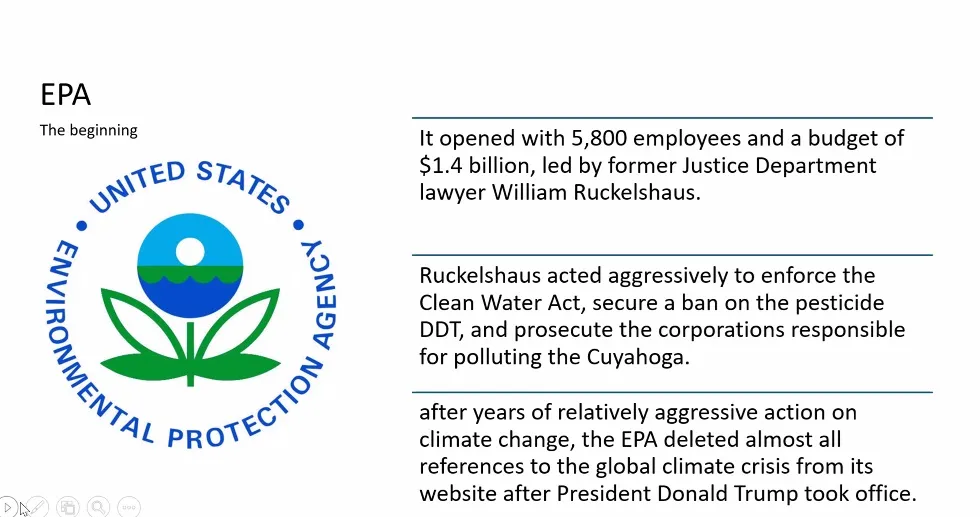
Lynn Godfrey gave an overview of the history of how the National Environmental Protection Act (NEPA), signed into law in 1970 by President Nixon, came to be fueled by the influence of pivotal books and events. Two in particular were the publication of “Silent Spring” by Rachel Carson, published in 1962, and the Cuyahoga River Fire in 1969. Both of these garnered national/international attention. The creation of the Environmental Protection Agency (EPA) followed the enactment of NEPA in late 1970. Lynn Godfrey described some of the twists, turns, gains, and setbacks the EPA has had over the decades, emphasizing the state of things with the current administration. She gave examples of communities that were impacted by industrial toxins, such as big cases from the late 1970s in Warren County, NC and Love Canal in NY to local sites and current situations in Petersburg, VA and Portsmouth, VA. She also gave a synopsis of how the Environmental Justice Movement got started. She advocated for us all to take action by contacting and messaging our Representatives, advocating to save environmental protections, to save NOAA, to keep “climate” in websites and dialog, and to protect people and communities.