Mountaintop removal, fracking, and now hyperscale data centers: West Virginia never misses out on the latest trend in environmental and social destruction, thanks to our legislators. Hyperscale data centers use as much electricity as a small city and up to 5 million gallons of water a day to cool their servers—and then return this water to streams at high temperatures, impacting aquatic life. Data centers can increase ambient air temperatures up to six miles away and generate lots of noise and light pollution. Who would want to live near one?
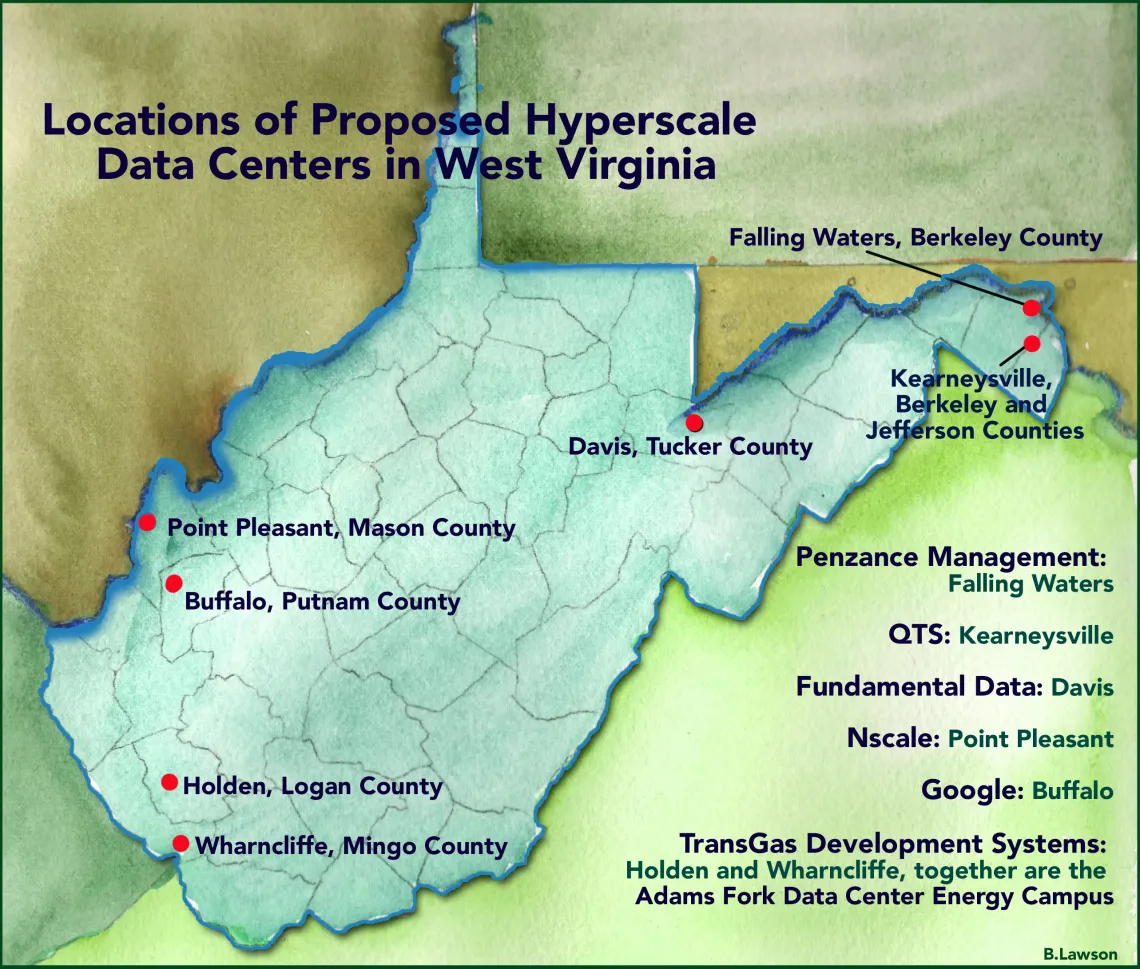
But our governor has made West Virginia as friendly to data center development as possible. HB2014, passed in 2025, lets data centers move in, free from any local zoning laws, while sending 70% of the taxes generated to Charleston. HB2002 sets up a permitting dashboard to operate as a “one-stop-shop” for obtaining and renewing qualifying business permits, effectively streamlining the process in West Virginia. No questions asked, not even of heavily redacted air quality permits. At least seven projects are in the works across the state.
Fundamental Data (FD) got an air quality permit for their off-grid, gas-fired power plant to run Ridgeline Data Center in Tucker County (see the Mountain State Sierran Spring 2026 edition) despite massive local opposition and a lawsuit. Though a second appeal is underway, the project has powerful support in the WV Legislature, including from House of Delegates Speaker Roger Hanshaw, who also works as a lawyer for FD. Representatives for FD told the Wall Street Journal that the facility could be “among the largest data center campuses in the world,” spanning 10,000 acres across Tucker and Grant counties if fully realized.
Monarch Compute Campus in Point Pleasant, Mason County, originally developed by Fidelis New Energy, was acquired by Nscale, a British-based, NVIDIA-backed cloud provider, in March 2026. Like Ridgeline, it will be powered by an off-grid, natural-gas-fired power plant. Microsoft will be their first customer.
Penzance Management, a real estate firm, is investing $4 Billion in their Bedington Campus in the Falling Waters District of Berkeley County to build a data center they are now calling an “Intelligence” Center. As developers, they “build to suit” for hyperscalers. It will likely be grid-connected. This is a speculative project as they don’t have a customer yet.
Not far from the Penzance site, developer QTS is planning two data center buildings on 300 acres in Kearneysville, spanning Jefferson and Berkeley Counties. The properties have access to a natural gas pipeline and two high-capacity electric transmission lines.
TransGas Development Systems, a New-York-based company, is planning the largest natural gas-fueled ammonia plant in the world and two off-grid natural gas power plants to power two data centers, collectively referred to as Adams Fork Data Center Energy Campus in Mingo and Logan Counties. Both the ammonia plant and the power plants have received separate air quality permits from the WV Department of Environmental Protection. Mingo County residents filed a federal lawsuit seeking to halt the Adams Fork project, alleging violations of the Endangered Species Act, Clean Water Act, and National Environmental Policy Act.
As of March 2026, Google acquired approximately 1,700 acres near Buffalo in Putnam County for a proposed multi-billion-dollar data center campus. Google claims that they will use all renewable energy and replenish more water than they consume. Still in the early planning stages, infrastructure, power, and water use have yet to be finalized. Further information is scarce.
Note that the Tucker, Mason, and Mingo County projects all plan to use off-grid (microgrid) power sources to avoid dependence on the PJM grid, claiming this will prevent rising energy costs for ratepayers. But then, as well as the noisy data centers, we are also getting four new gas-fired power plants. That means increased demand for fracking and its associated air pollution, methane release and radioactive fracking wastewater. The upstream impacts from data centers go well beyond the local noise, light, and air pollution.
Beyond the environmental impacts, we must consider the wisdom of massive data center build-out. New technology, such as the microscopic optical chip developed for quantum computing, can manage data with components smaller than a grain of salt, potentially replacing bulky, expensive hardware. What happens then to all the stranded warehouses full of computers and their power plants?
More fundamentally, why are we rushing headlong into this uncharted A.I. revolution with no consideration for how it will transform our social structure, economy, politics, warfare, privacy, education, and emotional well-being? Should Elon Musk, Jeff Bezos, and Mark Zuckerberg get to decide the future of life on Earth? We desperately need careful, thoughtful leadership, not legislators who throw out the welcome mat to every speculator who comes along promoting a dangerous technology.