Where Have All the Tufted Puffins Gone?
Researchers try to solve the mystery of why these adorable seafaring birds are disappearing
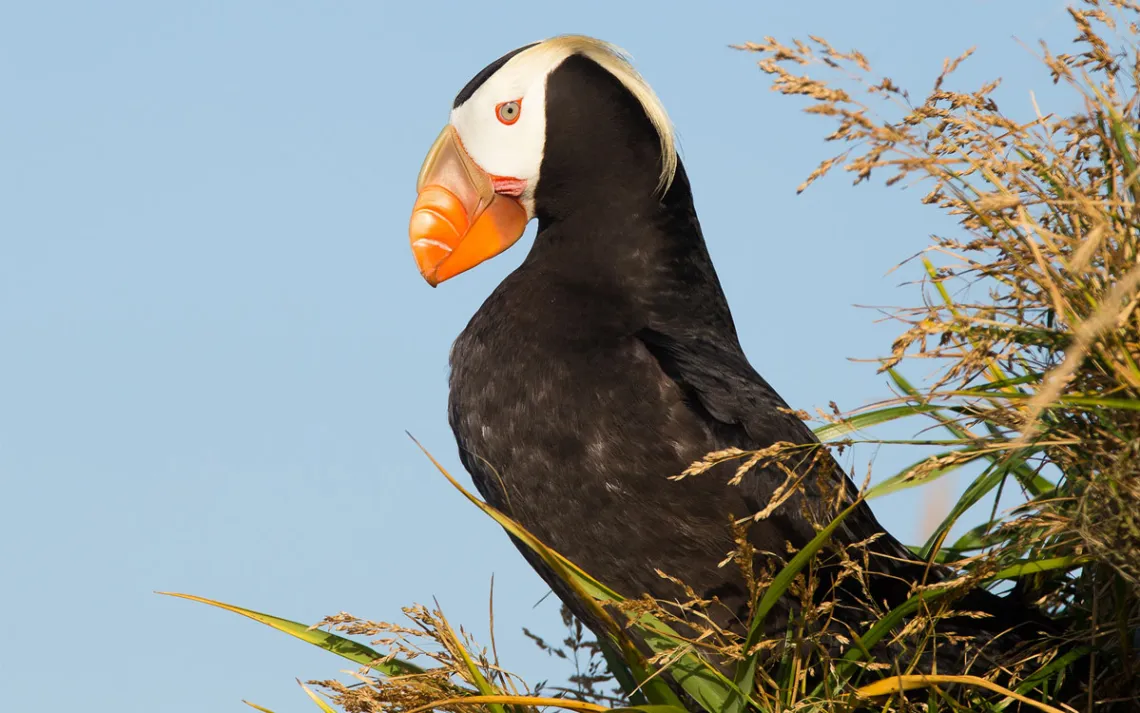
A tufted puffin near a burrow on Puffin Island, off the coast of Kodiak Island. | Photo courtesy of Lisa Hupp/USFWS
A thick marine layer recently hung over the Pacific Ocean as researchers planted puffin decoys across a patch of federal land on Oregon's central coast. The fake birds are designed to be lifelike, but they look a bit like puffin-shaped garden ornaments decorating the oceanfront ledges.
Real tufted puffins used to nest among the rocks and bunchgrass of the Yaquina Head Outstanding Natural Area, but there haven’t been any confirmed sightings in years. It’s a common phenomenon across the puffins' range, from Northern California to British Columbia. In Oregon, the regional puffin population plummeted from nearly 5,000 birds in 1980 to just 553 in 2021, when the most recent survey was conducted.
Now, a new coalition is trying to halt the decline. More than 20 nonprofits, government agencies, and researchers have formed the Tufted Puffin Conservation Working Group, a collaborative effort to pool resources and expertise to save this charismatic species. The cohort of birders recently finalized Oregon’s first conservation action plan. The 10-year plan hinges on research, advocacy, public engagement, and science-backed conservation strategies, like the one being implemented on Yaquina Head.
The decoys are a conservation tool known as social attraction. If puffins see other puffins, even fake ones, they’re more inclined to nest nearby. “The working group’s goal is to completely stop the decline of tufted puffins,” said Katherine Luscher, who coordinates tufted puffin conservation for Audubon's Seabird Institute.
The tufted puffin dream team
Tufted puffins look a bit like ocean clowns—bright-orange bills, white faces, yellow manes, and red-rimmed eyes. People flock to Haystack Rock, a dramatic rock formation on Oregon’s Cannon Beach, for a chance to see the birds. John Underwood has been one of those puffin-loving beachgoers for decades. Now 79, he saw his first tufted puffin as a kid. He remembers seeing thousands of puffins on Haystack Rock when he brought his own children to see the birds decades ago. But in recent years, he’s noticed their numbers dwindling. One summer, a US Fish and Wildlife Service volunteer told him there were just 120 birds on the rock.
Despite the decline, researchers and conservationists have struggled to secure legal protections for tufted puffins. In 2014, the Natural Resources Defense Council petitioned the USFWS, which manages threatened and endangered species, to list the species as endangered under the Endangered Species Act. But the agency denied the request, citing a stable population in the more northern part of the tufted puffin range, which extends into Alaska.
Underwood and his wife, Ann, printed $10,000 worth of tufted puffin sweatshirts to raise money for an awareness campaign. Underwood also joined the board of directors for Friends of Haystack Rock (FOHR), a nonprofit that helps protect the intertidal biodiversity around the rock. The organization started getting more involved in tufted puffin conservation and soon saw an opportunity to better protect the birds.
“We were worried we were just going to be counting this species until it’s gone, so we said, ‘What can we as an organization do?’” said Angela Benton, a FOHR board member. “We realized there were a lot of people doing really great work in tufted puffin conservation, but there was no real integration of it, so we decided to kick things up a notch by coordinating all of the efforts and expertise.”
Friends of Haystack Rock partnered with the National Audubon Society's Seabird Institute and launched the working group in 2024. The organization raised money to create Luscher’s position. In the years since, its membership swelled as other nonprofits, research groups, and government agencies joined, including USFWS and the Oregon Department of Fish and Wildlife (ODFW). Staff with the Bird Alliance of Oregon and Oregon State University are also members.
“Five years ago, people weren’t talking about tufted puffins in any coordinated way,” said James Lawonn, an avian biologist with ODFW. “The working group has elevated the conversation so different entities are now teaming up to identify research gaps and conservation strategies that wouldn’t be possible if everyone was working alone. It’s a dream team.”
The unsolved mysteries of tufted puffins
Tufted puffins spend eight months of the year at deep sea and nest out of sight in underground burrows. They’re also tough to band, since they prefer to nest in steep, rocky environments. Their remote, peripatetic nature makes figuring out why they’re disappearing at such an alarming rate a difficult task.
“There’s no smoking gun,” said Don Lyons, the director of conservation science at the Seabird Institute. “But there are some things we suspect are happening.”
One of the most likely culprits is rising sea temperatures, said Lyons, who’s been working in seabird science and conservation for over 20 years. The North Pacific is one of the fastest-warming ocean basins on the planet. As the ocean warms, it pushes out the cold-water fish that puffins depend on to survive.
“We know that sea surface temperatures affect food abundance and often affect breeding success for seabirds,” said Lawonn. Researchers say other issues, such as predation, loss of habitat, and human disturbance, are also likely contributing to the dire state of puffins.
To help assess the impact of these threats, every morning through the summer, volunteers stand on Cannon Beach, and other spots along the coast, monitoring puffin activity. They scan the rock, the sky, and the sea every 15 minutes, counting puffins and noting any activity they observe, like puffins flying with fish into burrows, which would indicate an active nest. They also note disturbances, like eagles or falcons flushing the rock.
The hope is that monitoring efforts will produce a current estimate of the remaining birds, as well as shed light on what’s affecting their population.
The USFWS used to coordinate the seasonal volunteers for this count, but as resources and capacity have dwindled at the federal level, the working group has offered support. It’s part of the beauty of the working group, said Luscher, that if one group is struggling with resource issues, others can step in. She also notes that USFWS still plays an important role in managing tufted puffin habitat and collaborating on other research and conservation projects.
There are other new research projects underway this summer, including one analyzing prey with the help of citizen scientists who photograph puffins carrying fish in their bills. There’s also one that’s looking at habitat loss in Oregon. And last summer, the working group flew drones over historical nesting sites to assess the viability of the habitat below.
Bringing birds back from the brink
Without clear information about what’s causing the decline, it’s hard to know exactly which conservation strategies to employ, said Lyons. But he cautioned that the group is taking “calculated risks” that could benefit the birds in the near term while longer-term research is underway—including social attraction.
The first step toward employing social attraction in Oregon is to confirm that tufted puffins are in the vicinity of the nesting sites. Once confirmed, the working group sets up cameras and decoys on site. The decoys also act as a visual cue to people who might notice them and become curious about the birds’ plight. The group is asking keen-eyed surveyors to submit any photos they take of tufted puffins interacting with the decoys.
“Nobody hates puffins,” said Luscher. “They’re beautiful; they’re not contentious. They’re just lovable, iconic seabirds that have a unique way of drawing attention to seabirds and their conservation needs.”
As the researchers look at their own growing numbers and what they’re achieving through collaboration, they feel hopeful about the future. This summer’s social attraction projects are a great example of the kind of work that wouldn’t be possible without collaboration and each group’s unique expertise, said Lyons.
“The synergy that’s making this work happen is striking, and it isn’t something that any single organization could pull off,” he said. “None of us have sufficient resources to turn this around on our own. But by coming together and pooling our resources and expertise, we can bring species back from the brink.”