A Memoir for the World’s Glaciers
In "Chasing Time," photographer James Balog weighs mortality with thousands of frames
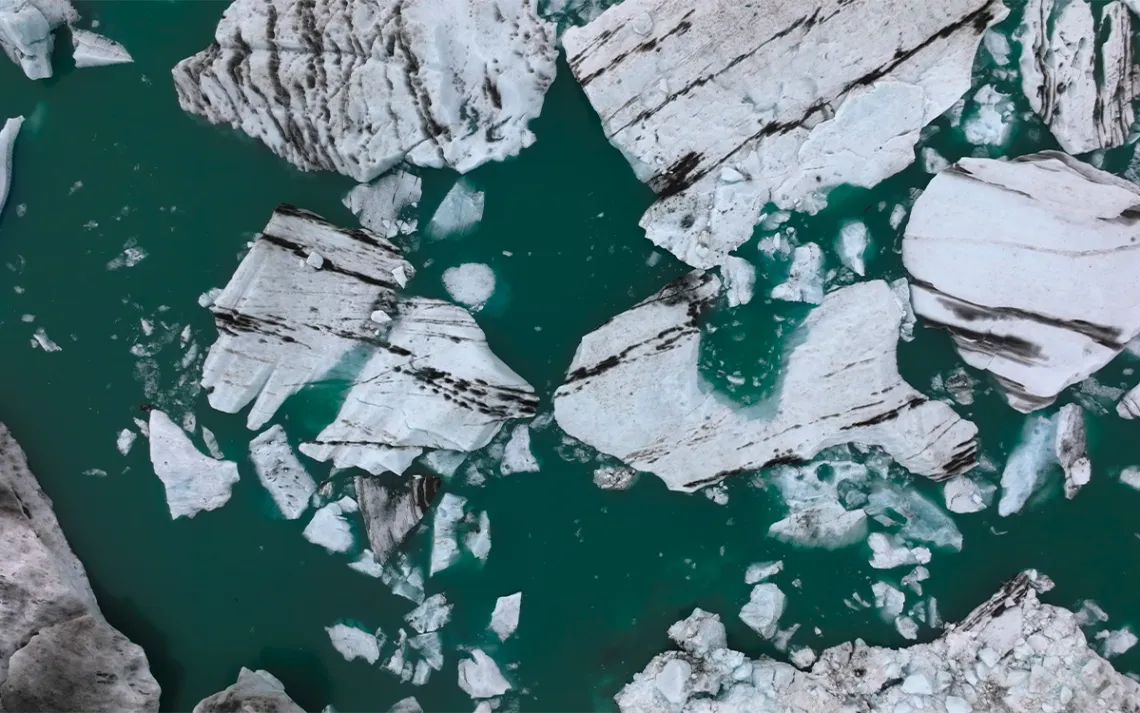
Jökulsárlón glacial lake in Iceland. | Photo courtesy of Exposure Labs/Chasing Time
Sitting quietly atop a dormant shield volcano in the mountains of western Iceland—more than 3,600 feet above a sprawl of Atlantic fjords and just below the Arctic Circle’s southernmost swoop—a small copper plaque enshrines a letter to the future.
“This monument is to acknowledge that we know what is happening and what needs to be done,” its message, written in both English and Icelandic, reads. “Only you will know if we did it.”
Below these words, haunting for their ominous air, the letter’s signature is startlingly technical, perhaps even foreign to nonscientific readers: “415ppm CO2.” One need only to look up from the letter and take in the dry alpine landscape to understand the unique sign-off as an anthropogenic bookmark.
In 2014, Iceland’s Okjökull glacier was declared dead by geologists after melting to just 4 percent of its historic size, a consequence of global warming. Few humans have spent as much time within the vanishing cryosphere as James Balog, a 73-year-old environmental photographer who has dedicated his career to documenting the world in flux. His own version of a letter to the future began in 2007, when he founded the Extreme Ice Survey, a global effort to capture the realities of glacial melt.
“We needed comprehensible, dramatic, visual evidence of what was going on,” Balog tells Sierra from his home in Colorado. “Glaciers are living creatures. They may not breathe, they may not speak, but they are animate just the same. And they are dying.”

Svínafellsjökull. | Photo courtesy of Exposure Labs/Chasing Time
With a team of scientists, mountaineers, and videographers, Balog installed 72 time-lapse cameras on several dozen glaciers in Iceland, Greenland, Canada, Alaska, the Alps, and the Northern Rockies, capturing real-time footage of the landscapes’ retreat. The immense scale of change they captured was unveiled in the award-winning 2012 documentary Chasing Ice, which has since screened in 172 countries, played before audiences at the White House and United Nations, and inspired museum exhibitions on climate change.
The film was also an important marker for the Anthropocene, a geological age defined by humanity’s collective influence on the environment. “If features this enormous and consequential and durable can vanish in such a short period of time,” Balog says, “it makes you realize that your own little life is pretty mortal too.” Okjökull was the first major glacier in Iceland’s history to be declared dead. On the day it was remembered with a national ceremony, in August 2019, Earth’s atmosphere contained 415 parts-per-million (ppm) of carbon dioxide.
Today, after six of the planet’s hottest recorded years, the atmospheric concentration of greenhouse gas exceeds 427ppm. And glaciers, recognized globally as an indicator of climate change, continue to suffer sweeping losses. Last year marked the 37th consecutive year that the world saw an overall decline in glacial mass. Since the turn of the century, more than 7 trillion tons of ice—roughly one-third of the Great Lakes’ total freshwater volume—has melted. By 2100, if carbon emissions continue at their current pace, three-fourths of Earth’s glaciers will disappear completely.
Transience is the central theme of Chasing Time, a 25-minute sequel to Chasing Ice. The deeply personal film, which made its world premiere in 2024 and debuted on PBS in November, is described by its directors as a love letter—not only to the glaciers Earth has lost and will likely continue to lose, but to Balog and his life’s work. In 2019, while framing many millions of photographs conveying the fragility of our planet, Balog was diagnosed with cancer. A reduced capacity for travel, compounded by rising operational costs, meant the Extreme Ice Survey, after 15 years, could no longer continue in its original form.
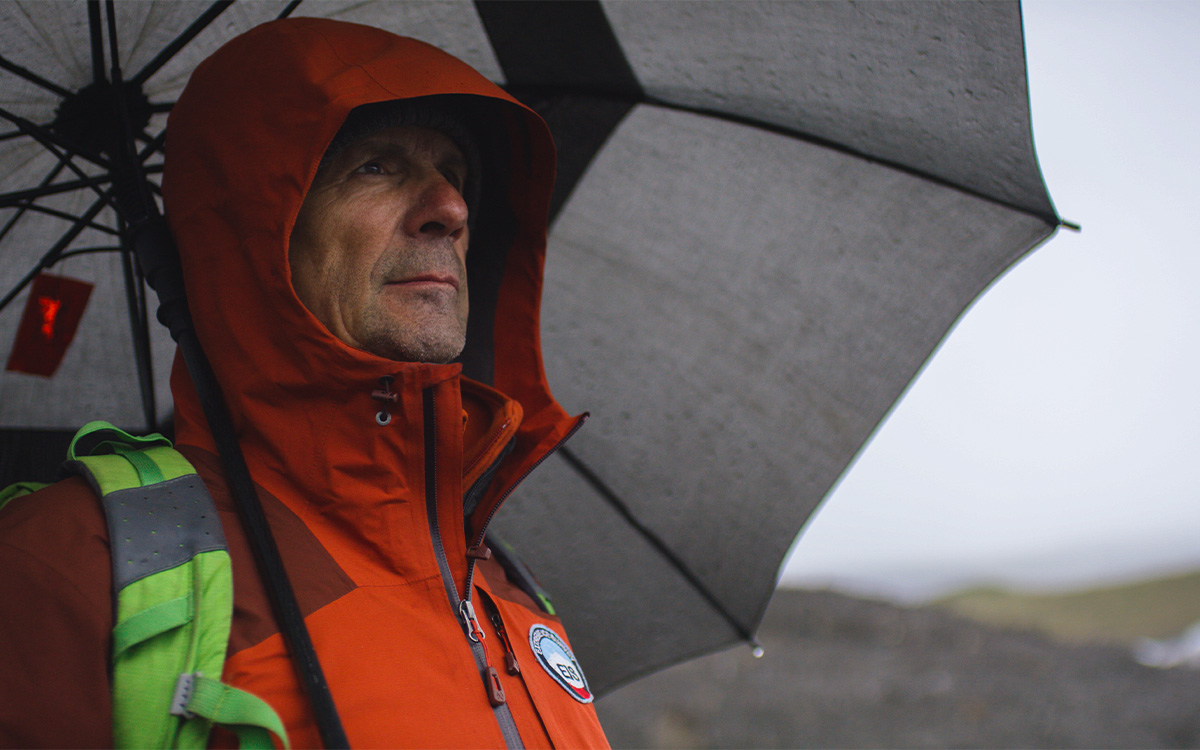
James Balog. | Photo courtesy of Exposure Labs/Chasing Time
Chasing Time follows Balog’s final spin of the globe as he returns to these diminished glaciers and removes, for good, his time-lapse cameras. Wide-angle shots of historic abundance and present-day lack juxtapose epochs of mind-boggling scale. The poetics of purpose, and endings, are felt unmistakably throughout Chasing Time. In watching Balog’s global circuit, the viewer feels both mortal humanity and Mother Nature—two forces coexisting in space, though with vastly different relationships to time—confront the loss of each other.
Subtler sensory cues hint at this connectivity. Layered into the film’s piano score, which plays often and softly over drone footage, the composers included human breaths as a nod to Balog’s relationship with these icy landscapes, which he considers alive.
Moments of quietude resonate profoundly, for both viewers and the filmmakers alike. In Chasing Ice, director Jeff Orlowski-Yang spent weeks camping in Greenland to set the world record for the largest glacial calving event ever captured on camera. In Chasing Time, his most memorable moment is one of the most mundane: sitting on a black-sand beach with Balog, reflecting on the project and their two decades spent working together.
“It’s not in James’s DNA to slow down,” Orlowski-Yang says. “So to sit back and hang and have space for that conversation will always be special to me.”
No scene is as moving as the one that was intentionally left out of the final cut. After removing the final camera from the Sólheimajökull glacier in Iceland, where the Extreme Ice Survey began, Balog remained after filming ended, and sobbed.
“He stood at this place where this camera was a sentinel for 15 years,” Orlowski-Yang says. “In reflecting on his own life and this endeavor, to what degree did taking this camera down feel like the end of his own story?”
Balog likens the emotions of the moment to those he felt while watching his daughter leave for college. “I was crying. My shoulders were heaving. I was quite upset. It was a big chunk of my adult existence,” he says. “You realize how much time has passed.”
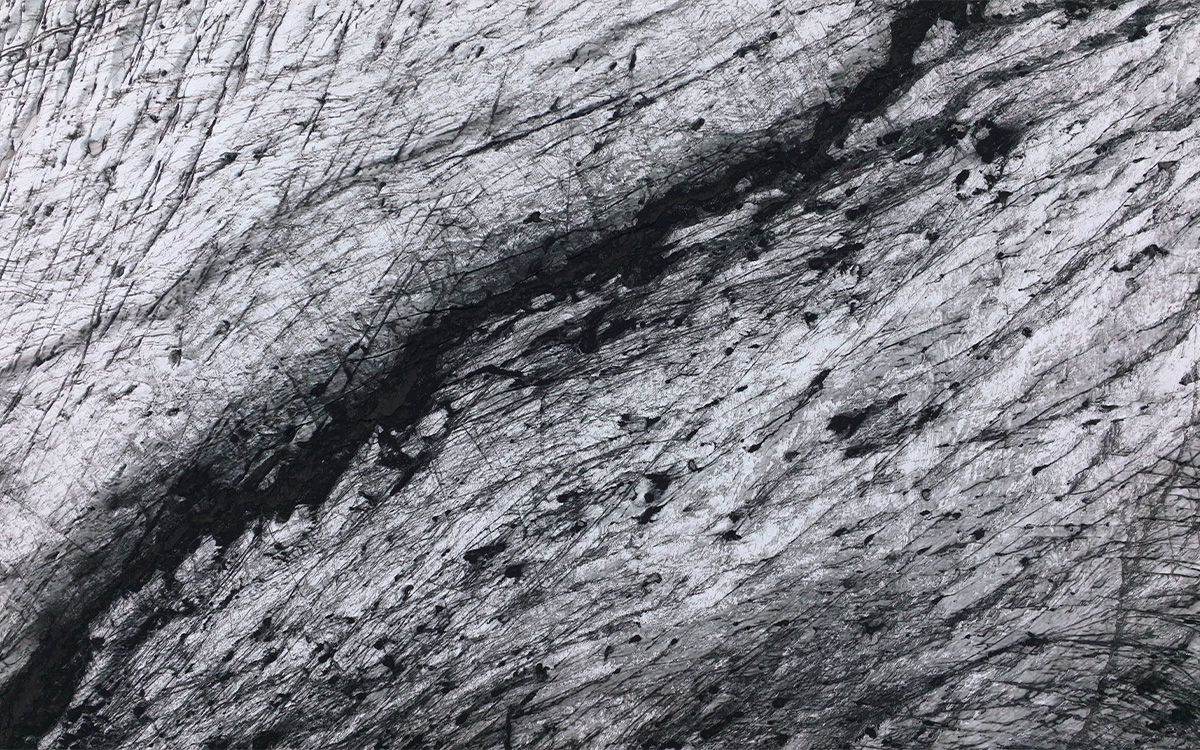
Black and white ice. | Photo courtesy of Exposure Labs/Chasing Time
Forming a delicate bridge between the real and abstract, Chasing Time occupies the blank space between “what we know is happening” and “what needs to be done.” Both in its literal title and emotional message, the film describes a race—one that, in the age of both anthropogenic impacts and storytelling, no one can run alone.
“This work isn’t a sprint, and it’s not a marathon either,” says Orlowski-Yang. “It’s a relay.”
To make this point, the film’s 39-minute extended cut, set to release on YouTube on March 21, 2026—World Glacier Day—expands on the importance of mentorship. While the first chapter of the Extreme Ice Survey has come to a close, the project is continuing through citizen science, the creation of a network of professional observers, and student outreach.
In Iceland, these opportunities—paired with a global initiative this year to recognize the importance of glacial preservation—have made a steadily positive impact.
“The glaciology community in Iceland has raised awareness in several ways, [including] joining various groups to hold lectures, conferences, and artistic competition among young people,” Hrafnhildur Hannesdóttir, a glaciologist at the Icelandic Meteorological Office and who featured in the film, tells Sierra. “It is important to continuously talk about these changes, to increase science and nature literacy, even in the country of fire and ice.”
The passing of the baton has also meant a passing of the camera. Just as Balog was a formative teacher to Orlowski-Yang in Chasing Ice, the cinematographer worked with first-time filmmaker Sarah Keo to co-direct Chasing Time.
“Going into the film, I was afraid that people would question why Jeff was co-directing with me, especially as someone who didn’t have a film background,” Keo says. “I had never directed before, I didn’t have formal training.”
But watching Keo grow as a director throughout the film, Orlowski-Yang says, was one of his “greatest joys” while working on the project, which otherwise, for its subject matter, was often a quite somber experience.
And in this, Keo says, she learned a wider lesson for processing climate despair. “We need more community care,” she says. “When you focus only on self-care, you tend to isolate and fall into a pit. When we’re surrounded by like-minded individuals who share our passions, they can help carry that burden with us.”
For Balog, there is little difference between the mindset needed to tackle the impacts of climate change, and endure a cancer diagnosis.
“You have to make the willful choice to say: ‘I’m not going to despair. I will feel despair, I will feel depressed, but I’m not going to let that eat me,’” he says. “‘I’m going to put it in a mental box on a shelf and go forward and turn despair into action. Take another step.’”
For those who for decades have joined Balog in chasing ice and time across hemispheres, the documentary’s takeaway is resounding: The film marks a finish line for few, and a starting block for many more.
“It’s his oeuvre, in many ways, coming together through a camera,” Orlowski-Yang says. “His eyes to the world.”