 The Magazine of The Sierra Club
How Pixar Got the Science Right in Hoppers
Meet the researcher who informed the writers about beaver behavior and threats to their habitat
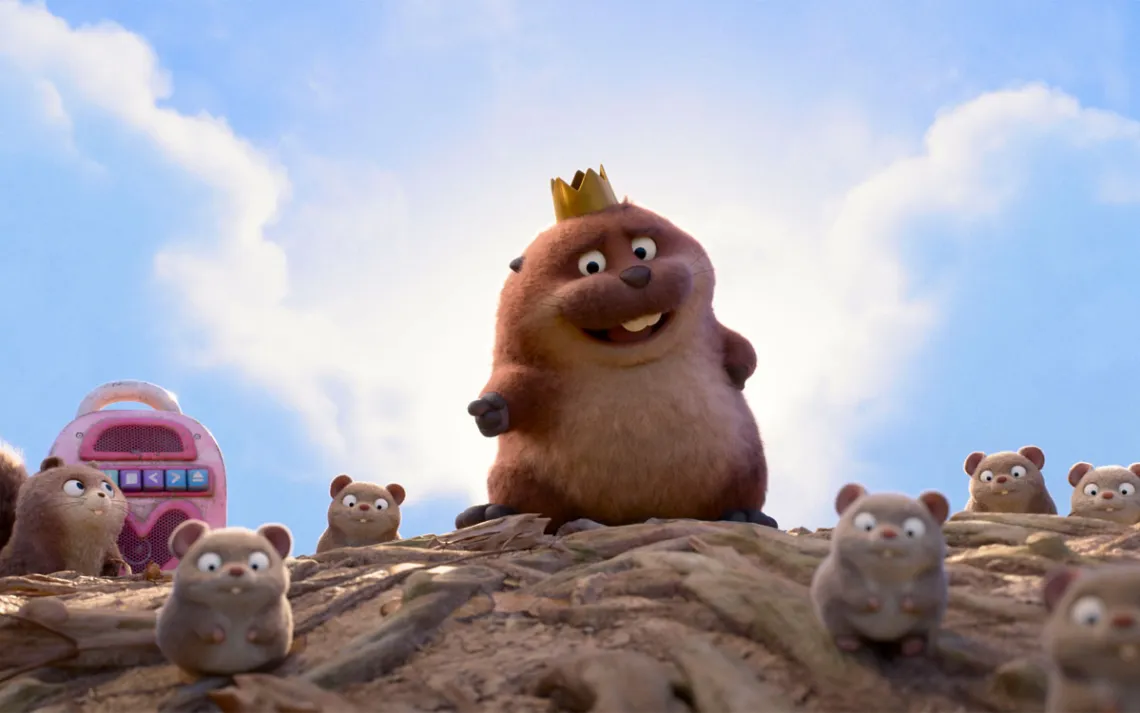
King George from Hoppers. | Photo courtesy of Pixar
Jesse Andrews feels like he was put on this Earth to write Hoppers. Growing up, his room was decked out with stuffed animals, posters, and a parade of origami raccoons—the animals he was most obsessed with.
“At night, the last thing before I’d go to bed, I knew that wishing upon a star was a thing that kids would do in fairy tales,” Andrews said. “So I would wish upon a star to become a raccoon.”
But the real foreshadowing that Andrews would help write Pixar’s newest film was the beaver poster that hung above his bed.
Hoppers follows Mabel Tanaka, a 19-year-old living in the fictional town of Beaverton. The mayor wants to build a highway through a glade where dozens of species are thought to live, which inspires Mabel to act. If she can prove that wildlife live in the glade, he’ll stop the highway.
However, while protesting the development, Mabel realizes that all the animals have vanished. Just as it looks like things might not go her way, she stumbles on and then deploys a new technology that allows her to body-swap with a beaver. The device, she concludes, might be the key to convincing all the animals to return.
Besides the Freaky Friday-esque switch, the movie stands out for its highly accurate portrayals of wetlands and beavers, from the riparian vegetation to the physics of beaver anatomy (they sit with their tails tucked under their bodies instead of having them lie out flat). It also plays on the idea of the animal kingdom by depicting the glade as a literal kingdom, composed of six monarchs, each representing a classification of animals. There’s King George, a beaver who is the king of mammals; a fish queen; a frog, who is the amphibian king; a goose, who is the king of the birds; three snakes, who are the reptile queens; and there’s even a literal monarch butterfly, who is the queen of the insects.
And while the film’s team has no shortage of talent and creativity, getting all the facts and facets right required special expertise. They needed someone who could advise them on the nuances of beaver behavior. Enter Emily Fairfax: Hoppers’ science consultant and a beaver expert.
“[Consulting involved] a lot of things that felt very familiar in my normal job as a professor,” Fairfax said. “I give talks a lot. I take people to the field. I am sharing every fact I know with anybody who will listen. And that's what I did for Pixar; it was just the audience was different than I was used to.”
Her consultant position started with beaver-related talks to small groups at Pixar over video. This grew into larger conversations at the Pixar campus in California, and eventually turned into in-the-field observations. In the wild, the crew was able to get up close to beaver lodges and dams to ensure they had accurate references when rendering the ecosystem on the big screen.
“Everyone was such a good sport,” Fairfax said. “And seeing them interact with my field sites in a completely different way was really cool for me.”
For example, one scene shows an exhilarated Mabel (in beaver form) running around and seeing deer, rabbits, raccoons, and five other species in one small area. That came about from seeing how the presence of beavers increases biodiversity in the wild. Andrews described feeling excited when he came across these types of facts. It meant he could use them to support and advance the film’s plot.
One of Fairfax’s first corrections was related to dam architecture. It turns out sticks are laid parallel to the water’s flow direction, so that they dig into the stream bed as the water pushes on them, which makes the dam more stable. In the film, that showed up in a dam-building scene that depicted the sequence of how beavers build dams. First, they carry and place heavy objects, often rocks, at the base of where they want to build their dam. They’ll then stack logs and sticks they cut down with their teeth, which they reinforce with mud that they carry while walking on their hind legs.
“I've joked many times that beavers are actually super buff,” Fairfax said. “They're picking up these rocks that are, compared to their body size, quite large,”
The film’s conflict surrounding the development of a bridged highway is also rooted in truth. Habitat loss is the biggest threat to wildlife in the United States, and wetlands are one of the most affected ecosystems. A 2024 US Fish and Wildlife Service report found that 670,000 acres of wetlands were lost between 2009 and 2019, which equates to about the size of Rhode Island. While they now cover only 6 percent of Earth’s surface, compared with 12 percent in the late 18th century, wetlands are used by 40 percent of all plant and animal species. Andrews said that there was a sense of urgency to create this film and address habitat loss since more of the natural world is lost each year.
The threats displayed in Hoppers are hard challenges to deal with. However, the newest Pixar movie’s message of fighting for the environment and pushing against habitat loss came at an important time. Wildlife species are disappearing so fast that scientists are calling the rate of loss the sixth mass extinction. And it’s largely due to the activity of humans, whether through habitat loss, climate change, or direct exploitation, such as hunting. Because of this, Andrews felt that Hoppers was a necessary story to tell for people to process this change and understand it.
“It was really important to us to make a movie [where] if you care about the environment, you feel seen,” Andrews said. “And if you feel resistant to messages, this movie doesn't back you into your corner. You can still feel open to it and still feel kind of excited about it. And I'm hoping we did that.”