Robert Redford’s First Environmental Fight
The actor was an activist determined to protect, land, air, and water
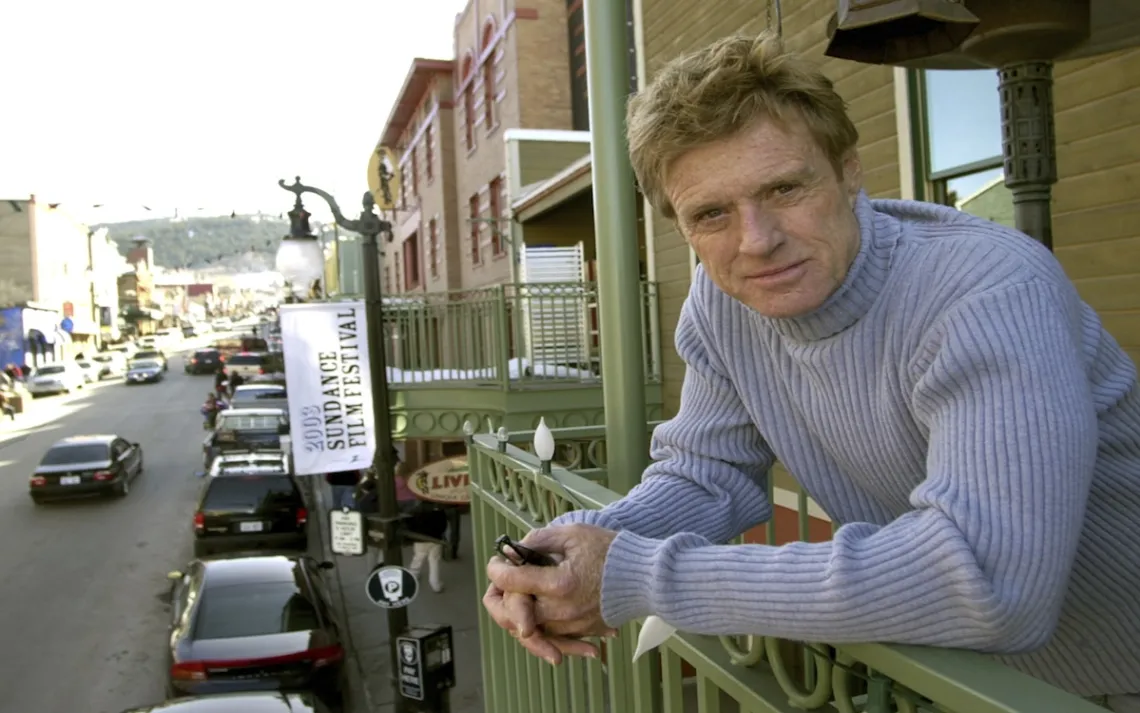
Photo by Douglas C. Pizac/AP
On April 17, 1976, over 500 residents of the small town of Kanab, Utah, cheered as they set fire to an effigy of a movie star wearing a blond wig.
To understand why, back up 22 years before then, to a time when a teenager named Charles Robert Redford Jr. made a detour on a road as he drove back from college in Boulder, Colorado, to his home in Los Angeles. A small ski resort, Timp Haven, occupied the spot he would later call Sundance.
“When I left, I couldn’t shake it off,” he said in Michael Feeney Callan’s biography, Robert Redford. “I lay in bed and thought about it. And whenever I had the chance to go back, I did. It became my favorite long shortcut, the only way to go home. I have a clear recollection of thinking, 'Someday I’d like to put a stake down here.’”
He did just that a few years later when he paid $500 for two acres. The land he found that day, in the shadow of Mount Timpanogos, would change his life. It was there that his love of the West would deepen, and out of that love grew his desire to fight for and protect it.
The first test was the planned construction of a $3.5 billion power plant called Kaiparowits.
*
Robert Redford knew the West.
He had rafted on the Colorado River, trekked into canyons, and, while shooting the timeless classic Butch Cassidy and the Sundance Kid, first encountered the Kaiparowits Plateau.
“Having experienced the beauty and fragility of the area during filming for Butch Cassidy and the Sundance Kid, I just couldn’t accept the idea that constructing a power plant in that location was a good one,” he said to his grandson Conor during one of his very last interviews in Orion magazine.
The Kaiparowits coal-fired plant was first proposed by Southern California Edison in 1965—a massive 3,000-megawatt installation slated to be the largest coal-fired plant in the world. It would have been located in southern Utah, right in the middle of several parks, including Bryce Canyon, Zion, Grand Canyon, and Capitol Reef. The plant, if it had been built, would have polluted both the water and air, emitting sulfur dioxide and nitrogen oxides, as well as potential mercury poisoning. The plant was conceived as a source of power for California markets, a kind of electrical Chinatown.
At the time, Redford was not only exploring the West, he was reading it. Wallace Stegner, who wrote of the region as an arid, vulnerable, and threatened place, was among his favorite writers. Redford began his journey as an environmental activist opposing Kaiparowits, and he very much had Stegner on the brain.
“It was my first major conservation issue,” he told Callan, “and what I discovered very quickly was the mass of ignorance out there. It’s not just the greed of industrialists. It’s the lack of fundamental awareness, a mindset created over 150 years that says Manifest Destiny allows us to do what we will with the land. My passion came from the pages of Wallace Stegner, who prided himself on attachment to the land. We flew over the Escalante rocks, this paradise that had been untouched for millennia, and I thought about what Stegner had written: that here was a place where the silence allows you to hear the swish of falling stars.”
To his credit, Redford did not just lend his famous face to these environmental efforts. As Stegner once wrote, “Environmentalism or conservation or preservation or whatever it should be called, is not a fact, and never has been. It is a job.”
The job required sitting through dull meetings and the dirty work of lobbying. Right away, Redford took to it like an avid student. He did the boring stuff. He worked closely with the Natural Resource Defense Council, learning directly from John Adams, the president of the NRDC, who taught him the sometimes frustrating art of talking to members of Congress, trying, often futilely, to keep them to their words. It turned out they were willing to give some of their time to a movie star, but they could also say one thing to his face and another when it came time to vote.
Of course, he could get some things done many environmental activists could not, such as calling up 60 Minutes, which offered him a national forum to explain how the Kaiparowits plant would destroy the air and water in southern Utah. Redford’s appearance on 60 Minutes resulted in more than 6,000 letters to the show, most opposing the plant.
“I had to be careful,” he told the Deseret News. “I was very much aware of the double-edged sword of being a celebrity because there are a lot of people who resent you speaking out, who feel you have not earned the right, that you do not have the credibility and so forth. So I decided to really look at this plan because, in my gut, I felt it would be a terrible mistake. It was right in the middle of five contiguous national parks and monuments. We already had demonstrations of what other power plants had done to the quality of life in other areas.”
In his fight against Kaiparowits, Redford “requested the assistance of environmental groups, raised money to open an office in Salt Lake City, and hired a small staff to investigate the environmental and economic ramifications of the project.”
In large part thanks to Redford’s efforts and a coalition of environmental organizations, including the Sierra Club, Southern California Edison abandoned its plans to develop the plant.
It was a big victory for the environmental movement, but not everyone was pleased. After the news that the plant would not be built, hundreds of people in Kanab, where many believed the power plant would have been an economic boon, hung an effigy of the actor in protest.
“This is the time and day that we, the people of Kane County, have chosen to put a torch to skunkman Redford, self‐proclaimed voice of the hypocritical obstructionists,” John Nelson, the county engineer, told The New York Times at the time.
Redford was nonplussed. From Stegner, he had learned the timeworn ideal of stewardship of the land. Adams believed that the experience taught him a valuable lesson. In his autobiography, A Force of Nature, Adams remembered: “In Kanab, Utah, Bob was burned in effigy by people who blamed him for the loss of jobs and cheap energy. They called him an extremist and a backpacking kook. His family received threatening letters. He had been in the lion's den. One was that the bitterness that had marked the fight against Southern California Edison was something to be avoided, if possible. Perhaps there was a way to bring all parties in a dispute to the table and see what common ground existed to pursue this idea.”
The rest of Redford’s career as an environmentalist would be marked by a search for that common ground.
*
As for Kaiparowits, in 1996, Redford celebrated the creation of Grand Staircase-Escalante National Monument, which included the land where the Kaiparowits power plant would have been built. He’d fought hard for Grand Staircase, a then 1.7-million-acre expanse of land, with President Clinton singling him out as a key influence in the effort to create the monument. He stood beside Clinton during the official declaration.
Unfortunately, Clinton’s team decided to have the dedication ceremony not in Utah where the monument would be, but on the South Rim of the Grand Canyon in Arizona. No one, least of all Redford, understood why, perhaps out of a somewhat understandable fear of angry locals. This move was regarded as a perfect example of the hypocrisy of outsiders determining the fate of Utah’s land. Though Redford was far from an outsider at that point, having lived on and off in Utah for 35 years, he would always be regarded that way by some.
As for the small towns like Kanab bordering Grand Staircase-Escalante, the hotbeds of the anger about the declaration where the movie star was hung in effigy, the outrage gradually died down.
For now the wilderness protections are holding. But, as Redford would learn over the years, environmental victories can be tentative until there’s another reason to step forward and take a stand to protect our land, air, and water.
Robert Redford, during his life, did just that.