All Aboard the Mardi Gras Service
Twenty years after Hurricane Katrina, Amtrak has revived a railway connecting Gulf Coast communities
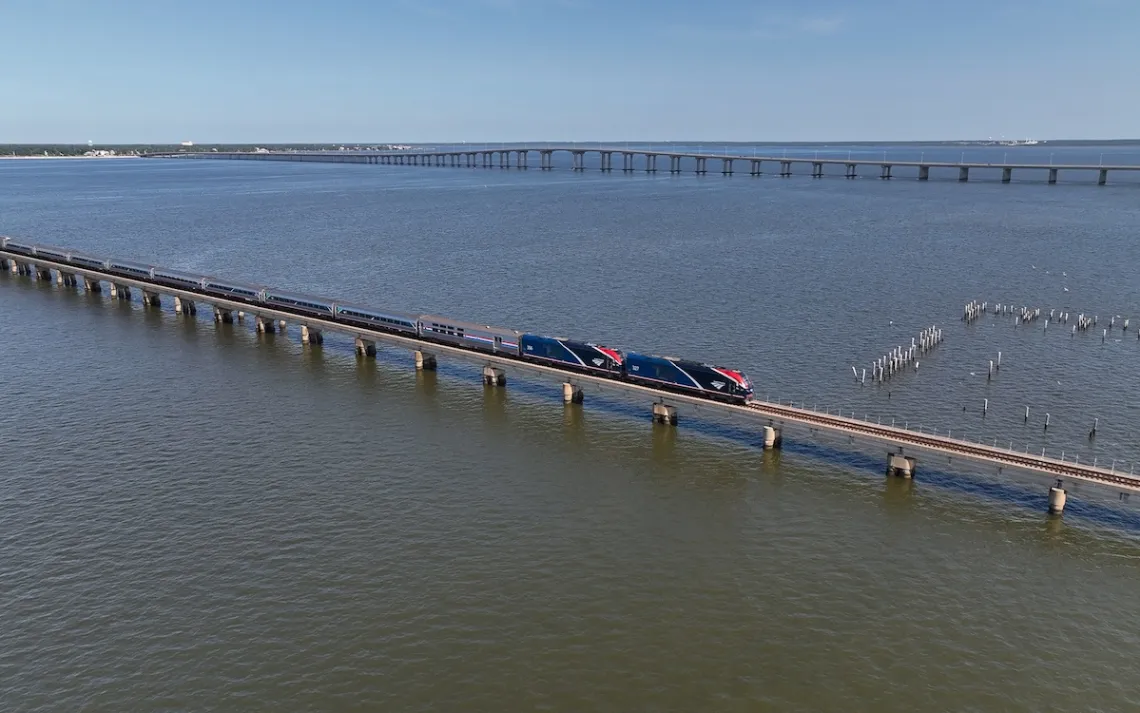
The Eastbound Mardi Gras Service crosses the Bay of St. Louis in Mississippi. | Photo courtesy of Amtrak via the Southern Rail Commission
On the morning of August 18, Rebecca Finlay and her daughter, Grace, boarded a train in Biloxi, Mississippi, bound for New Orleans. The pair were en route to celebrate Grace’s birthday with typical New Orleans activities: a walk through the French Quarter and a visit to the Audubon Aquarium. But this wasn't an ordinary day trip. They were joining hundreds of other passengers on the inaugural journey of Amtrak's Mardi Gras Service.
For the first time since 2005, when Hurricane Katrina devastated communities across the Gulf Coast, the region has a dedicated passenger train service. The return of passenger rail isn’t just about restoring what was lost after Katrina. Along with providing a sustainable alternative to driving, the new Mardi Gras Service was built with today’s Gulf South in mind: It links the popular destinations of New Orleans and Mobile, Alabama; it follows a convenient schedule; and it connects communities that have been underserved by American rail.
Before it became the Mardi Gras Service, the train line from New Orleans to Mobile was part of the Sunset Limited Service, one of the oldest passenger trains in the country. Amtrak acquired the line in 1971, and it eventually stretched from Los Angeles to Orlando, Florida.
But the storm on August 29, 2005, and its aftermath rendered the rail line from New Orleans to Orlando inoperable until early 2006, when freight trains began operating along it once more. Those tracks would not see a passenger train for another two decades.
During those years of suspended service, Amtrak explored options for funding a train that would serve people living on the Gulf Coast. The company considered reinstating the New Orleans–Mobile line as part of the Sunset Limited Service, but the long-haul focus of this route would result in stopovers along the coast at odd hours of the day, which wouldn’t work for locals or people touring the region.
“Returning to the Gulf Coast with a 1970s map was not going to be the kind of reliable and relevant service that it could be if it was twice a day and a shorter distance,” Marc Magliari, the senior public relations officer at Amtrak, said. “So we came back with what we believe is a more relevant and more reliable service than what was there before.” Amtrak chose the train’s name with the region’s culture in mind; both New Orleans and Mobile are widely known for their Mardi Gras celebrations.
“If you ride our train, you look out during part of it, and we're over water. It's like we're floating on top of it. It is a much prettier way to see the Gulf Coast.”
The freight company CSX spent $300 million to reopen the railroad tracks along the Gulf Coast five months after Katrina, but federal law made adding passenger lines more complicated. “Congress passed a law in 2008 dictating that service of this short of distance—750 miles or less—has to be locally supported by the state or by a regional organization. So the service is funded in part by the Louisiana Department of Transportation and Development, the Mississippi Department of Transportation, and the City of Mobile,” Magliari said.
The Mardi Gras Service opened at a high point for the coastal cities of Pascagoula, Biloxi, Gulfport, and Bay St. Louis. In the years since Katrina battered and flooded them, the towns have nearly fully recovered.
“The three coastal counties that make up the shoreline of Mississippi, from the Louisiana line to the Alabama line, were obliterated. Ninety percent of the city of Pascagoula was underwater. Imagine waters of up to 20 feet coming in from the gulf, combined with the high winds and tornado spin-offs. That's what it looked like 20 years ago,” said Paige Roberts, the president and chief executive officer of Mississippi’s Jackson County Chamber of Commerce. “What it looks like now is a prospering area. You will find quite a bit of rebuilding and growth and a really strong community spirit of resilience.”
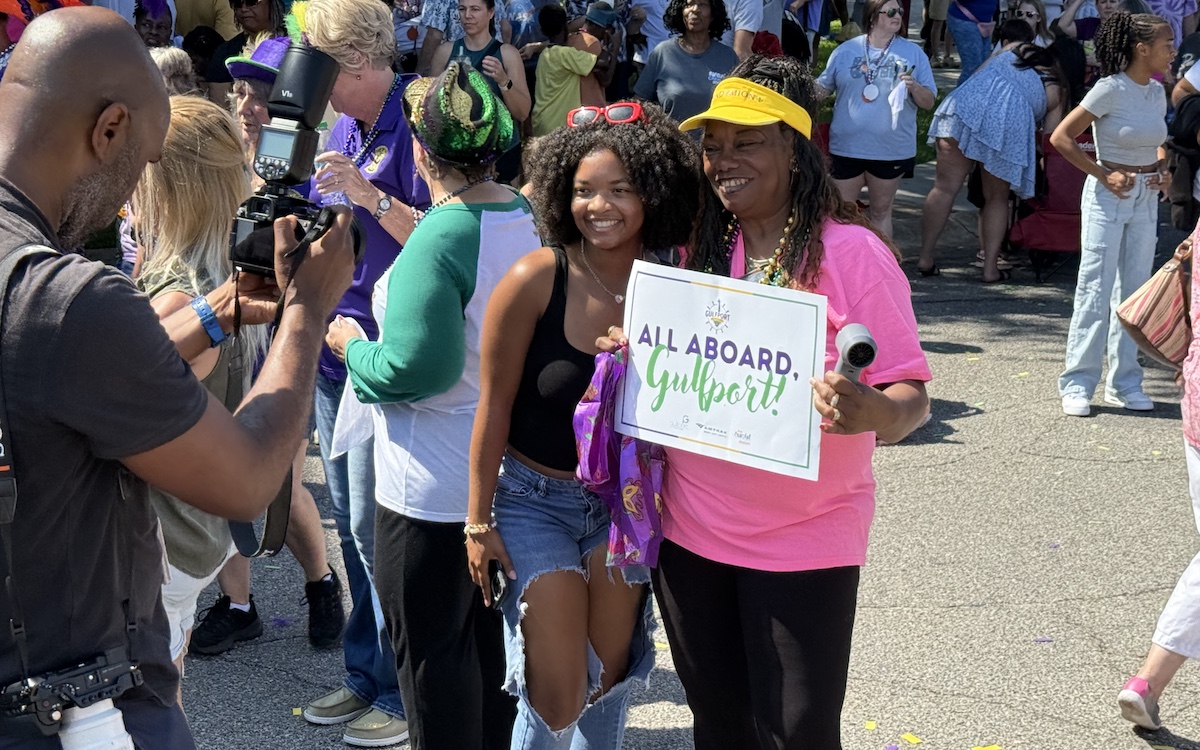
Residents of Gulfport, Mississippi, celebrate as the Mardi Gras Service makes its first stop there. | Photo courtesy of Amtrak via the Southern Rail Commission
Roberts noted an uptick in tourism in coastal Mississippi. “We’ve had an increase in occupancy stays in the counties across the coast, and that is not just since Hurricane Katrina but since the BP oil spill of 2010 and the economic downturn of 2008. Covid was a big hit to tourism, especially, but we in coastal Mississippi, for a variety of reasons, are doing quite well today in August of 2025.”
The addition of the Mardi Gras Service has made New Orleans a railroad hub in its own right. It now has more Amtrak connections than either Houston or Atlanta. “By running the Amtrak Mardi Gras Service twice a day each way, plus the daily City of New Orleans, plus the daily Crescent, there’s more Amtrak service in New Orleans than it has had since Amtrak began,” Magliari said.
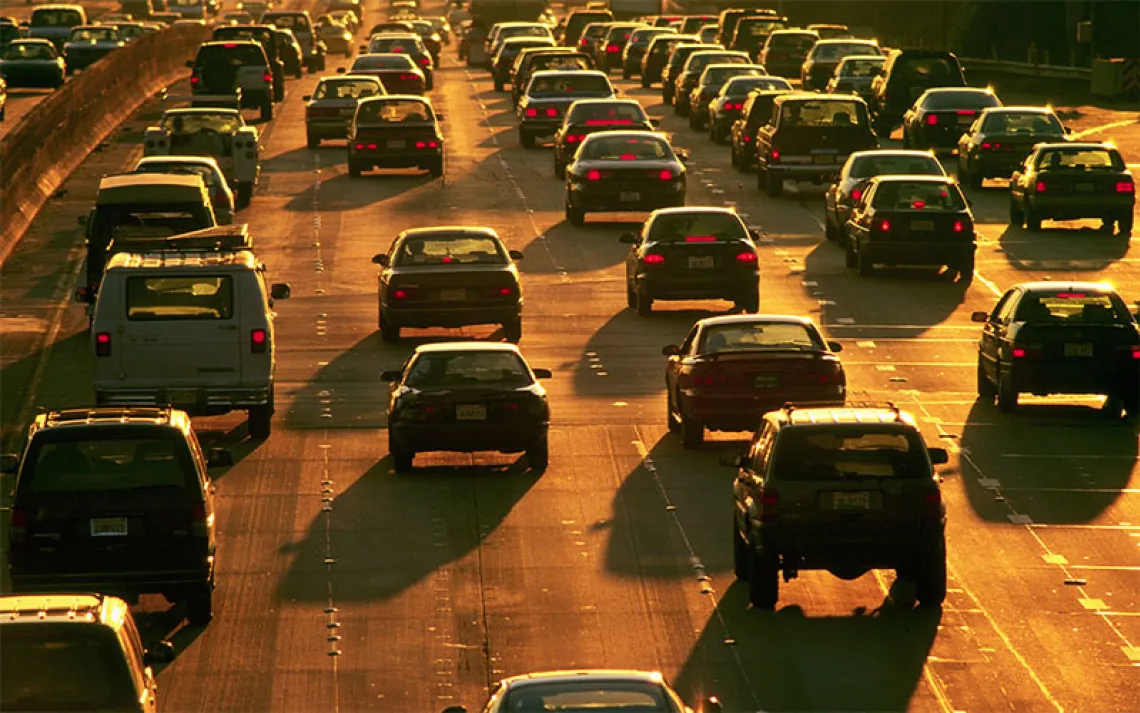
The Mardi Gras Service could play a role in strengthening tourism in the Gulf South further, because it runs parallel to the primary route that connects the region: Interstate 10. Although the commute from New Orleans to Mobile takes nearly four hours via train, versus two and a half hours via car, Magliari is confident that the benefits of railroad travel will attract passengers. He mentioned some perks of the Mardi Gras Service—including its region-specific menu with Moon Pies, Abita beer, and muffuletta sandwiches and the fact that one-way tickets start at $15.
“Our primary competition is driving, but if you can give people a reliable option on a decent schedule with attractive fares, at least from time to time, they won't need or want to drive their car,” he said.
Magliari pointed to the monotonous experience of car travel as passenger rail’s greatest marketing tool. “I-10 is the biggest argument for this train. Anyone who's driven on I-10 knows that there has to be a better way to get across the Gulf Coast than I-10. It's well maintained and it's safe, but it certainly isn’t pleasant seeing the same chain restaurants, the same billboards, all day long, both ways,” Magliari said. “If you ride our train, you look out during part of it, and we're over water. It's like we're floating on top of it. It is a much prettier way to see the Gulf Coast.”
While the diesel-based Mardi Gras Service is not the greenest way to travel, it’s less harmful to the environment than cars.
Cars produce around nine times more carbon dioxide per person per mile than diesel rail, according to a report by the UK’s Rail Delivery Group. Electric vehicles, often seen as the greener alternative, still emit about 2.5 times more CO₂ per passenger-mile than trains. (Of course, electrified railroads are far and away the most efficient and environmentally friendly form of transportation, but so far Amtrak offers only two such lines: the Northeast Corridor and the eastern portion of the Keystone Corridor.)
Beyond its convenience and environmental benefits, the Mardi Gras Service could serve a larger purpose in strengthening ties across the Gulf Coast. On the line’s first day in operation, many of the 247 passengers were local residents enjoying a new form of transport that made it easier to visit family and recreate.
Edward Holloway, who is from Daphne, Alabama, took a round-trip journey on the Mardi Gras Service starting from Mobile.
“I’ve been waiting a long time for this train to come back. I used to always take the Sunset Limited from Los Angeles, and the one from Portland, the Empire Builder,” Holloway said. He plans to take the new line frequently to visit his sister in Biloxi.
Finlay, who plans to take more New Orleans day trips by train, said she had a personal connection to the Mardi Gras Service. For the first time in her life, she was able to take the same route that her family once rode and operated.
“My great-grandfather used to work this line at Bay St. Louis, when this was L&N Rail, and my mom used to take the train a lot because she went to Loyola in New Orleans. So I feel like we have lots of generations riding the train with us today,” she said.