 The Magazine of The Sierra Club
Montana’s 2026 Fire Season: Puzzling Winter, Meet Potential Powder Keg of a Summer
The Big Sky State offers a lens into what could be an epic wildfire season nationwide
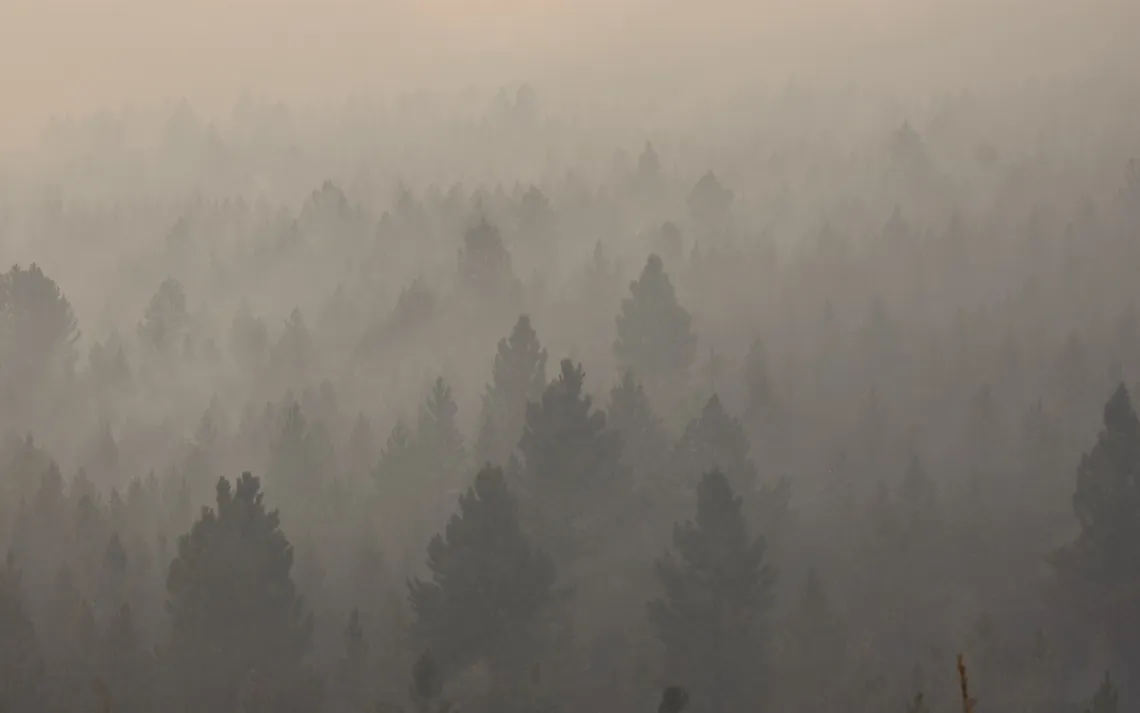
A 2021 wildfire near Ashland, Montana. | Photo by Matthew Brown/AP
Montana’s fire outlook appears less like a single headline than a nuanced pile of uneasy questions. Meteorologists point to the warm, wet winter that rearranged snow and soil across the Big Sky State. Forecasters say this swath of Northern Rockies meets “normal” fire season criteria for now, and climatologists expect El Niño conditions as early as June, with a one-in-three chance Pacific currents will amplify into “super” El Niño territory. For Montana, that typically translates to more precipitation in the short term, but ultimately, drier, hotter conditions.
Meanwhile, local fire ecologists and conservation advocates caution that shifting climates, constrained agency capacity, and development at wildlands’ edge render even an ordinary fire season risky for Montana communities.
According to the NOAA and the National Weather Service, 2025–26’s winter was among the warmest on record, especially across western Montana.
“Kalispell, Missoula, and Butte experienced their fourth, second, and all-time warmest winters of all time,” National Weather Service meteorologist Alex Lukinbeal told Sierra, noting that precipitation at many sites currently measures near or above normal, with the Lower Clark Fork basin, which covers most of western Montana, running at 115 percent of its normal precipitation.
The result? An unusual snowpack profile: Low- and mid-elevation snow melted out early in March, leaving most lingering snow above roughly 6,000 to 7,500 feet.
“That’s what everyone is scratching their heads about,” says Carl Seielstad, a University of Montana fire ecologist. “We had a decent snowpack up very high, like above 7,500 feet, and almost no snowpack below that, which is unusual. A warm winter enabled our soil to become totally saturated, so there’s a lot of water in the ground.”
That combination—high-elevation snow reservoirs and wet soils lower down—creates a complicated starting point for fire season planning.
Lukinbeal adds that a warm spring—which included a week-long heat dome across most of the state in March—also saturated soils at low elevations, producing an “early, robust green-up, especially in western Montana.” According to the National Interagency Fire Center (NIFC), spring moisture and early green-up are, in the short term, likely helping to counteract Montana's early wildfire potential by accelerating the growth of grass and brush, particularly in central grasslands and eastern plains, and turning thick fields of green grass into dry, flammable tinder come July and August.
“Some of the winter’s water will run off early in rivers and streams; some remains stored underground and in fuels,” Seielstad says, “slowing drying in places, and accelerating it elsewhere.”
NOAA’s Climate Prediction Center gives Montana a 50 to 60 percent chance of above-normal summer temperatures, and a 30 to 50 percent chance of below-normal precipitation in the state’s western half. “Driving this pattern is a rapid transition into El Niño, with an 80 to 90 percent probability of El Niño conditions taking hold by mid-summer,” Lukinbeal told Sierra, pointing to 2009 and 2023 as useful analog years.
Those analogs, Seielstad says, suggest a hot, dry start to the season in June and July, with possible relief in August. “The current expectation from predictive services is a normal fire season in the Northern Rockies through July,” Seielstad says, adding that in Montana, “normal” still means fires. “Normal is pretty active.”
NIFC reports caution that southwest Montana in particular could be vulnerable. Temperatures trended closer to normal in April than in previous months, but still, southwest Montana continued to be a warm spot.
Lo Choe, owner of Aura Fire Safety, says Montanans should be wary of scenarios wherein official season outlook maps aren’t as bad as they should be. “Early green-up, in particular, can lead to grass and brush curing way earlier than usual. Fuels that were initially dulled can later on in the summer pose extreme structural danger—causing fires with immense power to spread—if and when the right combination of wind, heat, and human activities align,” Choe said.
Seielstad urges attention to June as a critical month: Historically, western Montana receives significant precipitation in early June before drying.
“If we get to the Fourth of July and it’s crispy and brown, we’re in for a real fire season. If it’s still green, it’s kind of a normal season,” Seielstad says. But he emphasizes the limits of seasonal forecasts. “These long-lead forecasts are dicey. Meteorologists will tell you the best evidence suggests a path, but in reality we won’t know what happens until we get into the fire.”
Local NWS coordination with land management and fire agencies helps to identify hot spots. Meanwhile, regional centers like the Northern Rockies Coordination Center provide more granular outlooks. Some of Montana’s close neighbors—northeastern Washington and northern Idaho—are trending toward above-normal activity in July. Still, the Northern Rockies themselves, Seielstad says, appear as an “island of normal” amid heightened risk to the west and south. This leaves communities and land managers facing different challenges, even within relatively short distances.
“Policy can help a lot, by focusing the right kind of work in the right places to mitigate fire risk,” says Barb Cestero, Montana state director for The Wilderness Society. But she warns that recent federal policy directions have weakened the state and counties’ capacity to do that work. “The administration’s firings, forced retirements, and slashed funding of lands management agencies are resulting in declines in fire mitigation project implementation,” Cestero says, noting that mitigation implementation (like mechanical thinning of forests) has fallen by nearly 40 percent, and that prescribed burning, in particular, has dropped precipitously.
No matter what the 2026 fire season holds, Cestero argues all this reorganization of the US Forest Services and other agencies, and the “divorcing” of fire suppression from broader public-land stewardship, is undermining long-term resilience.
“When you remove land management considerations from wildfire management, you can end up with an all-out suppression approach that causes fuel buildup and overgrowth of the things that fuel mega-fires,” she says. For Cestero, the answer lies in a blend of full funding for agencies, focused fuels treatments near communities, and conservation-minded policies that keep wildlands intact where appropriate. “Conservation is an effective fire-management practice,” she says. “That needs a role alongside fuel treatments and prescribed fire.”
For Montana, experts unanimously endorse targeted, place-based treatments concentrated near homes, watersheds, and infrastructure. Seielstad notes that landscape-scale fires themselves sometimes act as the most effective fuel treatments, citing the Missoula-area Lolo Peak Fire of 2017 as an example.
“That fire probably helped protect Missoula and the Bitterroot Valley from another fire of that scale for 30, 40, 50 years in how it treated the fuels and now has protected us,” Seielstad says. He recommends statewide adoption of strategic use of natural fires where safe and politically feasible, guided by extensive planning and public engagement.
For homeowners, experts encourage local, practical steps. “People should focus on things close to their homes they can control: mowing, removing vegetation, rearranging flammable items like woodpiles,” Seielstad says.
Lo Choe elaborates, advising, “At least 100 feet of defensible space to start with, lean clean green zone between zero to 30 feet from the home, maintenance agreements for treated subdivisions, fuel breaks around communities, stronger water infrastructure and strategically located suppression resources.”
The Forest Service’s Rocky Mountain Research Station rolls much of its wildfire data, modeling, and mapping into the Wildfire Risk to Communities website, which aims to help community leaders and forest managers assess and mitigate wildfire risk according to zip code.
On a more structural level, Cestero emphasizes working with local, state, and federal partners, and retaining policies that reduce risky development at the wildland-urban interface. “Building homes right up along our public land boundaries increases the odds of human-caused fires,” she says, pointing to new Wilderness Society research showing ignitions are much more likely near roads than in roadless forests.
All together, signals point to a season of ambivalence. “But we’re moving in a direction where we’re thinking more fire is the norm,” Seielstad says. “At some level, we have to get fire back on the landscape to restore that resilience. But we have to do it in a way that acknowledges the very real threat megafires pose to our communities.”
For Montana residents, the advice is straightforward if sobering: Prepare locally, support sensible fuels reduction and restoration projects in the right places, and press for the staffing and funding that let agencies do prevention work before the next smoke season begins. In a changing climate, Seielstad notes, the question isn’t whether there will be fires—it’s which ones we let shape the landscape and which ones we prevent from shaping our communities.