What Minnesota Can Teach Us
A tribute to those standing up to protect a just and loving America
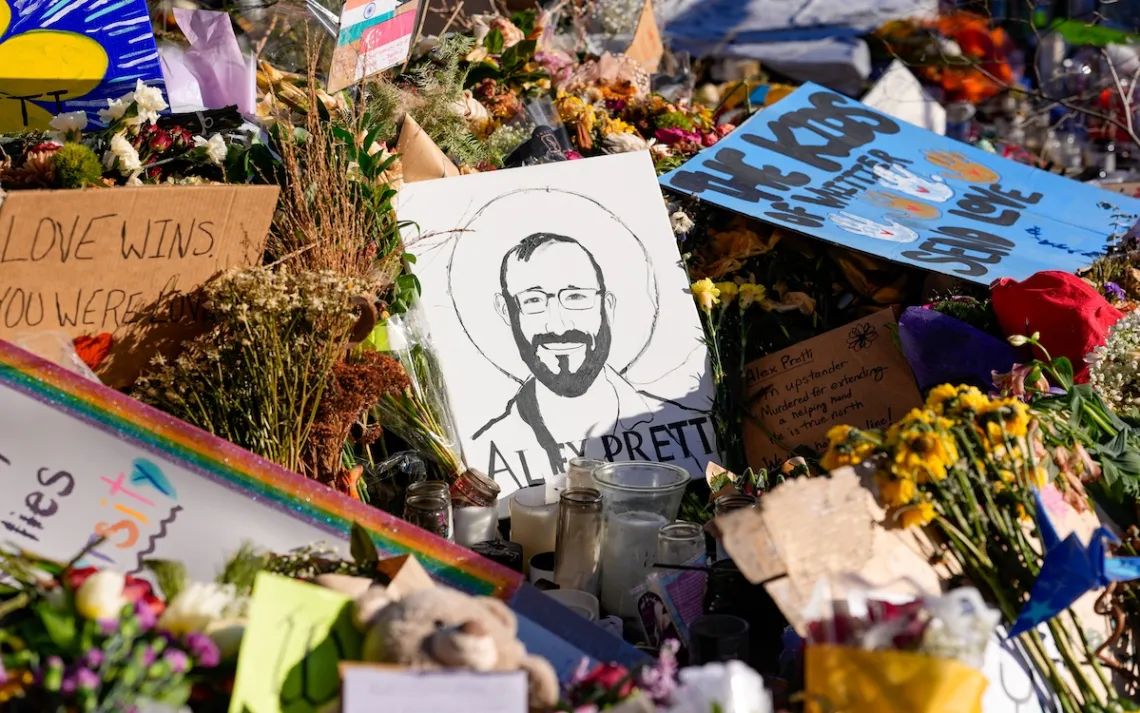
Photo by Jen Golbeck/SOPA Images via AP
It was in Minneapolis where I discovered freedom.
Where the hard pavement ends and the earth’s surface returns to soil, cottonwoods rise like guardians and trails run through them. Here, hidden amid the neighborhoods and freeways, are places where nature is still sovereign. Though it wasn’t until high school, when I purchased my first mountain bike, that they became my refuge.
Every city has those places where nature, however modified, still rises unimpeded. Minneapolis—with its many lakes, broad rivers, and tightly knit civic culture—has many such gems. I remember the first time I pedaled into the trails around Brownie Lake, an urban pool hidden on the city’s western fringe. Even with Highway 394 looming, it felt like a secret here, where herons stalked among lily pads and warblers trilled in humid summer air. High school was a gauntlet, but here I felt liberation.
As I explored a bit farther afield, I discovered the invitingly sinuous trails along the Minnesota River, just before its confluence with the Mississippi, where pileated woodpeckers cackled and fallen trees and even a Huck Finn–style raft provided passage across murky backwaters. The air, sweet and musty, smelled of growth and decay at once, all possibilities existing simultaneously.
Here, amid quiet beaver ponds and jungly bird calls, removed from the blare of the human world, was a serene aliveness. It soaked into me. In time, I chased that feeling West, where I settled in Montana.
The other day, as I emerged from a wilderness retreat, I re-entered cell service to find my phone flooded with messages. It was distraught friends from Minneapolis. Look at the news, they said.
Alex Jeffrey Pretti, a nurse to military veterans, had been shot in the back by masked agents of his own government. Two pictures of him standing with his mountain bike were circulating online, and he wore the same joyful smile in each. I didn’t know Alex, but I recognized his ebullience: This was a young man who loved to ride. He even rode a Surly—that Minnesota-based maker of sturdy, simple, steel bikes—like I sometimes do. He lived not far from where I grew up and was murdered only blocks from where I first rode a tricycle on the sidewalk as a child.
Pretti surely rode the same trails I did, at Brownie Lake and along those riverside ribbons. I imagine that, like me, he found relief in the wild from the pressures of his world. We came for exploration and adventure. We returned in some ways enriched. This is the spirit our country was founded on.
*
All great atrocities begin with dehumanization.
Pretti’s final words, “Are you OK?,” spoken to an unarmed woman he was shielding from pepper spray, revealed him as a kind, protective soul. His parents told The New York Times that he was dismayed by this country’s recent rollback of environmental protections. His involvement in Minneapolis’s widespread protests showed his outrage at the cruel treatment of asylum seekers, the heartless traumatizing of children, and the killing of those who resisted. His defense of the vulnerable is a hallmark of an ethical man.
Yet Kristi Noem, the secretary of the Department of Homeland Security, immediately labeled Pretti a domestic terrorist after he was killed, just as she had Renée Good, who told an ICE agent, “I’m not mad at you” a moment before he shot her dead. This follows years of President Trump falsely demonizing desperate immigrants seeking better lives for their children as animals, violent criminals, and worse.
Such rhetoric is poison. All great atrocities begin with dehumanization.
It’s no coincidence that people of color are the ones being targeted. None of this was ever about arresting criminals. The vast majority of people being rounded up have no criminal record. Many are innocent children, such as Liam Conejo Ramos, the five-year-old boy wearing a bunny-eared hat and a Spider-Man backpack when he was arrested by ICE with his father. Many are legal refugees and asylum seekers. There’s no small irony in President Trump accusing a VA nurse of being a professional agitator while the government pays undertrained ICE agents $50,000 signing bonuses.
What are we to take from all of this?
That if we stand against cruel brutality, as Alex Pretti and Renée Good and many others less well known did, we too can be struck down. That our leaders will lie about the circumstances, and some of our own countrymen will celebrate our killing.
So much of this violence and tribalism is driven by fear, and the incitement and exploitation of that fear for profit and power. Those who take it as their creed will only continue down a dark path of history. They do not realize that fear can only be truly healed by love, for ourselves and others, and that security is only durably achieved by mutual support. Domination can never deliver true safety.
I’m reminded of the Stevie Wonder song “Big Brother,” with its devastating closing lyric: “I don't even have to do nothing to you. You'll cause your own country to fall.”
*
As nonviolent, peace-loving people, many of us are seeking ways to stand against this insanity in a sane way. Pretti and many others in Minnesota are showing us how.
There is a deep moral harm being inflicted throughout Minnesota and on our country. As nonviolent, peace-loving people, many of us wonder what we can do. How do we break this destructive cycle?
We start by taking care of our ourselves and drinking from fortifying springs. Natural places heal and restore. We can return there, the world from which we came, to ride bicycles, walk, or simply sit and listen to birdsong. As Buddhist monk and poet Thich Nhat Hanh wrote, “Peace in the world starts with peace in oneself.”
Forests and rivers and natural areas nourish us while also serving as exemplars of resistance. They defy artificial simplicity with magnificent complexity, sterility with fecundity, domination with interdependence, confinement with freedom. Like flowers sprouting in sidewalk cracks, the elemental power of nature, some of which resides in each of us, cannot be long suppressed. Forests can be cut down, but they can also grow back.
We can learn from this as we seek ways to stand against insanity in a sane way.
Pretti and many others in Minnesota are showing us how—by coming together, trees joining at the roots, and taking to the streets. Thousands of cyclists in the city, organized by the community bicycle shop Pretti frequented, and supported by several Minnesota bicycle brands, even came together for a massive memorial ride on January 31 with temperatures well below freezing. Many wore yellow vests emblazoned with the words “Peaceful observer, don’t shoot.”
Sierra Club North Star Chapter program manager Joshua Houdek was there. Though he’s participated in various group rides for over 20 years, he’d never seen a turnout like this, and in mid-winter Minnesota no less. “The mass of people on bikes stretched for a mile—as far as the eye could see,” he says.
Despite the tragedies, the people of Minneapolis are showing us that there is still power in moral resistance and standing up to protect the vulnerable. All these years later, the city and its indomitable community spirit continue to teach me about freedom. We can all look there for a reminder of what a humane America can still be.