Republicans in Congress Push “Climate Shakedown” Bill That Permanently Shields Big Oil From Accountability
Climate advocates say the new bill would give the fossil fuel industry a "get out of jail free card"
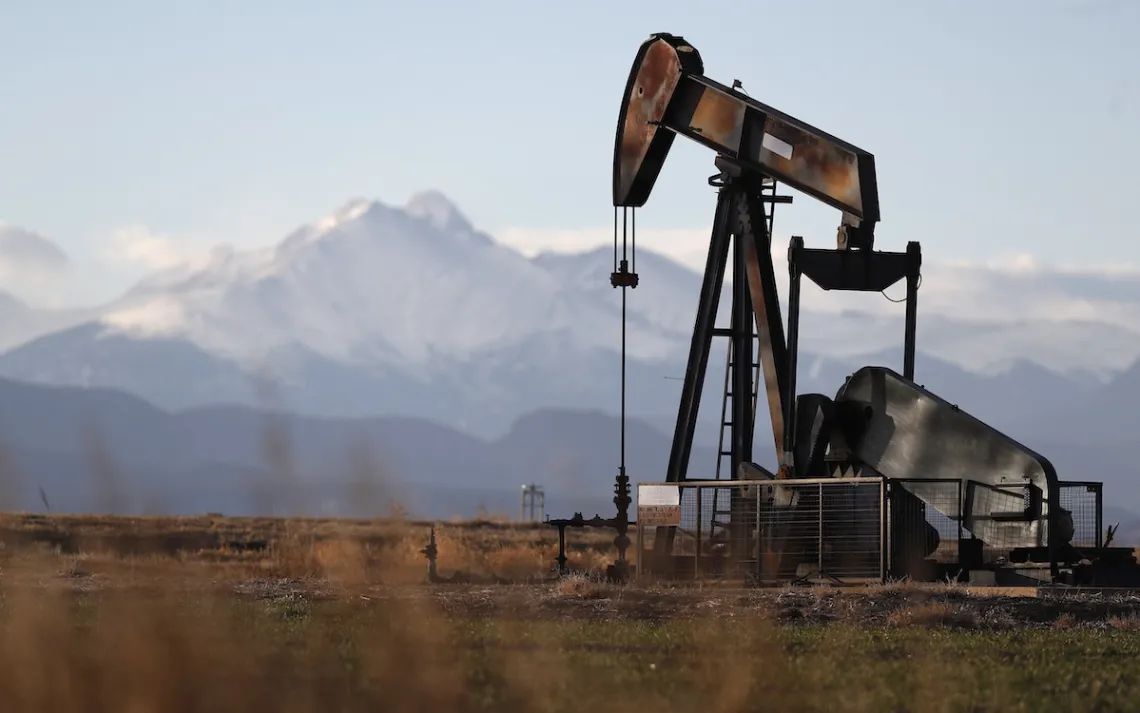
A pumpjack over an oil well along Interstate 25 near Dacono, Colorado. | Photo by David Zalubowski/AP
In April 2025, following a meeting with oil company executives at the White House, President Donald Trump issued an executive order directing then–Attorney General Pam Bondi to prevent states from holding the fossil fuel industry accountable for fueling the climate crisis. The Department of Justice then promptly sued New York and Vermont, challenging their polluter pays “climate superfund” laws. It also brought highly unusual suits against Michigan and Hawai'i that sought to preemptively block them from suing oil and gas companies. Those suits have since been dismissed.
Now, a year later, Republicans in Congress have taken Big Oil’s efforts to evade climate accountability even further by advancing a proposal that would permanently shield the industry from lawsuits and other liability measures.
Representative Harriet Hageman (R-Wyo.) and Senator Ted Cruz (R-Tex.) recently introduced federal legislation called the Stop Climate Shakedowns Act, which would grant sweeping legal immunity to the fossil fuel industry over its role in driving what scientists warn has become a climate emergency.
The bill prohibits liability against entities engaged in any segment of the fossil fuel supply chain. It would stop new climate lawsuits from being filed in federal and state courts and require all pending suits be immediately dismissed. Under the law, if enacted, polluter pays laws—which the bill refers to as “energy penalty laws”—would be overturned.
Additionally, it asserts that the regulation of greenhouse gas emissions and climate change is “governed exclusively by federal law.”
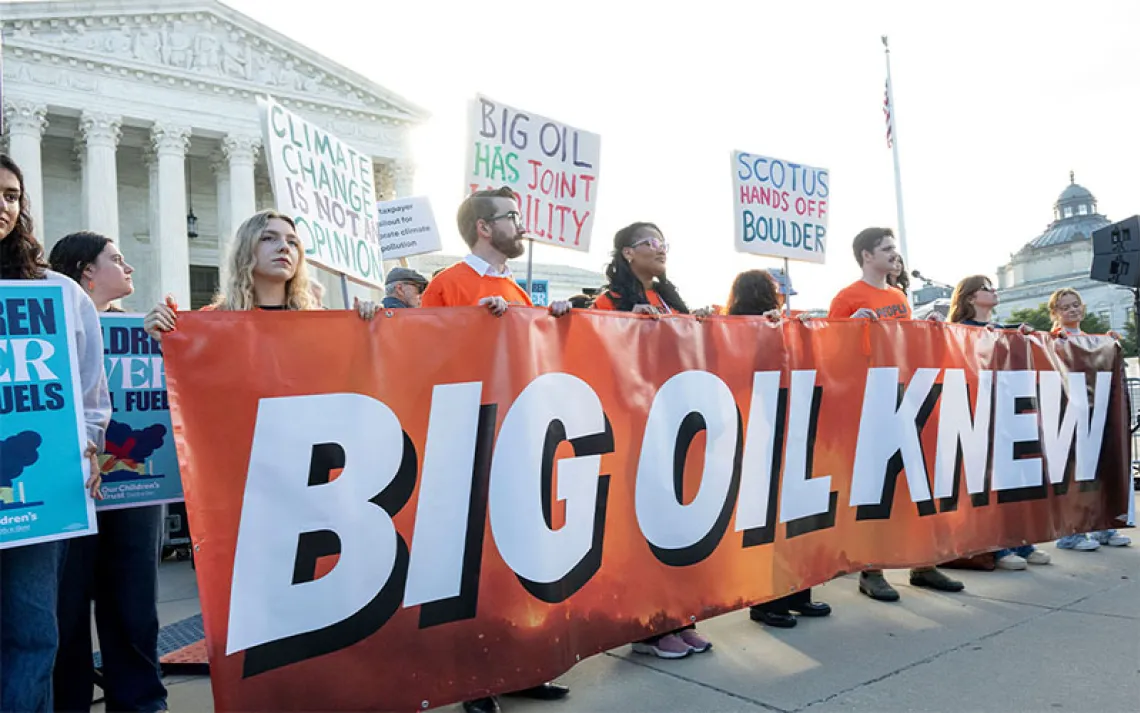
The bill is part of an escalating campaign that Big Oil and its political allies are waging to block any effort to hold the industry accountable as the climate crisis intensifies. Dozens of communities and states across the country have filed climate-related lawsuits against the fossil fuel industry, and some are getting closer to trial. Meanwhile, a handful of states are considering adopting climate Superfund laws like the ones enacted in Vermont and New York. A few states are also considering bills that aim to hold fossil fuel companies accountable for the climate-change-driven crisis in the homeowners’ insurance market. And legal experts have even floated the idea of pursuing criminal charges like homicide against the industry for deadly extreme weather events intensified by climate change.
“Our communities are paying the price for climate damage, and the polluters who are perpetuating the problem and who have lied about it for quite some time are continuing to try to stick them with the bill.”
The big polluters strike back
The oil and gas industry, backed by Republican officials, has mounted a counteroffensive to try to shut all of these efforts down.
Earlier this year, the American Petroleum Institute said that stopping “extreme climate liability policy” was among its top priorities in 2026. API has spent months lobbying Congress on “draft legislation related to state efforts to impose liability on the oil and gas industry,” according to lobbying disclosure reports. ConocoPhillips has also lobbied the House and Senate on “draft legislation regarding state superfunds.”
The lobbying effort has started to pay off. API and the American Fuel & Petrochemical Manufacturers issued a joint statement thanking Cruz and Hageman for introducing legislation “to stop a growing patchwork of state laws and lawsuits that threaten American energy and risk raising costs for consumers.”
The bill from Cruz and Hageman comes amid an unprecedented fossil fuel energy crisis spurred by Trump’s war with Iran. The conflict has driven up fuel costs for consumers while major oil firms reap significant windfall profits.
“This continues to be an affordability issue,” Mahyar Sorour, Sierra Club director of Beyond Fossil Fuels policy, told Sierra. “Our communities are paying the price for climate damage, and the polluters who are perpetuating the problem and who have lied about it for quite some time are continuing to try to stick them with the bill.”
Jason Rylander, legal director of the Center for Biological Diversity’s Climate Law Institute, called the proposal from Cruz and Hageman a “despicable attempt to give Big Oil special treatment and a shield against being held accountable for the immense damage it does to Americans and our environment.”
“The oil and gas industry is trying to get a get out of jail free card that would grant them complete legal immunity from being held accountable for fueling the climate crisis, driving wildlife to extinction, and harming communities all around the country,” Rylander told Sierra.
Some Republican-led states have already enacted legislation to shield polluters from liability for climate damage. Utah was the first state to adopt such a law, and Tennessee, Oklahoma, and Iowa have followed. And the Department of Justice’s attempts to crack down on states for pursuing climate accountability continues. On Monday, the department sued Minnesota, seeking to stop the state’s climate fraud case against the industry in its tracks.
Congressional Democrats on the record
Democratic lawmakers on Capitol Hill are starting to speak out against the federal fossil fuel immunity bill. Sierra reached out to a handful of Democrats in both the Senate and House, asking for their response.
“Big Oil has long known of the danger it poses to our democracy and to our climate, and we need to protect our ability to hold these companies accountable. We shouldn’t be shielding Big Oil—we should be shielding communities from climate harm,” said Senator Ed Markey of Massachusetts.
“These companies are just taking a page out of Big Tobacco’s playbook—attempting to skirt regulation and stop us from bringing enforcement actions against their specific industry,” Senator Richard Blumenthal of Connecticut said.
“In the United States alone, the fossil fuel industry enjoys a $700-plus-billion per year pollute-for-free subsidy, the biggest in world history,” said Senator Sheldon Whitehouse of Rhode Island. “Now they want not just to pollute for free but to operate outside the civil law, free of consequences. Everyone should be disgusted.”
Senator Chris Van Hollen of Maryland, champion of the Polluters Pay Climate Fund Act, which is cosponsored by Senator Markey, said, “Republicans want to give Big Oil a license to pollute with impunity and leave it to taxpayers to pay the costs. This is exactly the kind of special-interest grift that the American people are sick of.”
“The Stop Climate Shakedowns Act is a bailout for an entire industry that spent decades lying to the American public about the damage its products were causing,” said Representative Mike Levin (CA-49), a vice chair of the House Sustainable Energy & Environment Coalition (SEEC). “They funded the science to understand that damage, they saw the projections, they spent millions burying it, and now they want Congress to guarantee they never pay a dime for the consequences.”
“Once again, Republicans are prioritizing polluters over our planet and the well-being of the American people,” said Representative Paul Tonko (NY-20), co-chair of the House SEEC. “Shielding Big Oil from facing accountability for the damage they have caused is a slap in the face to the very concept of justice and to the countless who have been harmed by the fossil fuel industry.”
And Representative Suzanne Bonamici (OR-01), also a vice chair of the House SEEC said, “Granting immunity to oil and gas companies is immoral and would further harm people across the country who are already burdened by surging electricity bills, higher property insurance, and unaffordable healthcare costs.”
What happens next?
The liability shield legislation has been referred to the House and Senate Judiciary committees and has so far not seen further movement. As E&E News reported, the bill is “highly unlikely to secure the 60 votes needed in the Senate.”
If Republicans were to try to advance it, they would likely have to tack the bill onto some must-pass legislative package such as an appropriations or reconciliation bill.
“I think the likelihood is low that they will have the ability to pass it in regular order. But we are closely tracking ongoing conversations around budget reconciliation,” Sorour told Sierra. “There is a chance that Republicans may try to sneak this into that partisan, Republican-led effort.”
A similar immunity proposal that would have shielded pesticide companies from lawsuits over health hazards from using products like RoundUp was slipped into the Farm Bill, but it received bipartisan pushback and was ultimately stripped out.
The battle over the attempt to shield Big Oil from climate liability appears to be unfolding along partisan lines. A press release from Hageman’s office announcing her bill said it is intended to “protect American energy from leftist legal crusades.”
Climate and environmental activists have already been organizing in opposition to the fossil fuel industry’s immunity push. A petition calling on lawmakers to take a stand against it is expected to be delivered soon.
“We are grateful for members of Congress and others who continue to speak out against this attempt for the industry to get a get out of jail free card,” Sorour said. “We’re doing our best to sound the alarm and ensure the oil and gas industry doesn’t get to sneak this by without a fight.”