Living Ecosystems Designed to Protect Imperiled Species
By Linda Pauer
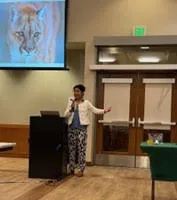
At the recent program hosted by Sierra Sage of South Orange County, Angeles Chapter Director Juanita Chavez delivered opening remarks to welcome participants and speakers on the topic of Protecting Imperiled Species. Her address set a positive and engaging tone for the evening, emphasizing the importance of community, collaboration, and the shared mission of environmental stewardship. Attendees were greeted warmly, and Chavez expressed her appreciation for their commitment to the chapter’s goals and initiatives.
Picture Credit: Linda Pauer
Beneath Southern California’s sun-drenched surface lies a complex tapestry of life –
one of the world’s most biologically diverse and imperiled ecoregions. Well-designed
crossings serve as a vital lifeline for imperiled species, ensuring their survival and
enriching the community’s living ecosystems. By blending habitat restoration, scientific
research, and passionate advocacy, the Wallis Annenberg Wildlife Crossing
demonstrates how urban areas can coexist harmoniously with the natural world.
Keynote speakers Celina Oliveri and Frances Appiah, both Caltrans wildlife biologists,
offered new information on the progress of this crossing and showed the important flora,
fauna and pollinators that contribute to the health of native plants. Despite the
abundance of the region, more than 200 species depend on the habitat connectivity of
this massive undertaking that will soon protect LA’s native wildlife and over 300,000
drivers daily.
Many of us cheered and purred in October when Caltrans announced that the first
plants were put in the soil. There will be approximately 5,000 native plants along the
crossing when completed. The foliage and infrastructure will serve as a much-needed
environmental boost by providing wildlife with a safe path over the freeway while also
minimizing interactions with humans.
Similarly, Norm Grossman, president of the Laguna Greenbelt presented the history of
the Irvine-Laguna Wildlife Corridor that is designed to link the coastal and mountain
habitats of Orange County but needs to be properly buffered from development. “Too
much noise, light and the intrusion of people and their pets will make wild animals and
birds less like to use the corridor.” The current 22,000 acres of the south coast
wilderness is a biological island, in danger of losing species due to a lack of genetic
diversity and habitat fragmentation.
Participants visited with leaders from Laguna Greenbelt, Inc., Cheetah Conservation
Fund, Save LA Cougars, Naturalist for You, Angeles Chapter Sierra Club and Sierra
Sage of South Orange County, who enjoyed collaborating on safeguarding biodiversity
through habitat preservation and community engagement.