by Ed Maurer
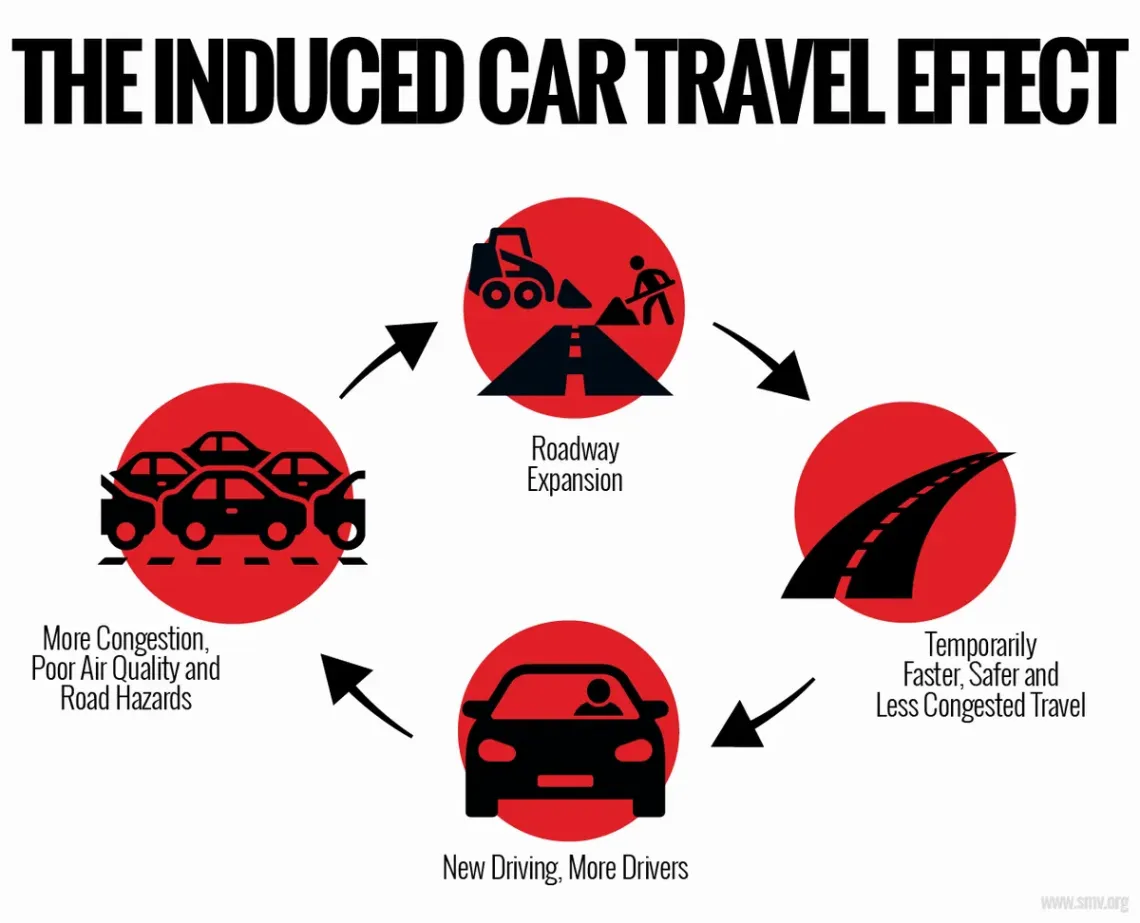
Back in 2023 Caltrans officials signaled an end to the era of massive, traditional, lane-adding freeway expansions in Orange County with the qualifier that targeted improvements (such as toll lanes) may continue to be constructed. Despite this welcome change of policy, the I-405 in Irvine is currently widened without any toll lanes. Furthermore, OCTA’s I-5 Improvement Project on the I-5 in Irvine will add one general-purpose lane in each direction to the tune of $700 million. It seems to me that OCTA didn’t get the Caltrans memo or they just can’t break the habit of increasing freeway capacity which induces more traffic.
Anybody interested in learning more about the concept of If we build it, they will come needs to take a look at the 2023 study by the National Center for Sustainable Transportation “Increasing Highway Capacity Induces More Auto Travel”. Here’s the abstract: “Building additional roadway capacity—via constructing entirely new roadways or extending or adding lanes to existing roadways—is often proposed as a solution to traffic congestion and even as a way to reduce greenhouse gas (GHG) emissions. The logic for the latter is that increasing roadway capacity increases average vehicle speeds, which improves vehicle fuel efficiency and reduces per-mile emissions of GHGs and local air pollutants. But that logic relies on the flawed assumption that the amount that people drive does not change when the time it takes to drive places changes. In fact, the amount that people drive does respond to changes in driving times. Empirical research demonstrates that as roadway supply increases, vehicle miles traveled (VMT) generally does, too. This is the “induced travel” effect—a net increase in VMT across the roadway network due to an increase in roadway capacity, which ultimately erodes any initial increases in travel speeds and causes increased GHG emissions. Researchers at the University of California, Davis, reviewed the empirical research on induced travel to understand the likely effects of adding roadway capacity in a variety of contexts.”
OCTA’s 2024 OC Transit Vision does not mention GHG emissions or climate change, issues that make it imperative that creative transit solutions be discussed, even in coastal and south Orange County. Instead, the report’s executive summary states that “wealthier, auto-centric communities along the coast, to the east, and in much of South County demonstrate lower levels of public transit propensity.” Why not think of how OCTA could address this antipathy to public transit that consists of lumbering buses and trains following fixed routes on thin schedules?
Autonomous vehicles for ride hailing – a form of private transit – will be in our area before long, and OCTA ought to think of how it could partner with companies such as VIA to integrate autonomous ride-hailing with public transit, with the aim of increasing the number of passengers in each vehicle, and of reducing the number of cars on freeways. Since OCTA has $700 million to build extra lanes to attract more polluting traffic, would it not make sense to investigate partnerships with ride-share companies to offer attractive alternatives to commuters and aging-at-home seniors from “low level transit propensity” areas where the inhabitants’ income and educational attainment make them open to new concepts and ideas.