
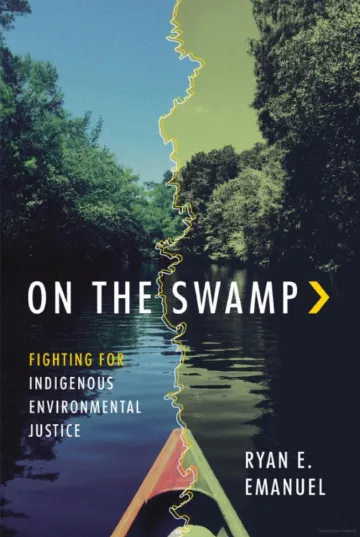
BOOK REVIEW: ON THE SWAMP
By Stan Bindell
On the Swamp, 291 pages. University of North Carolina Press
On the Swamp: Fighting for Indigenous Environmental Justice lays out the horrors that the Lumbee people faced due to natural gas pipelines coming through their lands, mega-farms that polluted their lands, hurricanes and other issues related to climate change.
Lumbee author Ryan Emanuel, an Associate Professor of hydrology at Duke University, takes the reader through decades of Lumbee dealing with these problems. But he shows “we are still here” as his tribe has persevered to survive, and have their culture remain part of their lives.
Emanuel also talks about how other tribes have faced similar issues.
Equally important, Emanuel lays out the strategy for resolutions and ordinances in North Carolina that must be adopted in order to keep these situations from reoccurring. While this would address the problems for the Lumbee people most of these strategies can be used by other tribes in North Carolina as well tribes in the other states.
First, he says, governments and corporations must shift in their views of Native American homelands and communities. They should no longer be ignored as governments and corporations need to include indigenous views, values and voices in their decision making and processes.
Emanuel’s second point is that governments and corporations must acknowledge that indigenous people still exist and deserve collective voices in the governing of their lands, especially the right to determine what types of development, or industries, take place in their homelands.
Emanuel’s third point is that minimum standards need to be set for respecting indigenous rights, especially the sacrificial transformation of indigenous landscapers and waterways.
Another point Emanuel makes is that governments and corporations need to acknowledge that marginalized communities can face multiple environmental calamities at the same time.
He urges governments and corporations to improve communication and public outreach, especially when it involves issues of environmental permitting.
He says too often government and corporations “have little or no understanding about the histories, cultures and political framework that tie indigenous peoples to our homelands and define us as peoples.”
Emanuel said for this to change, corporations and agencies need to obtain knowledge by training current workers or hiring new workers.
Emanuel said the Lumbee overcoming colonialism and surviving on their homeland is not a trivial matter. He credits kinship and community with helping the Lumbee survive.
Lumbees survived on their swampland when colonialists thought it was too harsh an environment to enter. Lumbee ancestors used one phrase about On the Swamp to mean “to be in the neighborhood or the community.”
As an educator, Emanuel has worked with members of the Hopi, Navajo, Pascua Yaqui and many other tribes. The goal has always been for indigenous people to gain all the education they can and to use that education for the survival of their nations.
“Promoting environmental justice is not a sole effort,” he said.
Suggestions for book reviews on books that address Native American environmental issues can be sent to reporter Stan Bindell at thebluesmagician@gmail.com