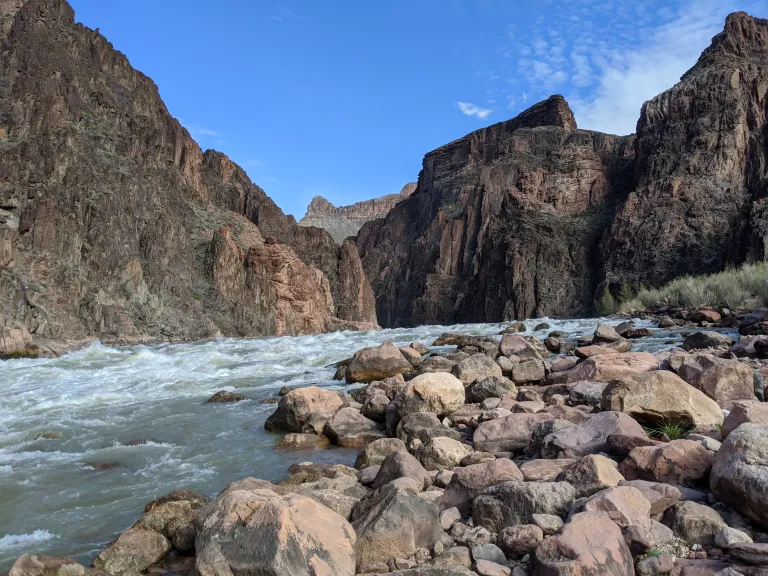
Granite rapid on the Colorado River in Grand Canyon National Park by Alicyn Gitlin
Colorado River Update: Uncertainty Is the Only Certainty
By Cary Meister, Chair, Sierra Club Colorado River Task Force
Email: coldenia@gmail.com
The existing framework managing Colorado River flows expires in 2026. Amid ever more uncertainties, no one really knows what the new management regime for these flows will look like in August 2026 when the US Bureau of Reclamation must announce the quantity of water approved for diversion in 2027, based on a two-year modeled forecast undertaken by Reclamation.
The major uncertainties and factors affecting predictive estimates of and agreement on water available for human use include:
- Strong disagreement between the upper basin states (Colorado, New Mexico, Utah, and Wyoming) and the lower basin states (Arizona, California, and Nevada) over which states should reduce diversion of Colorado River water. The upper basin states say they have never used their full 7.5 million acre-feet allotment of Colorado River water and already must adjust their take of the water to what is available, so only the lower basin states, who take as much water as they can get, should be the ones to cut back on water use. By contrast, the lower basin states insist that all basin states should have to cut back when there is a serious shortage of water in relation to current uses.
- Unclear direction at the federal level. The still-new Trump administration has not yet named a new Commissioner of Reclamation, although Andrea Travnicek has taken over as Assistant Secretary of the Interior for Water and Science, who ordinarily works closely with the Commissioner of Reclamation. How much power the Commissioner of Reclamation or Assistant Secretary has to force the states to follow a unilateral decision by Reclamation would certainly be taken to federal court by the basin states. Meanwhile, it is unclear that the Trump administration will respect the National Environmental Policy Act process that is driving the preparation of an environmental impact statement (EIS) by Reclamation, especially as decision day approaches. In addition, the Bureau of Reclamation has not been immune to the firing of government employees and freezing of funds from the Inflation Reduction Act and Bipartisan Infrastructure Law that began with the new president. These funds were being used to reduce water use and increase resiliency, such as by funding direct reuse water treatment plants in return for cities agreeing to reduce water use.
- The Colorado River. River flows have been declining, with climate change identified as a major cause. This is on top of large annual fluctuations in precipitation resulting from the El Niño/Southern Oscillation (ENSO). The 7.5 million acre-feet allocated under the 1922 Colorado River Compact to the upper basin, the same amount set aside for the lower basin, and the 1.5 million acre-feet guaranteed to Mexico by a 1944 treaty never existed at that time and today the total amount of water is about 12.5 million acre-feet. Climate models predict that the river will continue to carry less water. Yet some states, particularly Utah, want to take more of their allotment than now, such as by building a pipeline from Lake Powell through Arizona to the exploding (and high per capita water use) population of St. George, Utah. Moreover, all basin states have been unwilling to adjust their expectations from the amount of water they have been allocated on paper to the reality of the amount of water that actually exists.
- Native American water rights. Thirty Native American communities now reside in the Colorado River basin, and their ancestors have done so since well before written history. Many have settled with the federal government over their water rights, but a number have not. Even those who have settled water rights don’t necessarily have the resources (money, infrastructure) to actually use the water they are entitled to, and when they don’t withdraw the water from the Colorado, nevertheless they are not compensated for not consuming the water, while non-Native American farmers who do the same receive compensation in the hundreds of dollars per acre-foot. These same Native American sovereigns, whether officially called nations, tribes, reservations, or communities, are denied equal status with the seven basin states in negotiating post-2026 agreements, instead having to use the Bureau of Reclamation as an intermediary in negotiating with the seven states. Yet these same sovereign entities hold water rights to at least thirty percent of the Colorado River’s water. All this creates uncertainty for Native Americans, states, and the public in general in determining who will get what quantity of water or how much water they are willing to forgo, which for non-Native American entities is almost always compensated.
- A Compact call. The upper basin is required to deliver a total of 75 million acre-feet of Colorado River water to the lower basin over each ten consecutive years. In addition, the upper basin must annually provide half of the treaty commitment to Mexico, or 750,000 acre-feet. Yet Reclamation is projecting that upcoming annual releases through Glen Canyon Dam will total only 7.48 million acre-feet. A Compact call because of insufficient delivery of water to the lower basin and Mexico could come as soon as 2027. The Compact is unclear about the consequences of this to the upper basin, but the lower basin states would presumably seek delivery of the deficit, either through the courts or by other means.
Given these uncertainties, what are the likely outcomes of the NEPA post-2026 river management process and discussions among the federal government, states, and Native American sovereigns?
- The seven basin states come to an agreement on how cuts in water use will be made. Most likely, this would come at the last minute, judging by past behavior. Reclamation would probably accept it as their preferred alternative, but whether it undergoes full NEPA compliance when time is short and NEPA itself is under attack and already overridden by the new presidency’s edicts is certainly a concern. Of course, this continues to leave Native American sovereigns out of the picture.
- The federal government makes the decision. The basin states say they loathe this, but if they can’t agree, Reclamation may impose what it can under the law. A 1963 Supreme Court decision designated the Secretary of the Interior as the “water master” of the Colorado River below Hoover Dam. Regardless of what the feds decide, the states would probably take the decision to the Supreme Court. As a result of scoping comments for the post-2026 river management EIS, Reclamation did produce a document explaining which alternatives they plan to carry forward for analysis and evaluation in the draft EIS. You can access it at https://www.usbr.gov/ColoradoRiverBasin/documents/post2026/alternatives/Post-2026_Alternatives_Report_20250117_508.pdf. This might give some idea of what Reclamation will do absent agreement among the states. The caveat is that it was prepared by the Biden administration Reclamation staff and it may not represent the views of the current Trump administration, whenever those become more clearly known. The current administration in Washington, DC has already ordered the release of water from dams to California’s San Joaquin Valley when it wasn’t needed or requested by farmers there, so water releases on the Colorado River could conceivably be based on whim or political calculation rather than data.
Litigation among the basin states. Even short of an imposed decision by Reclamation, if the upper and lower basin states don’t achieve agreement, one or more of the seven states would probably go to court. Arizona HB2103, which would provide $1 million for Colorado River court expenses, has already passed the House with bipartisan support and awaits action by the Senate. Arizona Governor Hobbs is requesting $3 million for the same purpose in her budget for next fiscal year. The Utah legislature has passed a resolution stating that they reserve their right to use all of their Colorado River allocation and urge other states to use theirs, a mathematical impossibility, because the river doesn’t have that much water.
Federal threats to make the decision for the states have been successful in the past. When former Reclamation Commissioner Camille Calimlim Touton ordered the basin states to reduce their water use by two to four million acre-feet immediately, the seven basin states found a way to agree but do something short of that, which Touton accepted.
If there is one certainty about the Colorado River, it is that the natural environment and scheduling ecological flows that imitate the flow of the river before dams will be last, if considered at all. However, a coalition of environmental groups has proposed an alternative for the post-2026 river management EIS which would store some water and designate it for pulse flows along the whole of the lower Colorado, as occurred experimentally in 2014 when the river once again emptied into the Gulf of California. This alternative proposes designating 45,000 acre-feet of water to flow to the Gulf of California annually but recognizes that in years of less runoff the annual flow might not be possible. In that case, a catch-up annual flow of up to 135,000 acre-feet would be permitted as conditions allow. This is the farthest providing for ecological flows has ever advanced in a Reclamation EIS. But when the decisions are made to designate a preferred or proposed alternative, Reclamation has historically opted out of assured annual flows for the environment, including the adaptive management program of designated high flows through the Grand Canyon.
We live, indeed, in interesting times.