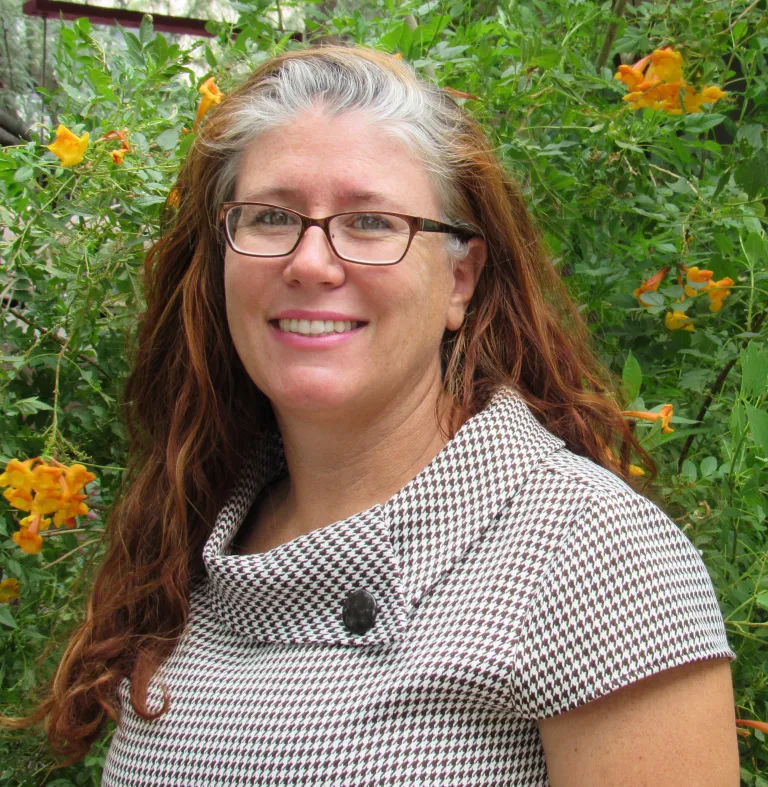
Cindy Tuell
Tell us a little bit about yourself.
I'm a second generation Tucsonan. My maternal grandparents moved to Tucson from Prague, Oklahoma, and Protem, Missouri, in 1941. I have two kids, 33 and 16 years old, three cats and 16 chickens. I'm a first generation college student, attending Pima Community College, the University of Arizona, then the law school at the University of Arizona as a single mom. I have been a volunteer with the Grand Canyon Chapter for just over 10 years, getting my start as a volunteer with the Sierra Club's Borderlands program around 2011, later joining the southern Arizona group (then known as the Rincon Group, now called the Nopales Group).
What are your hobbies or interests?
I love getting outside to hike, camp, walk, ride my bike, and just enjoy all that our beautiful world provides. I keep trying to be a successful gardener, but so far I haven't been terribly successful. I'm also a strong supporter of unions and have spent a lot of time lately learning about the power of unions to protect workers.
What is your favorite outdoor activity?
Lately, my favorite thing to do is sit outside and read and listen to birds. I've been trying to get better at identifying birds by their calls. I'm also learning to identify grasses, so spending time sitting on the ground just looking at the plants that are often overlooked while we hike to our next destination has become one of my favorite things to do.
What is your favorite place in Arizona?
My favorite place in Arizona is anyplace outside, away from the stresses of the urban environment, where my friends and family are. I think I have a preference for the Chihuahuan desert lately.
What made you want to volunteer with the Sierra Club?
Learning about the impacts of the border militarization, border patrol agents driving all over our shared lands, and the border wall from Dan Millis, who was the Borderlands Program Coordinator back in 2011 or so, got me involved in the Sierra Club. I was lucky to attend field trips to the borderlands to learn about the people on both sides of that imaginary line, and workshops where I learned how to take action to try to stop the destruction of the land and communities. That helped me see that I had a place in the Sierra Club. I learned I could use my voice and my privilege to speak up for people and places that were too often not given a chance to speak to those in power. I also learned that I had an obligation to elevate those unheard voices.
What do you believe are the biggest challenges facing Arizona?
Most people would say climate or drought. I think it is our government leaders. Those in power at the legislature refuse to hear bills that would protect our environment, our kids, our schools. Instead, they move bills that cause harm to our communities.
What accomplishments are you most proud of and why?
I'm so proud that I was given a chance to work with really good folks in southern Arizona to reorganize the Nopales Group. I'm also most proud of my two kids–they are kind, smart, lovely people. My kids aren't really my accomplishments, but they are what I'm most proud of in the world.
What one word do you think describes you best ?
Stubborn. I refuse to give up.
What inspires you to continue your environmental advocacy work despite challenges?
Honestly, I'm struggling right now. I think I keep doing this work because I can't not do it, even though sometimes it feels hopeless. Maybe it's thinking about the future for my kids? Maybe it's showing up in my community and seeing how many other folks are also showing up and knowing we are all in this together and we'll be OK if we all work together to try to make small changes in our communities.
How do you think individuals can make the most impact in environmental justice?
We need to listen to communities most affected by the environmental injustices of pollution, destruction of wild places, and attacks on voting rights. We should listen more, talk less, and take action on what we learn when we hear the voices of those who haven't always had a seat in the "environmental" movement.