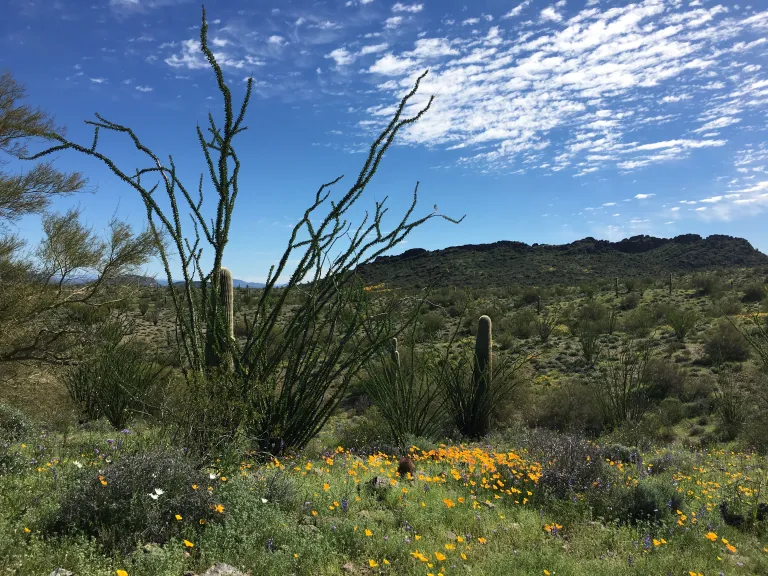
A sweeping view of Arizona’s lush desert landscape shows a home for various species facing growing conservation challenges.
Don’t just speak for the Trees, Speak for the Land too!
The beauty of Arizona consistently takes my breath away and a lot of that beauty is associated with the diversity of public lands, all of which are Indigenous lands. Does anyone ever get used to that first peek at the Grand Canyon and all of its layers of color, the Sonoran Desert in all of its diverse splendor after winter rains, the starkness of the Cabeza Prieta National Wildlife Refuge that still has and does sustain people and wildlife, seeing that first awe-inspiring snow of the season on the San Francisco Peaks, or floating on the Verde or the Salt through our national forests and witnessing otters at play. There is too much in our public lands to capture in one piece, but just recognizing the diversity and vastness of these lands, merely acknowledging how truly lucky we are to have these lands in our backyards to renew our souls, to view wildlife and observe plants, and to enjoy hiking, nature walking, camping, backpacking, kayaking, rafting, and so much more.
Because they have always been here, we tend to take them for granted. It is only when they have been threatened by land exchanges, a mine or other development, logging, and overgrazing, that we tend to pay attention. Those threats are all there still and Oak Flat has never been more threatened, but on top of these ongoing threats, we now have things like bills that include proposals to sell off massive amounts of public land, proposals to rollback or rescind national monuments such as the Baaj Nwaavjo I’tah Kukveni and the Ironwood Forest, schemes to eliminate p rotectionsfor millions of acres of roadless forests, including more than a million acres in Arizona, elimination of important public involvement provisions in the National Environmental Policy Act, and the total lack of respect for what is sacred to the many Tribes of our country and our state. Public lands are experiencing their most significant threats in recent history.
Now is no time for wringing our hands, however. Now is the time for action, for standing in solidarity with the 14 Tribal Nations to defend the Baaj Nwaavjo I’tah Kukveni, to resist the rollback of the Ironwood Forest, to work with San Carlos Apache and other Tribal entities to stop the destruction of Oak Flat, and to stop the actions to leave unloaded forests unprotected. We must use our voices loudly and frequently in what we write, what we say, and what we do. Not sure what to do first? Or Next? Contact us and we will send you postcards, help you write letters, share a petition, and tell you how you can help us get out the word to friends, family, and neighbors.
A thousand thanks for speaking for the land.
Sandy Bahr is director of Sierra Club’s Grand Canyon (Arizona) Chapter