Moving Fast and Breaking Things
by Chris Jocks
On April 16 of this year, Arizona Second Congressional District Representative Eli Crane wrote to the Secretary of Agriculture in Washington DC, urging her to administratively renew Arizona Snowbowl Resort’s Special Use Permit (SUP) with the U.S. Forest Service seven and a half years early. This permit is what authorizes Snowbowl to operate its business on public land. The current SUP was issued on December 2, 1992, and is set to expire after forty years, in 2032. Crane’s letter strongly urges Secretary Rollins to renew it now, and to expedite the process bypassing environmental or public review. A copy of Congressman Crane’s letter was recently made public.
Rep. Crane’s letter is built around a claim that has become familiar lately, that “activist groups” are hell-bent on obstructing business by inventing pointless environmental and bureaucratic obstacles. He writes that the U.S. Forest Service (USFS) and Snowbowl were “forced to negotiate” with “environmental activists and tribal representatives” when a legally required agreement (MOA) was found to have expired in 2021. This is grossly misleading. USFS was required by law (the National Historic Preservation Act) to meet with Indigenous government representatives as well as “traditional authorities,” aka medicine people, because for them the mountain on which Snowbowl sits is a sacred being, or the home of sacred beings, or is in some other way revered by Indigenous people from at least fourteen nations. The MOA is there so that a plan is in place if the business permitted by USFS results in adverse effects on this sacred place.
Readers of my op-ed last year may remember that after two and half years of negotiation, the replacement MOA was signed by none of the Indigenous participants in these meetings. This impasse resulted from the refusal of USFS to include monitoring of plants and soil and surface water, to measure the effects of millions of gallons of treated wastewater being sprayed on the slope every season since 2012. The MOA is back in place, on Snowbowl’s terms. Snowbowl and USFS were hardly the victims in this process.
So what’s behind this current push to quickly renew Snowbowl’s SUP seven and a half years ahead of schedule? It turns out that getting a new 40-year SUP now, rather than in 2032, would be a boon to Snowbowl’s balance sheet, enabling them to obtain financing on a 40-year repayment schedule rather than 7. Put that on one side of the scale. On the other side, think about the ongoing history of insult and disrespect to Indigenous caretakers of this sacred place, alongside issues of potential damage to Hart Prairie and increasing water scarcity and fire danger on and below the Peaks.
Evidence has been identified that could indicate that Snowbowl has violated its existing SUP by allowing treated wastewater (TWW) to flow beyond the permit area. This boundary was put there because TWW is distinct from tap water. It is known to contain pharmaceutical chemicals not filtered out in the treatment process, but it is also super-loaded with phosphorus and nitrogen. If applied in a location like Hart Prairie, studies from other locations indicate it is likely to incite takeover by opportunistic and quick-burning invasive species. You can find these studies at healthepeaks.com. On site data collection is needed to determine whether this is occurring, and has finally begun after long delays, although data collection at the source, the Rio de Flag Wastewater Treatment Plant on South Babbitt Drive, has been blocked by the City’s Water Division. A pro forma early renewal of Snowbowl’s SUP would allow all these issues to continue to fester, kicking these cans down the road until some indefinite future process.
Crane’s letter reflects the interests he is serving. He writes that “the success and visibility of Snowbowl” is of critical importance to his constituents, but the three people it matters most to are the Mountain Capital Partners (MCP), operators of Snowbowl, none of whom are Crane’s constituents. Two of them live in Durango; the other in Phoenix. MCP is headquartered in Durango and owns 13 ski resorts in Colorado, New Mexico, Utah, Arizona, Nevada, Oregon, and Chile.
I have spoken with a fair number of Rep. Crane’s actual constituents. For a very significant number of us, it is only responsible, respectful, and fair to weigh MCP’s profits against harm to the mountain and ongoing insult to the sacred beings who have been a reliable source of life-giving rain as well as guidance and strength for human beings here, since millennia before the United States even existed. For this reason, all decisions related to the responsibilities of USFS to care for this sacred place, must include not only Indigenous government officials, but the traditional authorities who carry the history of their peoples’ knowledge and action in love and respect for the Peaks.
If you agree, please communicate this to Coconino National Forest Supervisor Aaron Mayville. Consider also messaging U.S. Secretary of Agriculture Brooke Rollins. Otherwise, if you ski, please carefully consider what you are supporting when you purchase Snowbowl lift tickets or season passes.
Chris Jocks is a concerned citizen and registered voter in Flagstaff
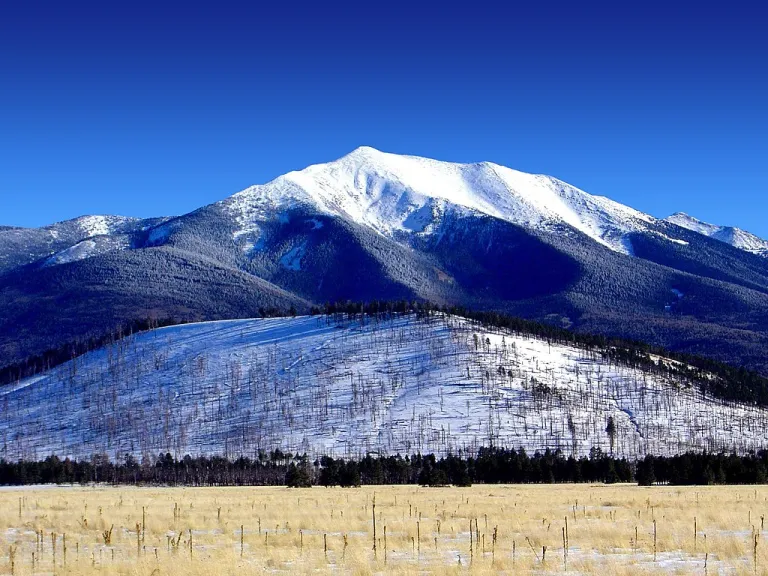
Credit: USDA Forest Service, Coconino National Forest.