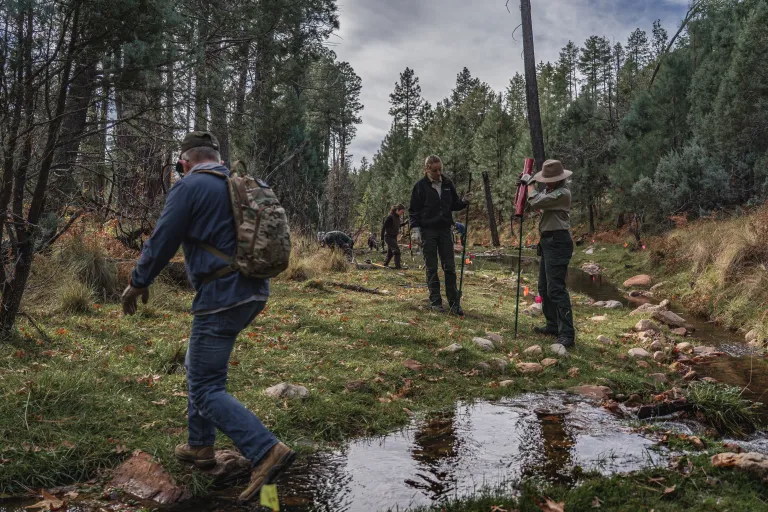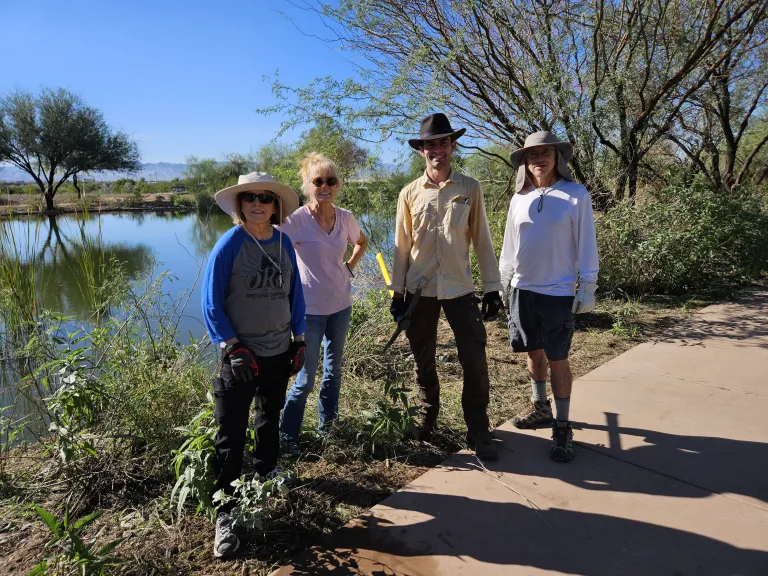
Thomas Gunnar Kehrt-Reese with a group of Water Sentinels volunteers
Finding Purpose & Hope Among Arizona’s Water and Land
by Thomas Gunnar Kehrt-Reese
I moved back to the United States – and to Arizona for the first time – six weeks ago. While neither option was my first choice following my graduate degree abroad, I felt compelled to return and do what I could to help our public lands. Arizona especially was a blight on my itinerary. For 17 years, I’ve had family in the Phoenix Valley, visiting once or twice a year for a few weeks at a time. To me, the region became synonymous with sprawl; a disregard for sustainability in both built and natural environments; and the apparent barren destitution of the desert. All seemingly only artificially alive thanks to extraction and air conditioning. Coming from temperate lands of rivers and forests and green fields, I was anticipating having to temporarily “survive” being here while restarting life in my home country.
Yet, in the mere six weeks that I’ve called central Arizona home, I’ve come to find that the ecology and history of the region exudes beauty and resilience, and is a reminder of the indispensability of community in all of its forms, especially among Arizona’s waters.
Water is a quintessential symbol of the precarious state of survival in both a largely arid state like Arizona, as well as in the larger context of climate change and life on Earth. Learning about and volunteering among Arizona’s riparian habitats have had an outsized influence on imparting a major shift in my mental model of the state and areas surrounding the Phoenix Valley.
In most cases, the outlook on Arizona’s water futures is, rightfully, less than encouraging. The Colorado River’s falling levels and floundering negotiations ahead of the Compact’s 2026 expiration, with 79% of its water in Arizona going to alfalfa. Inadequate groundwater management. Tensions between restoration and development along the Phoenix Valley’s river corridor (hopefully more sustainable and imaginative than another Tempe Town Lake). 60 – 70% of wildlife is dependent on riparian habitats, including 70% of threatened/endangered species, despite these habitats making up less than 0.5% of state land.
It’s definitely not exactly a fairy tale out here.
But opportunities to make a difference are teeming at the local level: A few dozen people joining USFS and AZ Game and Fish for riparian restoration in Tonto NF; Sierra Club’s Water Sentinels monitoring the health of Rio Verde and the San Pedro; hundreds of volunteers at Nature Fest in Phoenix offering their Saturday morning to clean up the banks of the Rio Salado. I’ve met people of all backgrounds and ages looking to find a way to contribute to the protection of these lands and waters. The flora and fauna show us that life has adapted here for hundreds of thousands of years. And traditional knowledge and expertise of indigenous peoples stands as testimony to more sustainable perspectives for humans’ place among it all.
I certainly don’t intend to “hope-wash” the severity of Arizona’s water challenges. It’s going to take all of us to save it, and the change is slow and reluctant against a maw of nefarious greed. But there is hope out there. We just have to get active, work with our people, and sometimes get down in the mud.