By Peggy Kurtz
Landmark Victory
Ten years ago, a citizen led movement in Rockland County prevailed against overwhelming odds in a true David and Goliath battle for the environment.
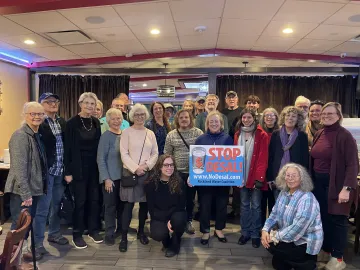
After eight years of struggle, Rockland County residents defeated a desalination proposal by Suez Water, the world’s second largest water company. On December 17th, 2015, the New York State Public Service Commission (PSC) ordered Suez to abandon plans to desalinate water from the Hudson River for Rockland’s drinking water. That victory was largely the result of the grassroots efforts of a core group of informed citizens, supported by larger regional organizations and elected officials. Sierra Club activists played a key role in this battle against all odds.
The landmark decision followed eight years of organizing by the Rockland Water Coalition, comprised of 34 local grassroots civic and environmental groups and larger organizations, such as Sierra Club, Riverkeeper, Scenic Hudson, Food & Water Watch, Citizens Campaign for the Environment, and Clearwater, supported by key elected officials.
Overwhelming Public Opposition
The public overwhelmingly opposed the desalination proposal. In 2012, hundreds of residents were turned away from an overflow room from a Department of Environmental Conservation public hearing. One year later, over 1,600 people turned out over two nights of PSC public hearings, overwhelmingly in opposition to the Suez proposal.
Rockland residents strongly objected to the fact that the water from the desalination plant would have included trace amounts of radioactive byproducts from the leaking Indian Point nuclear power plant.
The project would also have harmed officially rated irreplaceable aquatic habitat in Haverstraw Bay. In fact, Haverstraw Bay is the highest rated ecosystem in the Hudson River, a critically important nursery for Atlantic fisheries. Desalination would have resulted in the discharge of concentrated salt and other undisclosed chemicals into the shallow water body of the bay. Desalination also harms smaller organisms by entraining and impinging them in the intake to the plant.
Many also opposed desalination due to the very high ongoing energy consumption for operations. In comments to the PSC, Prof. Klaus Jacob, a renowned scientist at Columbia University’s Lamont Doherty Earth Observatory, called Suez’s desalination proposal “an abysmal, energy-guzzling greenhouse gas machine that has no place in a modern energy and climate-change conscious environment and society.” 1
Residents also strongly opposed the massive construction costs of $155 million and ongoing operational costs of the proposed desalination plant.
The work continues
As an active member of the Rockland Water Coalition, Sierra Club continues to advocate for an economically and environmentally sustainable water policy, which would maximize conservation and efficiency, sound land use policy, and repair of leaking infrastructure.
Sierra Club activists see Rockland’s water policy as a climate issue. Will we affirm unchecked consumption, while turning to one of the most energy intensive water supply options of all, such as waste water reuse?
Or will we craft an environmentally and economically sustainable water policy, built on reducing demand with conservation and efficiency? As we enter an age of global warming, how can we protect our drinking water and also aquatic habitat?
We also call for Veolia (formerly Suez) to plan for the multiple impacts of climate change on our water supply, including extended droughts and altered rain patterns, leading to potential water shortages, and impacts on water quality.
As the Trump administration has announced plans to rollback the regulation of toxic PFAS chemicals, Sierra Club members are working with other environmental organizations to lobby for stricter state drinking water standards and to ban non-essential uses for the toxic chemicals in thousands of consumer products.
On the tenth anniversary of this landmark victory, the work is not finished. Development pressures and climate change are likely to stress Rockland’s limited water supply in the future. Just as Rockland County’s defeat of the desalination plan became a model for other citizen water watch groups defending their water, we continue to believe that Rockland could be a model for a sustainable water policy, which will protect our water supply and our precious natural habitats, but we are not there yet.
As we celebrate this important anniversary, we remember the hard work by activists that went into the victory. We also remember the joy in working together to accomplish something big, which has held us together during these years. That strong sense of solidarity in the work can continue to sustain us as we confront the challenges ahead.
To learn more or to get involved,contact Peggy Kurtz: rocklandclimate@gmail.com, (845) 709-0802. You can also learn more at https://rocklandwatercoalition.net/
1 Comments of Prof. Klaus H. Jacob to PSC, Case 13-W-0303, Nov. 5, 2013.