Our group has relocated many prairie dogs from areas marked for development to safer habitats. We can always use help, either volunteers and/or donations. Please contact us if you know of any prairie dogs that need to be moved. We will try to get and/or already have the needed permits, and carefully follow safety protocols.
Please use the contact form on our home page to ask for help. We love our local White-tailed Prairie Dogs and want to help them survive.
Unbeknownst to most residents of Grand Junction, there is a whole world revolving around the removal of prairie dogs from empty land in town, typically land owned by a business or purchased by a developer that wants to build on the land. As current laws stand, business owners and developers are not required to humanely remove any prairie dogs, but if they do, there’s only one organization in town up to the task: the Sierra Club.
Photo Courtesy of D.E.A.R.
Prairie dogs fall within a sort of “gray area” of animals in terms of being pesky critters. Colorado Fish and Wildlife won’t deal with them and neither will animal control. Pest control will, but not humanely: Using pressurized exhaust, they simply poison the creatures. Many landowners simply shoot the animals or bulldoze over them.
For those who wish to attempt to get rid of the prairie dogs humanely, they’ll learn by word of mouth that the local chapter of the Sierra Club is experienced in this area, and one member in particular: Janet Wyatt.
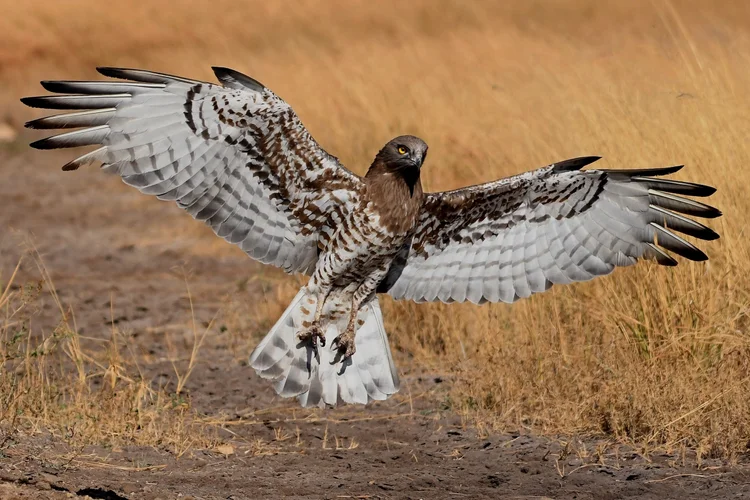
I met Janet after receiving an email from the Sierra Club looking for volunteers to help humanely remove 80 prairie dogs from a lot adjacent to a local bar/restaurant, which was desperate to be rid of the creatures, who were coming right up to the business’s doors. Looking out over the lot at 10 a.m. one weekday morning, I could see numerous prairie dogs, their heads poking out of the ground, some standing around and some skittering around and playing, though if a hawk swooped down or perched from a nearby tree, eyeing its prey, they retreated into their burrows.
Janet has no wildlife biology background or any other education that makes her well suited to prairie dog removal; she was simply taught how to humanely remove them by a local man, who for health reasons has stepped back from prairie dog relocation, and cares enough to put in numerous hours each day during a relocation.
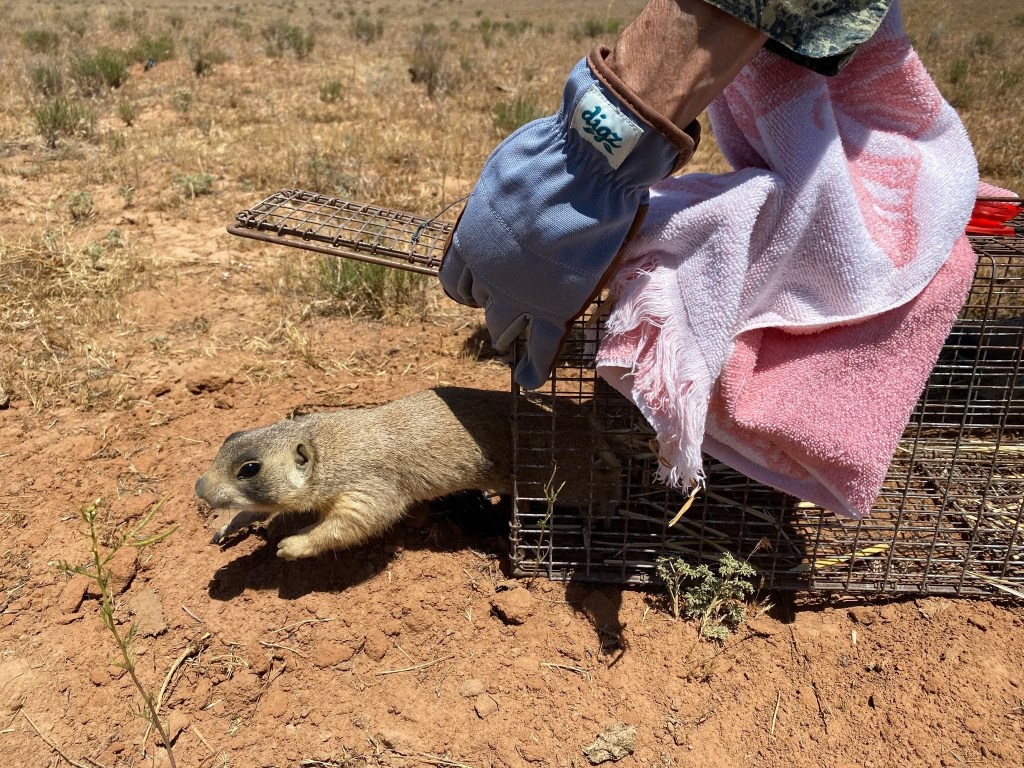
Humanely removing prairie dogs is a very passive process, with cages baited with raw peanuts and corn simply laid out in the lot, awaiting a prairie dog to trigger the cage closure and trap one or two at a time. On the day I first visited the lot, the traps had been out for several days but had yet to trap any prairie dogs. There are only a handful of cages at the Sierra Club’s disposal, and the lot is large, so the cages have to be moved throughout to attempt to get all the animals.
While Colorado Fish and Wildlife won’t remove the prairie dogs themselves, they do have extensive rules for how the Sierra Club can remove them, including that when traps are baited, someone must be there at all times to monitor the cages, hence the need for volunteers to help with monitoring over the course of a day.
Once a prairie dog is trapped, they are relocated to land that the Forest Service and BLM have okayed the Sierra Club to release them, located about a 50-minute drive from the lot. Janet and her volunteers assessed whether there were enough empty burrows for the number of prairie dogs to be released and didn’t find enough, so using pickaxes to dig into the hard soil, they created fifteen artificial burrows.
To help cover the cost of food for bait, gas to get to the land, and cages, the Sierra Club received a grant from D.E.A.R., Desert Ecosystem Analysis and Restoration. But mostly, the prairie dog relocation process depends entirely on the good intentions of volunteers like Janet.
The Sierra Club’s passive methods not only protect those involved from getting bitten by the creatures but put less stress on the prairie dogs as well. In other areas, groups use the “soap method,” or flushing, which involves using a water tank with an attached pump to deliver soapy, foamy water into the burrows, flushing the prairie dogs out, where they are then captured by hand or net and put into cages.
Many areas have local ordinances that require developers to make a good-faith effort to humanely remove the prairie dogs from a property before resorting to other methods. Janet has tried to get a similar ordinance passed in Grand Junction, but to no avail.
In the first week of this particular relocation project, only a few prairie dogs were caught, but as of June 4, the Sierra Club has successfully caught and relocated 27.
For prairie dog relocation services, Janet can be contacted at janetwyatt@comcast.net
Current News
Prairie dogs teaching us about wildfire management:
Scientists discover that prairie dog colonies make fire behave differently because of how they alter the landscape and keep grasses short and fresh. For centuries, they have provided a safe refuge from fires for other species living in the prairie, but humans continue to exterminate prairie dogs for development. How can we learn from the prairie dogs and work with them to protect the prairie landscape we live in?
We developed a kiosk with information about the local white-tailed prairie dogs, a keystone species. WSSC coordinated with Colorado Parks and Wildlife and the Bureau of Land Management on this. Here are the three posters in the kiosk which is near North Pond, also called 6 and 50 Reservoir, off Highway 6 &50, west of Mack. Thanks to everyone involved!
Left poster on top, center poster in center, right poster on bottom.
We had a fun celebration at the newly-installed prairie dog kiosk. It was a beautiful day, the artist and the news media showed up. Hopefully this effort will help white-tailed prairie dogs and their ecosystem!
from our friends on the eastern slope-
The Prairie Dog Coalition
Prairie Dog Brochure
Many folks haven’t been properly introduced to the wonderful world of the prairie! That’s why we published A Quick Guide to Prairie Dogs and Their Ecosystems. We want to display this brochure in visitor centers, trailheads, museums, and other places across the prairie dog empire, and will stock them free of charge! Click the button below to request copies and download a digital version.
If you want your community to have clear guidance on how to coexist with prairie dogs, you want a management plan! Creating a management plan takes patience and persistence. It is a collaborative effort involving many stakeholders. We created guides that aim to provide a framework within which those diverse stakeholders can find strategies suiting the needs of their communities to improve outcomes for the prairie dog ecosystem.
Is there a prairie dog colony near you under threat? Do you want quick answers to common questions about prairie dogs? Do you need help organizing a relocation? The Action Packet may have the answers you need!