How can you help wolves?
 |
Many concerned folks ask, "How Can I Help Wolves?". Here's a comprehensive guide to resources and actions you can take to help wolves:
Learn About Wolves
- Read books and peer-reviewed research, watch videos from this extensive curated list
- And there's more curated publications and suggested reading at livingwithwolves.org
- Download free e-books and more at rockymountainwolfproject.org - especially the “Living With Wolves” Photographic Exhibit
- Read "American Wolf: A True Story of Survival and Obsession in the West" by Nate Blakeslee
- Read “Decade Of The Wolf” by Doug Smith and Gary Ferguson
- Watch “How Wolves Change Rivers” with 36 million YouTube views!
- Watch the documentary movie “Medicine Of The Wolf”
- Watch the documentary movie or read the book “Living With Wolves” (DVD/Book)
- Watch the documentary movie “A Season Of Predators”
- Listen to a piece about the 06 female wolf in Yellowstone
- “Like” the “Legend Of Lamar Valley/The Valley Of Wolves” Facebook page (a community of wolf watchers from Yellowstone that post photos/videos of Yellowstone wolves, and share info on what’s going on in the world of wolves)
Join, Volunteer & Stay Current
- Join your Colorado Sierra Club and participate in your local Group meetings & events
- Indicate your volunteer interest in “wolves” here
- Volunteer with your local Colorado Sierra Club Group
- Meet your local Colorado Sierra Club Group Project Wolf Team member
- Sign-up for email updates from the Rocky Mountain Wolf Project
- Follow the Rocky Mountain Wolf Project on Facebook and their events calendar
- Sign-up for the weekly e-newsletter from the Timber Wolf Information Network
Spread The Word Everyday
- Proudly display wolf-friendly bumper stickers (esp. “Colorado Needs Wolves Need Colorado” from the Colorado Sierra Club, and “Colorado Needs Wolves” from the Colorado Wolf And Wildlife Center)
- Share posts & photos from reliable, factual sources and wolf-advocacy organizations on Facebook, Instagram, Twitter (one post/photo per week)
- With the help of your local Colorado Sierra Club Group Project Wolf Team member, write timely letters to your local newspaper
Engage!
- Keep track of wolf/wildlife legislation at local, state and national levels.
- Sign online petitions, join campaigns and contact legislators.
- Fight attempts to de-list wolves (all species) from the Endangered Species Act
- Fight attempts to “de-fang” the Endangered Species Act
- “Like” your local and state legislators on Facebook
- “Like” wolf-advocacy organizations on Facebook:
- Colorado Sierra Club (and your local Group), Defenders Of Wildlife, Rocky Mountain Wolf Project, Wolf Conservation Center
- Participate in wolf-advocacy marches and demonstrations
Get Up Close And Personal
- Visit a Colorado wolf sanctuary
- Colorado Wolf And Wildlife Center in Divide
- Mission: Wolf near Westcliffe
- W.O.L.F. Sanctuary (currently private but open to the public soon)
- Wolfwood Refuge in Ignacio
- Visit a wolf sanctuary when traveling the US
- International Wolf Center in Ely, Minnesota
- Wolf Conservation Center in South Salem, New York
- Wolf Haven International n Tenino, Washington
- Wolf Sanctuary Of Pennsylvania in Lititz, Pennsylvania
- Visit Yellowstone National Park & take a guided wolf discovery/photography tour (google “Yellowstone wolf tours”)
from Delia Malone, 12/30/2025,
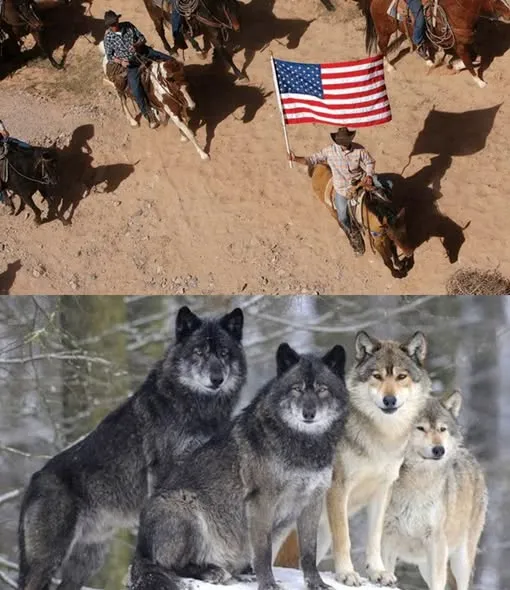
Restoring Wolves has always been about restoring the Wild - without Wolves there is no Wilderness, no Wild. And that is exactly what colonialism’s “manifest destiny” sought to eradicate. The audacity of Wolves to say “no” - this land is our land. That is what riles opponents of Wolf restoration- Wolves won’t bow to colonialist domination of the Wild - and for that they’re persecuted.
The surprising way wolves have reignited a culture-war-style battle between ranchers and conservationists might be the single most important climate story you aren’t seeing on your timeline — and it calls into question everything we think we know about land, power, and ecological justice.
Wolves have been slowly returning across parts of the West and Upper Midwest — and with them, a political standoff. Conservationists argue wolves are essential to repairing damaged ecosystems. Ranchers and hunting groups say the costs are being pushed onto rural communities.
States like Colorado, Montana, and Wisconsin have turned wolf policy into a battleground, with ballot measures, court fights, and legislative showdowns. At the federal level, protections under the Endangered Species Act are still contested, with recurring efforts to strip wolves of safeguards and hand control back to the states.
The debate isn’t settled. It’s polarized. And it’s no longer just about wildlife — it’s about who gets to decide how wild the country is allowed to be.
New research from the University of Leeds found something unexpected: if wolves were reintroduced to the Scottish Highlands, they could unlock the recovery of native woodlands that have been choked out by overabundant red deer. Those woodlands, in turn, could sequester up to one million tonnes of CO₂ each year — about 5 % of the UK’s woodland carbon removal target on its own.
Why does this matter? Because most climate policy still focuses narrowly on technology or emissions caps while ignoring the power of nature itself to pull carbon out of the sky.
Reintroducing wolves changes the behavior — and numbers — of deer that have grazed saplings into oblivion for centuries, allowing forests to grow back naturally instead of relying solely on fences or planting schemes.
This isn’t a sci-fi climate hack; it’s rooted in a long line of ecological research. Wolves — as apex predators — reshape entire food webs. When they were reintroduced to Yellowstone in the 1990s, elk populations and behavior shifted, willow and aspen returned, beavers bounced back, and rivers even began to reshape as vegetation stabilized soils.
That’s the ecological mechanism behind “rewilding” — letting natural processes reboot landscapes. And rewilding isn’t some luxury campaign slogan. It’s now recognized as one of the nature-based climate solutions that can actually help mitigate climate change by restoring carbon sinks, increasing biodiversity, improving flood control, and building resilience in the face of warming.
Of course, this isn’t without controversy. In Europe and the U.S., wolves provoke strong reactions. Ranchers worry about livestock, hunters worry about game animals, and many rural communities feel left out of the climate conversation that so often centers urban sensibilities over rural realities.
In Germany and elsewhere, wolf populations have rebounded significantly, and while scientists emphasize the ecological benefits, debates about livestock losses and compensation continue.
Politically, wolves are a lens for deeper divisions about how we use land, whose voices count, and what we consider “progress.” In Colorado, a citizen ballot measure to bring back gray wolves passed — but barely — showing just how polarized these issues can be even among people who generally lean pro-environment.
But here’s the thread progressives should care about: science is painting a picture where ecological restoration is climate policy. It’s not about romanticizing wilderness; it’s about deploying real, measurable, natural mechanisms to capture carbon, rebuild soil health, and create landscapes that benefit both nature and people.
We can argue all day about subsidies, carbon markets, or corporate commitments — but if we ignore the role of ecosystems in climate stability, we leave powerful tools on the table.
Wolves and other keystone species aren’t just trivia for nature lovers; they’re part of a broader shift toward understanding that ecological health and climate resilience are inseparable.
The question of whether wolves belong on our policy agenda is really a question of what kind of solutions we’re willing to embrace — and whether we’re ready to let science, not fear or folklore, guide us.