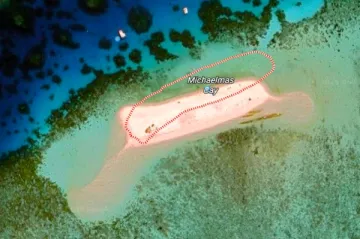
Since childhood, the Great Barrier Reef off the coast of Australia has been on my bucket list. After seeing photos and hearing about its greatness, I regarded the reef as a fantastical place teeming with life, diversity, and colors. It was especially high on my bucket list because I had heard of the reef’s destruction over many years. I feared that by the time I would be able to go, it would be completely gone. So, when my sister had the opportunity to study abroad in Australia this summer, my family and I jumped at the chance to witness its beauty with our own eyes. (Photo: Michaelmas Cay in 2009)
My parents visited Australia in 2006, two years before my birth, and were lucky enough to see the Great Barrier Reef in all its previous glory. My dad scuba dived while my mom snorkeled, but when recounting the experience, they both recalled the vibrant colors of the fish and reefs. They told tales of colors so bright they were almost neon, stunning anyone who passed. Everywhere they turned, they were surrounded by schools of fish, and any form of sea life a person could imagine. After hearing these dazzling stories, my excitement only grew. To ensure my sister and I got the same experience as they did, my parents booked a tour in the same area, Michaelmas Cay.
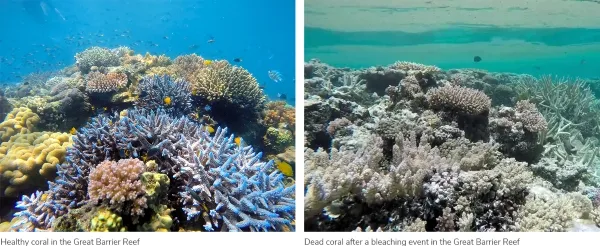
The day of the tour quickly arrived. I have the unfortunate burden of terrible sea-sickness, so as we sped towards the reef, the boat rocking back and forth, I felt less and less like I would be able to enter the water without throwing up, especially since the wind was particularly strong on that winter morning. However, my desire to see the reef overpowered my stomach’s unrelenting twists and turns, and I entered the water. I snorkeled from the boat towards the Cay (the small, beachy island). Looking down, I was not bombarded with colors, as I had hoped. The water, incredibly clear, showcased the glaring lack of vibrancy of the reef. As we swam, I saw mostly sand, then large patches of grey reef. An occasional, small group of fish swam by my body. I had expected a bustling city of sea life, but what I was met with looked like an abandoned city. A ghost town.
The tour guide pointed out different types of fish, yet I struggled to distinguish them, as they were all pale-skinned with grey undertones. Soon, the Cay’s shores were in view. However, my vision was quickly obstructed by plumes of sand drawn up by my fins hitting the seafloor. I looked down, surprised we had already arrived at the beach. I then realized we had not yet arrived: the Cay was still 20 or 30 meters away. Below me were the remains of the reefs my parents had seen twenty years ago. Healthy and thriving reefs were replaced by uniform, white sand, washed away by decades of human abuse. I swam quickly the rest of the way to the beach, flopping down on the sand, filled with a crushing sadness.
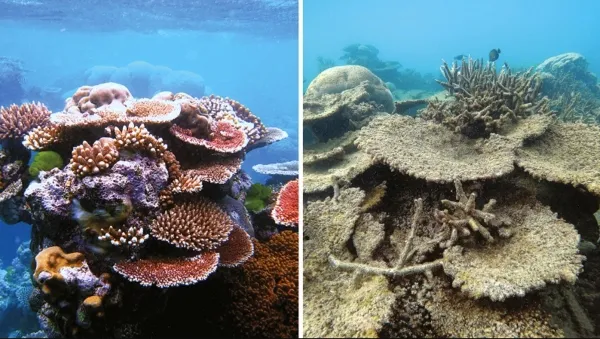
However, trying to retain some form of optimism, I went back to the boat to scuba dive in the area with more concentrated reefs. Unfortunately, I was met with the same reality. Deep down along the sea floor, I looked in every nook and cranny for the schools of fish I was promised. I only found one singular fish: a small, lone clownfish hiding in pale pink anemones. After about half an hour of scouring the reef for something that bore a resemblance of the reef we used to know, I came up out of the water, knowing it was gone. After taking only a step on the boat, I threw up over the side. Whether it was from the rocking boat or the ache I felt for our earth, I don’t know.
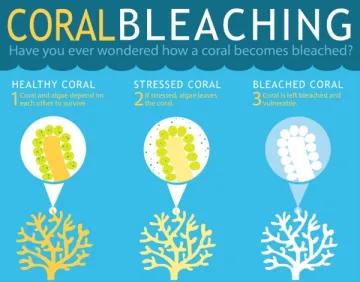
Coral bleaching was something I’d always known about. I even remember giving a presentation on it in middle school. As we emit more greenhouse gases—carbon dioxide, methane, and others—into the atmosphere, more heat is trapped instead of escaping into space. Our planet is warming, but not as quickly as it otherwise would because the oceans absorb much of this excess heat. Covering about 71% of Earth’s surface, they act like a giant heat sink. While this helps slow the rise in global temperatures, it comes at a cost to marine life, especially coral.
Corals live in a symbiotic relationship with a type of algae called zooxanthellae (pronounced zow-uh-zan-theh-lai). The coral provides the algae with a safe place to live, and in return the algae supply the coral with food through photosynthesis and give reefs their vibrant colors. When the water becomes too warm—or in some cases too cold—the corals become stressed and expel the algae. Without their algae, they lose both their color and their primary source of food, leaving them pale, weakened, and slowly starving. If the stressful conditions continue, the corals die, and over time their skeletons break apart under the force of waves and currents, leaving behind little more than bare sand where a thriving reef once existed.
I suppose this is what I saw. The graves of hundreds of coral which used to line Michaelmas Cay. Knowing the process of coral bleaching and seeing it are two entirely different things. Although I’m grieving not being able to see the reef in its prime, I’m glad I was able to see what was left. It is a stark and jarring reminder of the effect our human actions have on the world around us. In a world seemingly filled with greed and apathy, it is important to dig out the empathy we all have inside, turn it into power, and demand change.