By Jonathan Ullman, Chapter Director
President Richard Nixon defunded the Everglades Jetport, slated to be the largest airport in the world, on January 16, 1970. The airport was derided by activists like Marjory Stoneman Douglas who warned it would obliterate the Everglades. The project was so far along, a massive runway was already built in the middle of the swamp.
More than 50 years later, that runway is surrounded by the public lands of Big Cypress National Preserve and Everglades National Park. The Miami-Dade County “training airport,” is officially known by call letters TNT.
On June 19, 2025, the state of Florida announced it had confiscated TNT and renamed it “Alligator Alcatraz.”
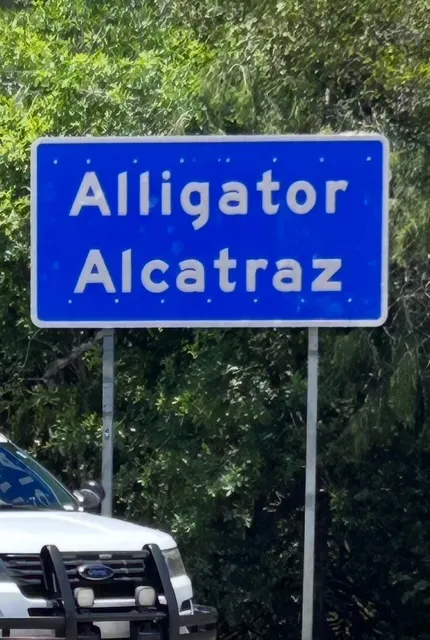
A team of private contractors rolled in tents and cages and generators. They poured concrete over the wetlands; they placed ads on Indeed for guards. They installed an official state of Florida road sign on U.S. 41 Tamiami Trail that said, “Alligator Alcatraz.”
The money spent, a half billion dollars, will be reimbursed to Florida by the U.S. Government. As of July 14, more than 1,000 detainees were held, with a capacity of 3,000.
The cost per bunk comes to $245 a night, the price of an upscale hotel room in downtown Miami. It’s summer, the rainy season, in one of the most inhospitable places on the earth. The temperature rises to 95 degrees with humidity at 80 percent on average. The combination can make it feel like 115 degrees.
Afternoon summer rains strike like monsoons. The area is surrounded by Everglades wetlands so flooding is a given. Mosquitos breed explosively. A hurricane would wipe the facility and its inhabitants off the map in minutes.
Gasoline tanker trucks arrive constantly to keep the generators on. There is no grid electric power for tent cooling. Drinking water and sewage must be driven in and out.
On June 27, the environmental groups Center for Biological Diversity and Friends of the Everglades, founded by Marjory Stoneman Douglas, sued. They were joined by the Miccosukee Tribe of Indians whose population had fled to the Everglades during the Seminole Wars and live off Tamiami Trail.
Hundreds of protesters have gathered for demonstrations led by Betty Osceola, a Miccosukee Tribe member and long-time environmental activist.
One week, there were hundreds of people waiving signs along two-lane Tamiami Trail. Another week, there was a multifaith religious gathering. The Archbishop of Miami even came with a motorcycle brigade calling for the camp to be shut down. Rabbis from the east and west coasts of Florida converged to lead prayers.
The camps are full of people from across Florida pulled over for simple traffic violations. According to The New York Times, most detainees do not have criminal convictions.
On July 25, the first flights out of TNT began. Reporters don’t know how many were sent, where they are going or when the inflow and outflow of people in the middle of the Everglades will end.
This is not the first time when non-criminals were concentrated in a remote location with an inhospitable climate. Manzanar is an Owens Valley town just outside of Death Valley. During World War II, more than 10,000 Japanese Americans were forced to leave their homes and relocate to Manzanar in 36 blocks of tar paper and pine barracks. They were among more than 120,000 Japanese Americans who were held at 10 camps in the U.S.
Like the Everglades, Manzanar is scorching in the summer but also frigid in winter.
The camp was closed on November 21, 1945.
It is no coincidence, some on Internet discussion feeds are calling the Everglades camp Mosquito Manzanar.

Water from the Everglades and the Owens Valley were diverted to build the great cities of Miami and Los Angeles. While these two sources have different climates, they now share the same distinction as concentration camps.
The Japanese American National Museum and the American Jewish Committee issued a joint statement about the use of the term concentration camp.
“A concentration camp is a place where people are imprisoned not because of any crimes they have committed, but simply because of who they are. Although many groups have been singled out for such persecution throughout history, the term 'concentration camp' was first used at the turn of the [20th] century in the Spanish American and Boer Wars.
During World War II, America's concentration camps were clearly distinguishable from Nazi Germany's. Nazi camps were places of torture, barbarous medical experiments and summary executions; some were extermination centers with gas chambers.”
Of Alligator Alcatraz, the rabbi of a congregation on Florida’s Gulf Coast recently wrote in his weekly sermon:
“A facility, let us name it plainly: A camp, has opened for the detention of undocumented immigrants. It stands here, in the shadow of our own community, amid the sawgrass and swamplands of the Everglades. It is not a prison, but it is not freedom. It is a place where human beings: men, women, and children; will be confined, silenced, and uprooted from any semblance of stability or dignity…
… Let me be clear. Although this is not Auschwitz, nor Bergen-Belsen, we must not disrespect history by making false equivalencies; but we would be dangerously blind not to hear the echoes of history in our midst. We know how it begins, always: with camps for those labeled “outsiders,” “illegals,” “undesirables.” We know how even democratic societies can, little by little, begin to unravel the threads of human dignity, rendering people invisible. It begins, too often, with silence. With the normalization of what should never, ever be normal.”
- Rabbi Ammos Chorny, Beth Tikvah, Naples, FL
* * *
Don’t be silent either as an environmentalist or as a human being as they are one in the same. Check out these websites on ways to get involved locally:
https://indivisibleventura.org/
Feel free to contact me for more info or just to share your thoughts.