Bighorn in the Sespe Wilderness
By Mike McWherter
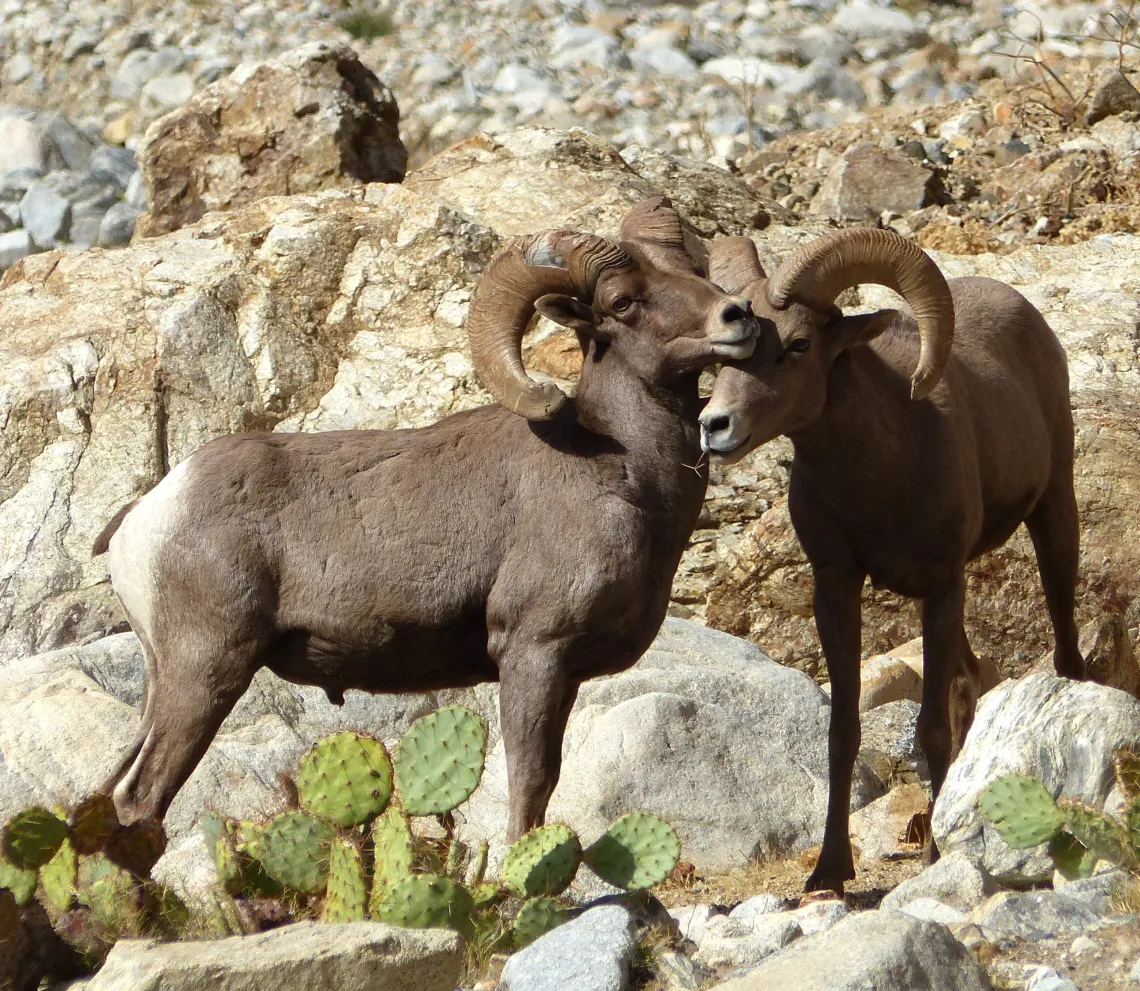
I first saw desert bighorn sheep (Ovis canadensis nelsoni) in 1985 while hiking in Cow Canyon which drains Mt. Baldy (San Antonio Peak) in the San Gabriel Mountains boarding the city of Los Angeles. I was amazed to see them hugging steep exposed cliffs high above the canyon.
Then suddenly one sheep plunged down an almost vertical cliff to the streambed below to join another group of bighorns that for some reason seemed to be charging directly at me. They all suddenly veered off, being blocked by their leader who stood poised between me and them. They continued down the rocky streambed and soon disappeared, the last I ever saw of them. But that was in 1985.
Over the many years that have since passed, I learned that some of them had been captured by the CA Department of Fish and Wildlife and introduced into the Sespe Wilderness area in 1985-1987. I wondered how they were doing in our local mountains, so in 2024 I contacted Dustin Pearce, the unit biologist for bighorn sheep in Santa Barbara and Ventura counties.
Dustin told me that “We do in fact still have bighorn sheep in the Sespe Wilderness – their primary use area is south of San Rafael Peak and can often be seen in large numbers down at the Sespe Hot Springs”.
He said a total of 36 bighorn sheep were translocated and 28 were equipped with radio transmitting collars. By 1989 16 of those collared animals were confirmed dead. In the 1990s and early 2000s monitoring efforts for this small population were extremely difficult because of the inaccessible terrain.
“By 2003 the population was considered extremely reduced/extirpated,” Dustin said. It was not until after the Day Fire (2006) that there appeared to be an increase in the Sespe bighorn sheep population with the newly opened habitat.
Survey efforts were reinitiated with a collaring effort that took place in 2017. That year, 19 animals were collared providing new information on home range and space use. The population estimate as of 2019 was 119 bighorn sheep with a confidence interval of 88-150.
“Since 2019 we have not had any helicopter surveys for this population but have had ground surveys when possible. The population does appear to be healthy, but we will need additional information soon on vital rates (survival, reproductive rates) and specifically genetic diversity,” Pearce said.
My hope is that this population of desert bighorn will, as it once did, thrive in our local Sespe Wilderness area and hikers will have a chance to spot these magnificent creatures.
Please report any sightings of bighorn to Dustin. If possible, note the location, number of bighorn rams, ewes, youngsters and lambs, and any other information, especially photos. Contact him at: Dustin.Pearce@wildlife.ca.gov
* * *
Mike McWherter has been a member of the Sierra Club since the 1970s. He has published many articles and photographs about wildlife, conservation, and mountaineering. His articles helped Sierra Nevada bighorn sheep gain Endangered Species classification in 1999. In the early 1990s he wrote articles, one for the club’s magazine Sierra, advocating Wilderness status for much of the Mojave
desert’s California Conservation Area. Between 1980 and 1989 he was an associate editor to Summit - a mountaineering magazine. He has written two books on the Andes of Peru and Bolivia.
His first book, Andean Encounter, can be read free through the American Alpine Club’s digital library collection at: library@americanalpineclub.org