 The Magazine of The Sierra Club
Street Theater
Puppet Politics
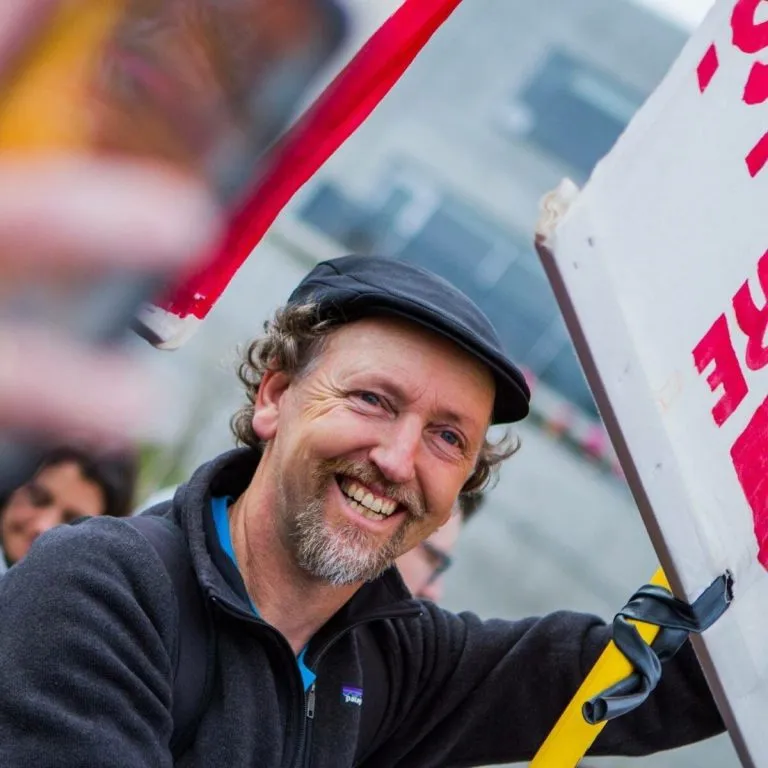
Can a giant puppet head change the world? David Solnit thinks so. The 39-year-old carpenter and community organizer is part of the Art and Revolution Collective, a San Francisco–based group that has expanded demonstrators’ standard arsenal of protest signs and chants to include masks, skits, pageantry, and oversize puppets. The resultant carnival atmosphere adds levity and pointed humor to otherwise sober protests. But the activists also have a serious purpose: The spectacle brings to light complicated issues like trade globalization, helps grab much-needed media attention, and even mellows police and calms crowds.
One of several loose-knit groups of "puppetistas," Art and Revolution first unveiled its masks, one-act plays, drums, and puppets on the streets of Chicago during the Democratic Convention in 1996. That event featured one of the group’s most elaborate puppets ever, the 21-foot-tall Corporate Tower of Power, a headless, necktie-clad business executive perched atop a model skyscraper emblazoned with corporate logos. Eventually, the CEO toppled, revealing painted scenarios of the group’s ideas for a better world. (Because of overhead trolley and electrical lines, you won’t find a puppet taller than about 12 feet these days.)
While giant puppets capture spectators’ attention, skits inform and encourage involvement. A recent Art and Revolution event at a Chevron Texaco refinery in Richmond, California, was called "Alice in Oil-land" and featured a spoken-word artist and a hand-cranked device resembling a low-tech television set. The skit told the story of the global oil industry and how it ultimately affects people’s lives on the streets of Richmond ("without sounding like a two-hour college lecture," Solnit points out). At the show’s conclusion, dancers unfurled banners calling for safer and cleaner alternatives, such as "renewable energy," "reverence for the earth," and "restorative justice." Art and Revolution also held "art parties" in the community called "Another World Is Paintable," where kids covered four-by-five-foot canvas squares with their visions of the future and then carried them to the entrance gate of what they had dubbed the "Toxico" refinery.
Sitting in his group’s San Francisco warehouse surrounded by papier-mâché "Frankenfood" monsters, oil dinosaurs, and endangered coho salmon, the lanky, goateed Solnit says, "The idea is to open up political space for everyone to take power, by talking at the heart and gut level" and making protest "fun, participatory, and rich in culture." Only then, he says, can we "break through the corporate media." (As it turns out, the techniques that capture spectators’ attention are irresistible to the media, too: Few things appeal more to a roving news photographer than an ornate giant puppet head. Knowing this, savvy puppeteers adorn their creations with prominent signs, thus ensuring that "WTO Trades Away Our Forests" becomes the real photo caption, no matter what a newspaper editor may eventually write.)
Solnit shows off storyboards used to choreograph a coho salmon "die off" held in front of a California Department of Fish and Game office in 1998. Working with local activist groups fighting the Maxxam Corporation’s logging plans for the Headwaters Forest in Northern California, he coordinated dancers and other volunteers who trained for an hour or so before the demonstration. Then, with Solnit narrating, the "denizens of the forest" assumed their roles as salmon or murrelets or carriers of a broad blue banner that represented rivers imperiled by logging debris; on cue they flew, swam, and flowed along the streets of Eureka, California. Recruiting was easy. After all, Solnit says, "would you rather attend a planning meeting, or a puppet-making workshop?"
Most recently Art and Revolution and other groups took on the Free Trade Area of the Americas talks in Miami. (See "Lay of the Land," page 14.) The Miami City Commission was so anxious about an invading army of artists that it tried to pass a temporary resolution banning the activists’ puppets. Solnit found the overreaction ridiculous, and confirmed his belief that his cadre of street protestors has a secret weapon: "We have more fun than they do."