 The Magazine of The Sierra Club
Should Polluters Pay for the Climate Crisis? Big Oil Says No as Supreme Court Weighs In.
Boulder County presses for climate accountability in Suncor v. Boulder
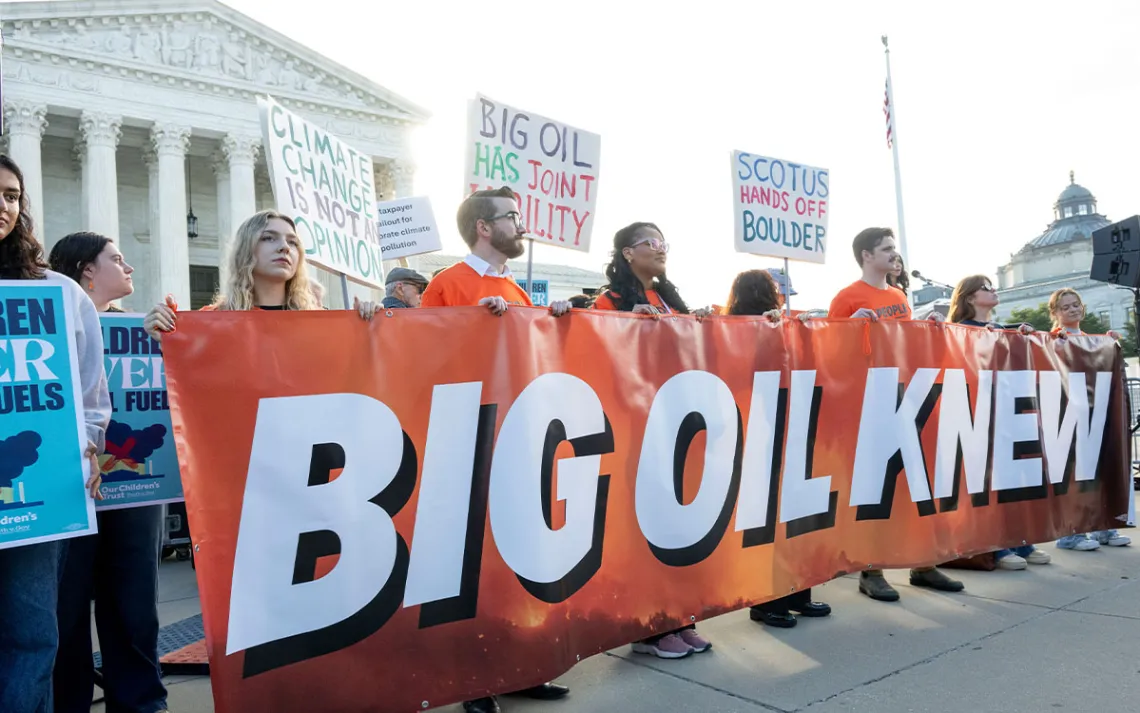
Climate disaster survivors, Colorado ranchers, Boulder County youths, and climate accountability advocates rally outside the Supreme Court on October 5. | Photo by Kevin Wolf/AP Content Services for Fossil Free Media
In late 2021, the Marshall Fire—the most destructive wildfire in Colorado’s history—tore through Boulder County, Colorado, charring the landscape and incinerating homes and buildings in its path. Alina Miranda’s house was one of the many destroyed by the flames. In the aftermath of the disaster, she missed weeks of school and resorted to sleeping in a laundry room, separated from her parents, due to limited housing options.
On Monday, Miranda, now 21, joined other wildfire survivors in the nation’s capital for “The People v. Big Oil” rally outside the Supreme Court. They were there to support a landmark climate accountability case called Suncor v. Boulder.
“I lost everything in the Marshall Fire, including my pets and my home,” Miranda said. “My state has a right to protect my health and hold corporations like Suncor responsible for the damage they’ve caused families like mine by prioritizing profit over long-term climate health.”
The Marshall Fire destroyed over 1,000 structures and resulted in more than $2 billion in damage. As the climate crisis fuels extreme weather events like these, the costs, according to Boulder County and its allies, should not be shouldered solely by taxpayers. The industry specializing in the extraction, transportation, and combustion of fossil fuels, which are driving that crisis, they say, should be held accountable instead.
In 2018, the Colorado community sued oil companies ExxonMobil and Suncor, seeking to recover damages for localized climate impacts. The lawsuit, brought under Colorado tort law, argues that the companies knowingly contributed to dangerous climate change while concealing the risks from the public to boost sales of their products.
This alleged deceptive conduct is at the heart of dozens of lawsuits filed by cities, counties, states, tribal governments, and individuals against fossil fuel giants like ExxonMobil over the past decade. The cases point to damning evidence uncovered through scholarly research and other investigations indicating that the industry had long-standing knowledge of the potentially “catastrophic” consequences of unchecked fossil fuel use yet engaged in extensive efforts to spread climate denial and disinformation, thereby delaying the clean energy transition and magnifying the climate crisis.
With oil and gas majors facing the prospect of billions of dollars in potential liability, they have launched a full-court press to try to stop these lawsuits.
The Court agreed in February to take up ExxonMobil and Suncor’s petition after a 2025 ruling from the Colorado Supreme Court allowing Boulder’s case to move toward trial. The question presented in the oil companies’ petition—“whether federal law precludes state-law claims seeking relief for injuries allegedly caused by the effects of interstate and international greenhouse-gas emissions on the global climate”—was framed broadly such that it would apply far beyond Boulder. This same question was previously pitched to the court in a petition from oil company defendants in a climate lawsuit brought by Honolulu, Hawai'i. The justices denied that petition in January 2025.
“What Petitioners advocate for is nothing less than a judicially crafted liability shield for the fossil fuel industry,” a group of 19 states led by Colorado and California said in an amicus brief backing Boulder.
ExxonMobil and Suncor argue that Boulder’s state tort claims are barred under federal law, including the Clean Air Act and the Constitution itself. “This case involves an unprecedented effort to use state law to regulate global conduct,” Kannon Shanmugam, counsel for ExxonMobil, told the Court during his opening argument. “Our constitutional system does not permit state law to be used in that manner.”
Boulder argues that it is not trying to “regulate global conduct” or dictate national or international energy policy; it is merely seeking compensation for harm to its residents and property. “This case is not about asking the courts to solve or even mitigate the effects of climate change. It is, simply, about fairness and trying to survive,” Boulder County commissioner Marta Loachamin said in remarks outside the court after the hearing.
Inside the courtroom, some of the justices seemed skeptical of the oil companies’ sweeping constitutional theory. “Several justices resisted the idea that the Constitution’s structure alone bars state climate suits,” Alejandro Camacho, an environmental law professor at the UCLA School of Law, wrote in a post-hearing analysis.
Some justices appeared more receptive to the companies’ argument that the Clean Air Act preempts or supersedes state tort law claims pertaining to greenhouse gas emissions. Justice Brett Kavanaugh pointed to the court’s case law establishing precedents restricting the application of tort law in disputes over interstate air and water pollution. Chief Justice John Roberts, in questioning Boulder attorney Kevin Russell, suggested that Boulder’s case was an attempt to evade those precedents, but nevertheless amounted to “an effort to reduce emissions.”
“This case is not about emissions. It’s about deception and about producers,” Russell argued. A few of the justices picked up on that distinction. Justice Elena Kagan, for example, drew the comparison to litigation against tobacco and opioid manufacturers. And Justice Sonia Sotomayor said, “It’s not clear to me how regulating the production and false advertisement of oil affects air and water.”
“ExxonMobil and Suncor Energy’s efforts to evade accountability hinge on misrepresenting Boulder’s lawsuit as an attempt to regulate emissions,” Kathy Mulvey, fossil fuel accountability program director at the Union of Concerned Scientists, said in a statement.
The October 5 Supreme Court hearing was held against a backdrop of a dismantling of federal climate policy under the Trump administration, which has rolled back pollution controls on sources like motor vehicles and power plants and disavowed the EPA’s Clean Air Act authority to regulate greenhouse gas emissions. Sarah Harris, deputy solicitor general who argued in support of ExxonMobil and Suncor, told the Court that the administration’s actions have no bearing on their legal argument that the Clean Air Act preempts state tort law. But legal experts say there is a glaring contradiction in the position that the federal government has the sole authority to regulate climate pollution while the Trump EPA is disclaiming that authority in its regulatory rollbacks.
Joanne Spalding, the director of the Sierra Club’s Environmental Law Program, told Sierra, “The Trump administration says it has no authority to reduce climate pollution from even the largest sources—like power plants and vehicles—yet contends that this supposedly nonexistent authority preempts state and local governments from protecting their communities that face climate disasters.”
In addition to the federal preemption question presented by the oil companies, the justices posed their own question as to whether or not they have jurisdiction or authority to intervene in Boulder’s case, given that the litigation is still in early stages and there has been no trial on the merits. That question came up during Monday’s hearing, and legal experts say it could provide an off-ramp for the court to avoid wading into the more substantive issues in the case.
Justice Samuel Alito, who owns stock in several oil companies that are defendants in other pending climate cases, did not participate in Monday’s hearing. His recusal came just one week before the oral arguments.
The court’s decision is expected sometime in 2027.
A ruling in favor of ExxonMobil and Suncor could restrict or even knock out Boulder’s case and others seeking damages from fossil fuel companies. Some of these cases have been paused pending the Supreme Court’s decision.
In the meantime, communities are continuing to pursue efforts to hold Big Oil accountable for climate harms. Just last week, Middlesex County, New Jersey, filed the latest climate lawsuit against ExxonMobil and other major oil firms.
At the same time, the fossil fuel industry and its political allies are escalating their attempts to shut down these efforts and shield the industry from climate liability.
“The fossil fuel industry has been going to extraordinary lengths to attack these climate cases, not just asking the Supreme Court to end the lawsuits, but also pushing Congress and state legislatures to grant fossil fuel companies immunity from all climate-related liability, said David Arkush, director of Public Citizen’s climate program.
Utah and four other Republican-led states have already passed laws banning climate liability, and Republicans in Congress have introduced a bill called the Stop Climate Shakedowns Act that would grant sweeping legal immunity to the fossil fuel industry nationwide.
“The current offensive isn’t just about defeating the cases,” Arkush said. “It’s also about preventing the public from learning the extent and severity of the industry’s wrongdoing. It’s about fossil fuel CEOs’ profound fear of sitting in front of a jury of 12 Americans and trying to defend their companies’ deceptive conduct—because they know it’s indefensible.”