The Firebirds and Fire Followers Rising From Altadena
Residents still recovering from the Eaton Fire in California look for home beyond the blueprints, the insurance companies, and the elbow grease
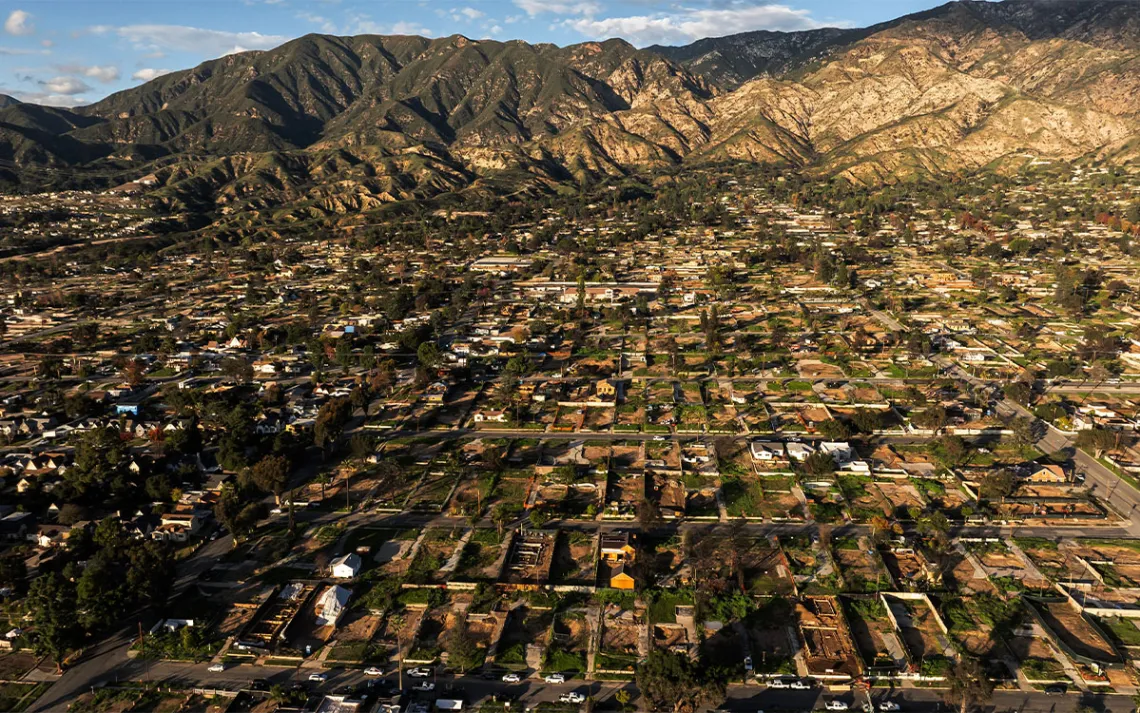
Photo by Ted Soqui/Sipa via AP Images
We were not a week out from the wildfire. That oily acridness still stung the air. And yet, already a scatter of homemade signs had begun to sprout. All over. Especially along the curving stretches of the newly unfamiliar—blocks and blocks of Altadena, California’s harrowing fire wreckage.
We Will Rebuild!
Altadena Strong!
Altadena is Not for Sale!
These freehand placards, flyers, banners—some fashioned from repurposed wood and tempera paint, then sunk into ruined lots or tied to chain-link—felt more potent than a wish. Others made from construction paper and classroom markers—neater, quieter, yet no less emphatic—read like prayers.
Buttressed by roaring 80-mile-per-hour winds, the 2025 Eaton Fire rewrote the story of a century-plus-old region in less than 24 hours. The flames took 19 lives and destroyed more than 9,000 structures across 14,000 acres of the San Gabriel Valley foothill community. What had once been home was now wrenchingly unrecognizable.
For those following the news from afar, it might now, nearly two years later, appear as if Altadena’s recovery is humming swiftly along. New construction has begun—the whirr of power saws and locked-in rhythm of hammers commence early most mornings. Television news crews have followed the dramatic transport of historic homes, readied and secured to trailers, then ferried carefully from central Los Angeles to a decimated lot in the foothills: New chapters all around. And while another wave of “For Sale” signs have popped up among the Matilija poppies and the mountains are showing a new shadow of chaparral, it hardly feels like progress for many, nor does it yet feel like home.
Approximately 50 percent of total-loss survivors have yet to take even the first step of their rebuilding process. And many Altadena residents have found themselves underinsured and facing unreachable—and still climbing—building costs. Locals still encounter block upon block of weed-filled open lots and permanently altered sight lines.
Those early “We Will Rebuild” proclamations might be what anyone would expect from a devastated community’s collective pro forma fist pump. Over time, those proclamations have evolved into a reckoning that is far more complex and robust. The fire didn’t just destroy homes; it ripped away a deeply ingrained sense of magical thinking. The Eaton Fire robbed us of our imagined sense of safety.
Residents shifted from shock and grief to a keen sort of clarity about the “climate change future” that was no longer future but alarmingly present tense. So just what is safe?
One local friend, in the early hours after the fire, was quoted in a national paper. She wondered if residents rebuilt, would a simple copy and paste approach be best for the future? Or might this historic wildfire present "an unanticipated opportunity to build back in a better way?"
Where does one even start?
*
I have been talking to Altadena residents about fire and recovery pretty much nonstop since early January 2025—just hours after I was evacuated from my own Altadena-adjacent home. Some of the discussions, formal—recorded, archived interviews, follow-alongs. Some of it casual—fly-by, chance encounters. Overall, there is a day-to-day sense of hovering between past and future—not exactly fully occupying a present. Because the present feels ghost-like, temporary. Unreal.
As this first year comes to a close, the community discussions have shifted from enumerating the granular details of loss to coming to terms with next steps, in a bracingly honest way.
What might Altadena look like? How might it hold on to its idiosyncratic quirkiness, its vivid urban-wild character, while at the same time feel safe and secure for the next 100 years?
While many still long for the Altadena that once was—the whimsy of overgrown flora, the wooden bungalows, a loose relationship with formal requirements and permits, the room to roam—our changed climate and its consequent concerns (drought, fire, flooding among them) require a drastically different way of thinking about its next chapter.
What we are all learning, in real time, is that “getting home” is more than blueprints, a contractor, brick and mortar, and elbow grease. It’s retrenching—reorienting yourself, coming to terms with a new self.
What would it take to come back and have the best of both worlds?
“What makes a place feel like a home is not only just what you put inside.”
*
Sometimes “progress” is counterintuitive. Sometimes instead of racing forward, it might be best to pause and take a breath.
“What makes a place feel like a home is not only just what you put inside,” said Amy Shimson-Santo, a poet, editor, and writing instructor who has spent the last year and a half leading writing workshops focused on trauma relief in fire-affected communities. The idea is to bring people together to listen and write—but the gatherings have also functioned as an informal opportunity to consider creative ways to restitch the community even while it has been dispersed—scattered across the region, state, and far beyond.
Late in 2025, Shimson-Santo joined forces with Altadena-based artist Alma Cielo, who is spearheading an ambitious initiative called 1000 Voices Altadena Mosaic. Partnering with the Los Angeles Conservancy, Cielo’s aim is to produce a public artwork that also serves as a community archive of collective memory. In that time, it has also organically created a refuge for reflection.
Over the last year, residents have been invited to attend a series of hyper-local workshops,in parks, at festivals, and community centers across Altadena to hand-fashion a tile that represents their relationship to home and their personal story of place. Each tile will become part of a mobile mosaic to be displayed at sites across the community—a visual, from-the-heart reminder of what Altadena was and can still be.
The project found shape in the wake of an epiphany. When Cielo had returned to her own burned-out Altadena property, it was “still smoking,” as she described it to me. She noted that among the scarce keepsakes that had survived were the ceramics—tile, porcelain, rough-hewn stoneware. So delicate and yet so strong. Those had endured. And so had her family. It was evidence that they—and their place in the world—had not been entirely erased.
“From the beginning, I didn't think of myself as a ‘victim’ or a ‘fire survivor,’” Cielo told me. “The word that came to me is firebird. I say firebird instead of phoenix. The fire initiated an immense change in me.”
Shimson-Santo had learned of Cielo’s mission through a close-knit network of artist friends.
“From the very beginning, Alma has been listening. Watching. Trying to figure out how to tell the true story of what's going on in Altadena, and she needed some support helping people to find a way to access and articulate their memories, their experience with place,” said Shimson-Santo. “My focus is therapeutic writing. Truth-based writing can be vulnerable. The key is to create this safe space where people can really be who they are with people they don’t really know, but who have shared the same experience. They are all finding their way back home. There are healing elements to being each other’s witnesses. Your story is part of my story.”
“From the beginning, I didn't think of myself as a ‘victim’ or a ‘fire survivor.’ The word that came to me is firebird. I say firebird instead of phoenix. The fire initiated an immense change in me.”
On a Saturday afternoon, I found my way to the CORE Hub, at the edge of the burn zone on north Lake Avenue, to meet with Cielo. When I arrived, she was placing a blank sheet of paper and a pencil at intervals on worktables arranged in a horseshoe. I watched participants file in: A buzzy little girl in a shiny tutu and tiara hovering close to her mother and grandparents, a quiet couple who didn’t lose their homes but were attending as “allies.” Later, each participant chose a soft clay tile, modeling tools, a palette of watercolors, and a brush. The pre-writing, Cielo explained, helped to quiet the mind, to focus on what might be meaningfully present, though for any participant, that calm could be obscured behind an unending list of daily survival tasks—insurance lists, meetings with contractors, tracking deadlines.
Disasters disrupt more than the territory, Shimson-Santo noted.
“People will come into a community when tragedy happens, and they will pull out the biggest line, a theme, and that becomes the story of the community.” This project, she’s observed, gives the story of home back to the people. “This is not a journalistic thing. Not a social research thing. They are the authors of their experience. They will dictate and create what community means.”
And what might come next.
In the early sessions, she recalled, attendees introduced themselves by their address so that people had a sense of their connections across the town’s grid. But she found that that approach had a muting effect, depending on the day, or the composition of the room.
"We don’t introduce by address anymore, because the last time, by the time we got around the table, it was like a morgue. No one could say anything.” They were, as it turned out, still marooned in trauma.
Sessions now start with questions “How do I know I’m home?” and “What do you remember or love?” She said, “We wrote on that for weeks, to get people focused. We focused on ambiental or spatial aspects. ‘I want my door to open to the mountain’; ‘I miss the barn owl outside my door...’”
Seated before the group, she asked with a soothing lilt, “How will you know when you’re home?"
"When I can turn the key inside my lock? When I can pull into my driveway? When I see the shadows the sun makes on my bedroom wall?”
When you lose your home in an extreme wildfire, you lose more than just that and that alone. You lose community, rituals, routines, shared language. You lose your sense of self in the world.
The next chapter starts with getting back home inside yourself.
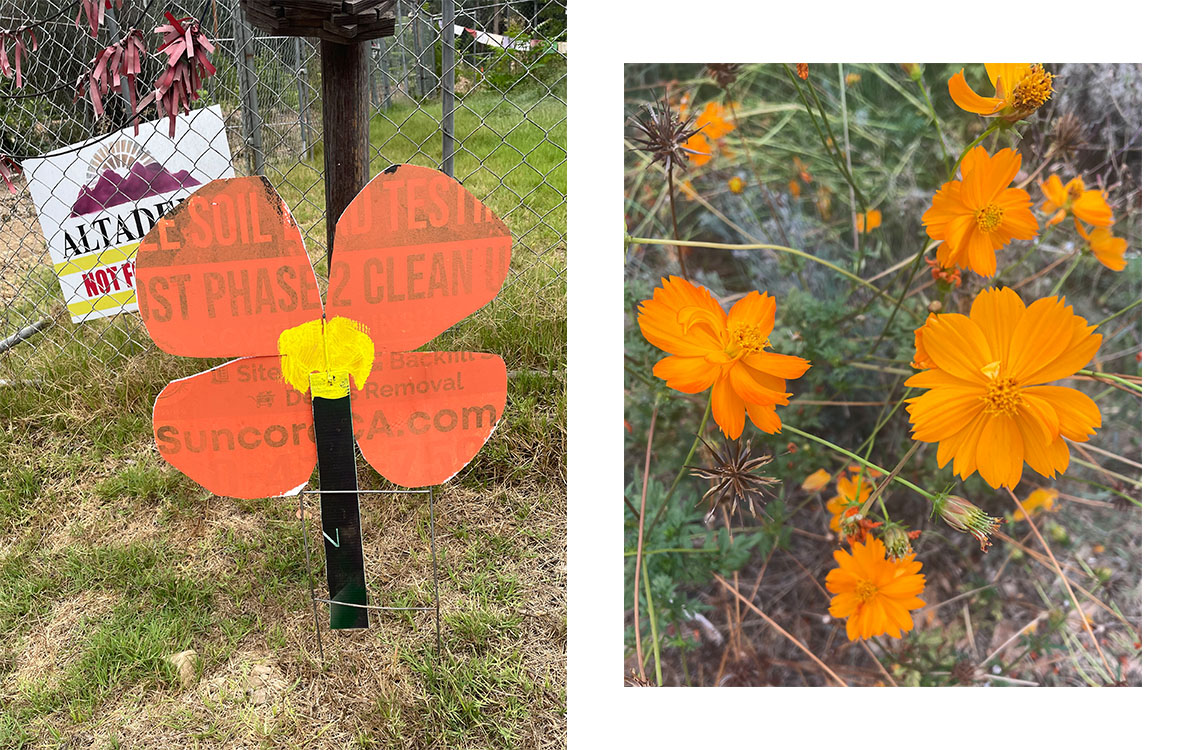
Repurposed and regenerated—Altadena, Summer 2026. | Photos by Lynell George
*
In the earliest hours and days after the fire, the horror of it, the statistics, the historic nature was a focus for many. This extreme weather event was the fifth-deadliest and second-most-destructive wildfire in California history. And while it would later be officially determined that a decommissioned Southern California Edison transmission tower was the flashpoint, this wasn’t simply a “freak event.” With a warming climate coupled with protracted droughts, fires of this gravity will be something that we must anticipate and aggressively prepare for in coming months and years to come.
Initially, I observed people incentivized by raw fear, grabbing at something to do to feel safe, even if it was just momentarily. Like Band-Aids. I understood. I felt it. What had seemed quaint and offbeat was now not. Those tousled trees and wild overgrown shrubs that had once felt like a hideaway, even magical, now summoned dread. Especially when the winds picked up. As the Santa Anas always do, annually, October through March.
I was on a just-after-daybreak walk in West Altadena in early February 2025, during the first week of the Army Corp of Engineers massive debris clean-up. I wanted to retrace an old route near Altadena’s cherished deodar oasis, Christmas Tree Lane, to take the measure of things.
I made a turn on a miraculously still heavily tree-lined street, just as a man in work boots and jeans climbed out of a silver Toyota truck he’d parked half in/half out the driveway of a low-slung ranch-style house. He waved hello. Altadena-friendly. But when he paused and introduced himself, I intuited that he was looking to chat. Not urgent but with purpose. After extending a hand and introducing himself as Brian, he wanted to warn me that some of the big stake trucks carrying debris down from the burn zone were taking a shortcut down his street. And that debris, he stressed. was full of aerosol toxins.
“There are things that you can inhale just once and it's there forever,” he cautioned. “Not to mention what’s now in our soil.”
He worked, he told me, in the film industry as an environmental health and safety manager, and as it turned out, had been in New Orleans 20 years ago, early post–Hurricane Katrina, on a shoot. Back then, he was on high alert about black mold and other post-disaster toxins on one of his possible location sites. He was feeling similar apprehension now on his own street, calculating levels of risk. Smoke damage and more.
As he spoke, he went back to the driveway, rooted around in his truck’s cab, and plucked from his stash a more heavy-duty respirator style mask. He handed it to me.
Gesturing toward a sky-scraping battered Mexican palm tree—which looked more like a spent matchstick—listing southward in his neighbor’s lot, he continued: “That’s why I’m not completely back home.” There was much to do before even thinking about reoccupying his home, he continued. He was already mentally mapping out the landscaping—no wooden fence, maybe a gravel pathway. He was considering perhaps, just perhaps, some natives. I started to visualize the starkness, as his hands gestured toward the breadth of what still stood. “We’ve all got to be careful,” he told me, leveling his gaze. “That was just the warning shot.”
We were all learning in real time.
*
My friend Flora Ito has seen, firsthand, residents who have been activated by a similar prickly unease. She works as nursery manager for Theodore Payne Foundation, a private nonprofit devoted to education around and preservation of California native plants. A few months after the shock waned, residents made their way to their Sunland grounds. She interacted with a stream of residents—from both January 7 fire zones, Altadena and the Palisades—who had questions about landscaping and defensible space.
“Obviously it was a turning to, ‘What should we do?’” she told me. “All with good intentions.”
The questions she fielded, I noted, echoed Brian’s concerns. “How do we reseed? What do we replant?” Flora explained. “It’s like human behavior—the anxiety and all of that. And people do see gardening as a way to get through their emotions.” But this, she recognized, had an extra note of urgency about it.
In those early months, while all manner of acreage lost and damage tallies were still being tabulated, their team distributed handouts and sent customers links to their wealth of resources. But most of all, they listened.
This wasn’t their first 21st-century climate event. By now they were old hands. The 2017 La Tuna Fire, in the Verdugo Mountains, which burned more than 5,000 acres, made its way to their doorstep. While they incurred no damage, they too had to evacuate—not once but twice. This event incentivized them to share the information and resources about wildfires and their ecological aftermath. They held symposiums, hosted lectures, created a local native plant garden, and began to identify and study crops of “fire followers”—plants that flourish after a blaze.
This time, with a palpable distress hanging in the air, Flora said: “I wanted to listen. And help people to read and learn about next steps and resilience. About what’s possible.”
Even if they might not see it now.
What would, or could, these neighborhoods look like? Not stark or denuded as some were projecting but repopulated with an eye for safety, sustainability, and beauty. A native arcadia, poised for what was next.
“For me, working in the nursery all these years, it was also interesting to hear what plants did survive,” she said. “I heard oak trees and shrubs like toyon ... and there were a few [stories] that I could count on [one] hand, where they felt that being surrounded by those native plants saved their house.”
We were all learning in real time. She’s been moved by the courage and fortitude. “People, humbly identifying themselves and telling their stories. People who are willing to try again.” And much like the residents who need time and space, Flora reminded me, “The land also needs time to rest.”
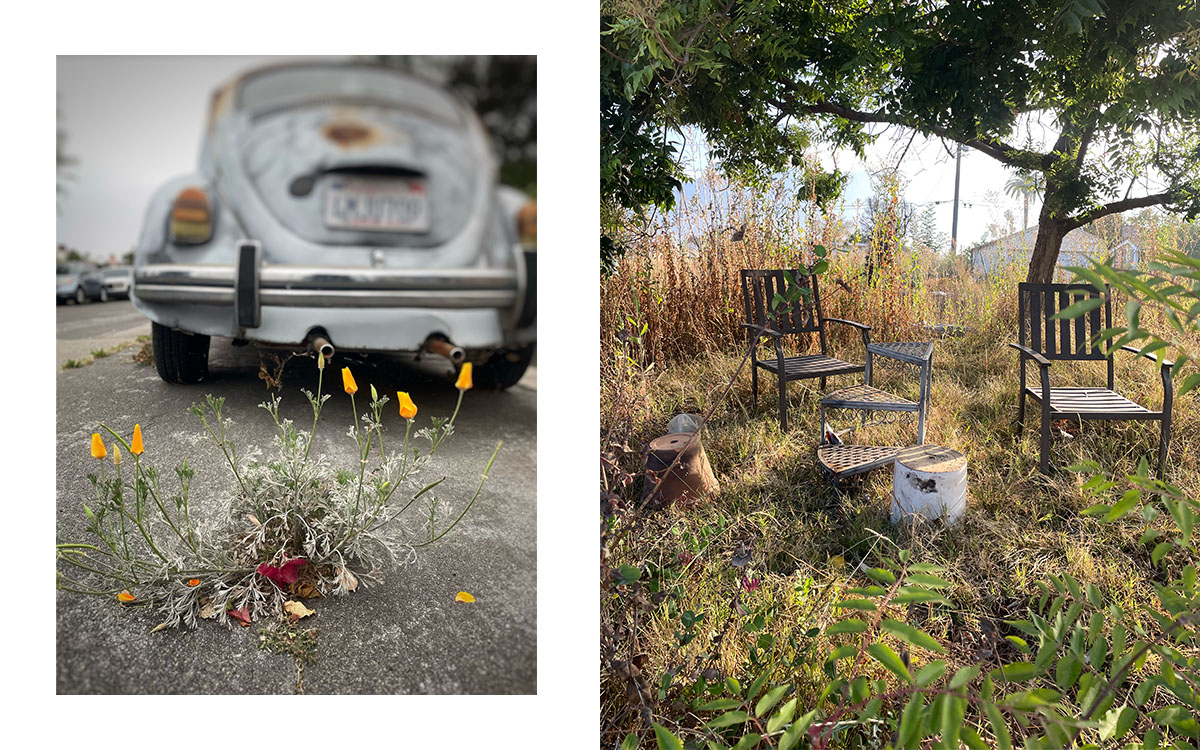
Persistence and patience—Altadena, Summer 2026. | Photos by Lynell George
*
Even still, the scale of Altadena’s ravaging and transformation is dumbfounding. From jagged husks and scorched rubble to emptied-out wild-sunflower-filled fields. The severely altered landscape is a boldfaced visual metaphor for “new slate.” In the last 18 to 20 months, the region has been visited upon by a dizzying number of rebuild forums, remediation consults, community roundtables, resource fairs—each convergence opening new threads of speculation. At the root, the only sure thing: The inevitable will happen. But when and at what intensity?
As workmen pour foundations and new silhouettes of structure frames begin to rise across the cleared territory, more speculation swirls about what the “new Altadena” might become. It’s something we can see now, even though it is still in early stages. On certain tracts, all that wild and “room to roam” has begun to fill: One-story domiciles now re-emerging as structures boasting two or more levels and buildings that extend right to the edges of property lines alter not just scale, space and whimsy, but privacy.
The volume has turned up on essential questions. How might we safeguard what was unique and sui generis? How does one shield what was/is authentic or typical of the place but make it safe?
With those questions in mind, this past spring, I popped into a one-stop event at The Collaboratory, a new Eaton Fire resource hub on Woodbury Road in Altadena. The gathering was a wide-ranging resource fair of architects, contractors, roofers, ADU fabricators, mental health professionals, and so much more for fire-affected individuals to gather information and have one-on-one conversations.
A few steps from the entryway, a floor-to-ceiling map stretched across most of one wall. An inset provided a legend, delineating and quantifying the breadth and magnitude of damage. Little house-shaped icons carried designations: Destroyed, Major, Minor, Affected, Inaccessible, Not Damaged. The houses, varying in colors, populated the map, creating a sobering tapestry.
“Fatality” was distinguished by a gold heart icon. At the very top of the list was a blue house—“Rebuilt”—and its facade contained specific details—a door, a window, a decorative under-the-eaves heart. I searched for friends' streets. My street. Mesmerized by the graphic story it told, I didn’t realize how long I had been standing there, but it was long enough that a woman came out of one of the office spaces to ask me, her gentle hand on my shoulder, if I was OK. That’s when I realized that not only was I standing stock still before it, but my hand was over my mouth.
On my way to find some air and a jolt of coffee, I chanced upon Chris Corbett, an architect, who is one of the founding members of Altadena Collective—a group of architects, real estate professionals, project managers, and landscapers who aim to assist Altadena recover in a meaningful way, with an eye for celebrating the area’s history and character.
I’d been spotting their signage—discrete, evocative, a shade whistful—on my travels criss-crossing town: signs, sunk into lots or affixed to chain link that featured various home styles typical of structures that we’d lost. Bungalows, Spanish, California Craftsman. A sign was posted on a lot that once held one of my favorite casitas. It had been a quirky-quaint Spanish-style home with an expansive patio that had overflowed with plants in pots and in tangled flower beds. Shaggy trees created a dreamy entryway and framed a colorful mosaic-tiled fountain.
For months, the lot had stood empty except for old wires, thick clots of tarry embers, torched metal cans. Then a rough-and-tumble 1970s-era RV now occupied the property’s western edge. The Altadena Collective sign sunk into what's left of the cleared rubble suggested their intentions. They are coming back. Rebuilding perhaps, I hope, as close to what was as possible.
Like many people living in this parcel of LA, Corbett had friends, colleagues, associates—one or zero degrees of separation—who had lost their homes. Early on, he’d put together a post-fire care package for one of his daughter's teachers.
“When I delivered it, he told me, ‘Yeah, I'm gonna have to rebuild.’ He seemed actually pretty calm about the whole thing.” Not a week later, the teacher followed up, letting him know: “I could use some help understanding the process.”
This was not an isolated need. Not long after, he learned that his other daughter’s speech therapist had lost her home—a Janes Cottage, distinguished by its “storybook” steep gables and Tudor Revival architectural style. She too expressed that she needed help—as might, she added, a group of already-organized residents who had also owned Janes destroyed in the Eaton Fire. “I told her,” Corbett said, “that I would be happy to help, to meet on Zoom and talk to her about things, like what was it like to work with an architect? A builder?”
It was during one of those community calls that Corbett connected with Tim Vordtriede, a local architect who had lost his home in fire.
“He was presenting about the history of the Janes, which I didn't know anything about. Later he told me that he worked with another colleague, Chris Driscoll, and that we should all meet. It was one of those moments where we all really aligned on the fundamental aspects about how we could contribute our skills in this effort.”
What began as an ad hoc, grassroots effort to give back to the neighborhood and promote community advocacy evolved into a collective of professionals with a plan. “We just decided to continue to hold these meetings about recovery. Word got out. We were approached by a lot of people,” says Corbett. “They felt heard.”
At the outset, with the Janes, they began to do deep research into its history. “We started going into the [Janes] that weren’t lost and measuring and analyzing them, based on their floor plan. We found it was an early tract development, [with about] six different plans. So, even though the exteriors might be similar, each one was unique,” Corbett told me.
“We developed a method and a typology pattern to it all,” Corbett said. “We ended up coming up with six main designs that people could choose from. At the time we named them A through F, but that didn't seem to have enough character to it. So we decided to start naming them based on [their] letter [as a way to honor the region]. So A became Alta, B became Butler [after the former resident and science-fiction author Octavia E. Butler], C became Cobb, D became Dena, and so on. I think we ended up going with the seventh one. So the G became Grandeur.”
The research, community outreach, and ongoing conversation proved critical at every level of the process: “What all of us began to learn right away is that it wasn’t about just rebuilding a cottage. This isn’t a typical kind of client building a dream home. They are a group of people trying to get back the things they lost.”
If time hasn’t yet healed, it has shifted some perspectives. In the beginning, said Corbett, residents wanted to get back the thing that they lost, “exactly as it was.” But with time to research and assess, they’ve shopped around and gotten some distance, he said. “They’ve formed more ideas about what recovery can be.”
What does regeneration look like? Sound like? A wall of sound: saws, drills, hammers locked in. Bluetooth speakers blasting a chorus of brass and bass, serenading standing structures. Flatbeds carrying wood, drywall, and cement bags snake through residential streets like a caravan. Sunday through Sunday. Life seeps back into Altadena little by little. But it is a fraction of what it was. Still.
*
This past September, the title of a talk hosted by Pasadena Heritage caught my attention: “What Makes a Craftsman a Craftsman?”—specifically in this post-fire moment. “Is a Craftsman a set of exterior details?... or [is] it an underlying philosophy?” The event’s description posed the critical, of-the-moment question: “Can a new home built of different technologies to new codes and from modern, state-of-the art materials still be a Craftsman”?
As the RSVPs were at capacity, I arrived early to claim a seat. Moments before the presentation began, a woman with an open notebook, already laced with a web of notes, equations, and phone numbers, slipped in next to me, then leaned over to ask if a Craftsman was in my plans. I told her that I was there to be ears and eyes for a displaced and overwhelmed friend and was gathering information. She shared that she had a Spanish-style home that was a total loss and initially thought that she would rebuild similarly. But in the interval that had passed, wavering between selling or recommitting to Altadena, she’d thought she’d keep her land but try something different. Her foremost desire: To construct something that reflected the history and style of the neighborhood but was fire-hardened and could stand up to whatever bedlam the future might throw our way.
The featured speaker, Steven S. Lamb, an architectural historian and preservation adviser, clicked through a series of slides showing us a strikingly wide array of interpretations on a Craftsman—classic, modern, abstract, unique—some thrillingly quirky, in hues and shapes. While there was much to consider and wade through about fire zones and safety restrictions, it didn’t mean, he encouraged, that you couldn’t have something that reflected your taste, the very reason you called yourself an Altadenean.
What does regeneration look like? Sound like? A wall of sound: saws, drills, hammers locked in. Bluetooth speakers blasting a chorus of brass and bass, serenading standing structures. Flatbeds carrying wood, drywall, and cement bags snake through residential streets like a caravan. Sunday through Sunday. Life seeps back into Altadena little by little. But it is a fraction of what it was. Still.
In late September, Inside Climate News reported that more than 3,600 permits were issued across the Eaton Fire burn area, with just under 200 destroyed housing units fully rebuilt.
LA County Supervisor Kathryn Barger, who represents unincorporated Altadena, remarked in a mid-year assessment: “Significant barriers remain. Many impacted residents have taken no action to rebuild because they lack the capital to move forward—an issue exacerbated by delayed insurance payouts.”
Thousands of displaced families are still weighed down by permitting mazes and dead-end or dried-up loan opportunities, while home and business owners are protesting over a historically slow payout of federal disaster funds.
This jibes with Corbett’s calculations. “We anticipate that 50 percent of Altadenans will return,” he told me. “But the next 50 percent, the long tail of recovery, will happen over three, five, seven years—as people try to figure out how to—or if they can—rebuild.”
But, he said, “There are very few people who even have permits. After all that is finished, it’s going to be little more than a trickle.”
“A new reality has begun to set in,” Nikki High, owner of Pasadena’s Octavia’s Bookshelf (also named for the author) told me. High is a longtime Altadena resident who took her entire stock of books off the shelves immediately following the fire to provide space for free basic resources—diapers, water, respirators, air purifiers, and more—for a community in desperate need. “You can feel it all over. People facing the realization that they may not be able to come back. And what will that do to what we know Altadena to be? And that ... ” she said through a long sigh, “is a new sense of loss.”
“We have to understand that disasters happen and that safety is a major concern,” Corbett said. How vibrant, strong, and connected a community can be is not determined by how quickly houses rise from the rubble, “But how strong and connected it is—and can remain.”
This is why working collaboratively and across disciplines is so critical—having ongoing conversations with residents, activists, organizers, business owners, historians. What one expert, agency, or supplier can’t provide, another can troubleshoot or recommend. “It’s the people,” Corbett underscored. “Social resiliency is a better determiner of recovery than anything else.”
“Maybe we, Altadena, can be a template. What is community and community practice given extreme weather events? Disasters of this magnitude. Are there any little lessons that might help someone else? Somewhere? Here?”
*
Hovering between past and future, the fatigue and wariness in Altadena is tangible. I think about the poet Shimson-Santo’s words: “Part of coming home isn’t just about the house. All this repair work has to be done in the material world—and it's tremendous—but what is the work we have to do inside?”
On the late-summer afternoon I visited Cielo and Shimson-Santo’s workshop, the weather was sweltering, uncharacteristically humid. A super El Niño was kicking in. Nothing like the dry summers of my youth. Climate fully changed. And so have we, fundamentally.
From my place at the table, I watched 20 or so gathered leaning into their tiles—a window into a memory. On them were renderings of lavish entryways, a child’s family portrait, a coyote slinking across a bucolic road, a radiant poppy in full bloom, a single ear—listening. There was an expansive, comfortable quiet that enveloped the room; it was one of intimacy, flow, connection.
“Maybe we, Altadena, can be a template,” Shimson-Santo reflected. “What is community and community practice given extreme weather events? Disasters of this magnitude. Are there any little lessons that might help someone else? Somewhere? Here? Down the road.”
She paused. I heard an octave dip in the music of her lilting voice. “Because this is the curriculum that is going to be happening for the rest of our lives.”