 The Magazine of The Sierra Club
The Monkey Wrench Gang
Clean-energy thinkers and tinkerers roll up their sleeves
Humans have been tapping renewable power for millennia: The Chinese built windmills 2,000 years ago to pump water, for instance, and before that the Greeks supposedly zapped enemy ships with beams of sunlight concentrated by curved bronze shields. What's changing today are not just the design and scale of the applications but also the way we talk about them.
A profusion of recent books, blogs, Web sites, and magazines scrambles to keep up with the clean-energy revolution. Too much of this information adds up to a total snoozefest--wonky and technical, if not cynical and dismissive--but it's hard to think of a topic more urgent, inspiring, and breathtaking. Fortunately, writers, from grassroots innovator William Kamkwamba to megastar Al Gore, are seizing on green technology from all angles, offering hopeful tales of progress, techie chronicles of whiz-bang inventions, and epic manifestos.
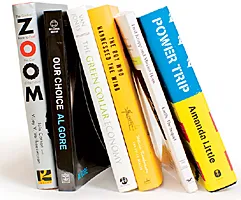
Gore's highly anticipated call to arms, Our Choice: A Plan to Solve the Climate Crisis (Rodale, 2009), is a rigorously detailed 400-page inventory of here-and-now solutions to climate change--solar, wind, geothermal, smart-grid components, and carbon capture and sequestration--rich with glossy photos and elegant diagrams. Essentially, it's a sexy textbook, and despite the prevalence of geeky terms like "single-crystal polysilicons" and "gradient zones," I recommend it to anyone who wants a crash course in leading clean-energy technologies and how they work. One caveat: While Our Choice purports to be about hope, it's heavy on doom and gloom: "I am offering you the choice of life or death," reads the opening line, quoting Deuteronomy. "You can choose either blessings or curses."
Consider several more-buoyant books: Earth: the Sequel: The Race to Reinvent Energy and Stop Global Warming (W. W. Norton, 2008), by Environmental Defense Fund president Fred Krupp and Miriam Horn, brims with capitalist fervor as it describes a smorgasbord of green technologies, from the tried-and-true to out-there possibilities like virus-powered batteries and "hairy" solar panels built from nanoparticles. Another celebration of innovation is Zoom: The Global Race to Fuel the Car of the Future (Twelve, 2007), in which Economist writers Vijay V. Vaitheeswaran and Iain Carson explore a "great awakening" in the global auto industry that's propelling advances in clean electric cars.
Turning an eye to people, not gizmos, environmental advocate Van Jones argues in The Green Collar Economy: How One Solution Can Fix Our Biggest Problems (HarperCollins, 2008) that emerging green industries can alleviate poverty and promote social justice. "Will the green wave lift all boats?" challenges Jones. He says that skilled, well-paying jobs in solar and wind installation, home weatherization, electric-car manufacturing, and grid retrofits would improve the health and economy of the low-income communities burdened with most of America's polluting plants and facilities.
No doubt the feel-good clean-energy story of the decade is Kamkwamba's The Boy Who Harnessed the Wind: Creating Currents of Electricity and Hope (HarperCollins, 2009), written with Bryan Mealer. As a young boy in Malawi, Kamkwamba was forced to drop out of school as his family's farm was devastated by drought. Following diagrams in a library book, Kamkwamba built a windmill with materials from a scrap heap, pumping water to his family's crops and prosperity into his community.
Numerous blogs track the latest news on thin-film solar cells, superconducting power cables, and lithium-ion batteries. Visit Fortune's passionately geeky Green Wombat, the gearhead paradise EcoGizmo, Wired's fetishistic Autopia, Joseph Romm's policy-minded Climate Progress, and the wonky but practical industry site Clean Edge. Having grown up with an engineer grandfather who was forever tinkering in the garage, I love the way these eco-tech blogs have the same gee-whiz backyard-enthusiast inventiveness as Popular Science, but with planetary solutions in mind.
It's also worth following bigger-picture developments in the clean-energy industries on the New York Times blog Green Inc. and the Wall Street Journal Environment page, both required reading for green investors. For color on the activist organizations promoting clean energy, check out the inspired photographs and commentary on 350.org, which aims to make 350 parts per million (the safe upper limit of carbon dioxide in the atmosphere) "the most important number in the world"; Gore's Repower America; the green-collar-jobs advocacy site Green for All; T. Boone Pickens's bold PickensPlan (pickensplan.com); and the plucky-youth climate blog It's Getting Hot in Here.
In the early 1900s, Thomas Edison said in a little-known interview: "The scheme of combustion to get power makes me sick to think of it, it's so wasteful. You see, we should utilize natural forces and thus get all of our power. Sunshine is a form of energy, and the winds and the tides are manifestations of energy. Do we use them? Oh no! We burn up wood and coal, as renters burn up the front fence for fuel. We live like squatters, not as if we owned the property." The father of America's energy industry would be pleased to know that his opinion, rare in his day, has been joined a century later by so many others.