 The Magazine of The Sierra Club
The Solar Industry Has Been Bogged Down by Red Tape. Digital Tools Are Changing That.
These new technologies are making it easier to power up via the sun
Illustrations by Koren Shadmi
When Paul Dale decided to expand his rooftop solar system in Massachusetts three years ago, he thought it would be a breeze. He already had 22 panels. The addition of eight panels and battery storage would lower his family’s utility bill and boost their energy independence. Dale signed a contract with solar installer Solaris Renewables in January 2023.
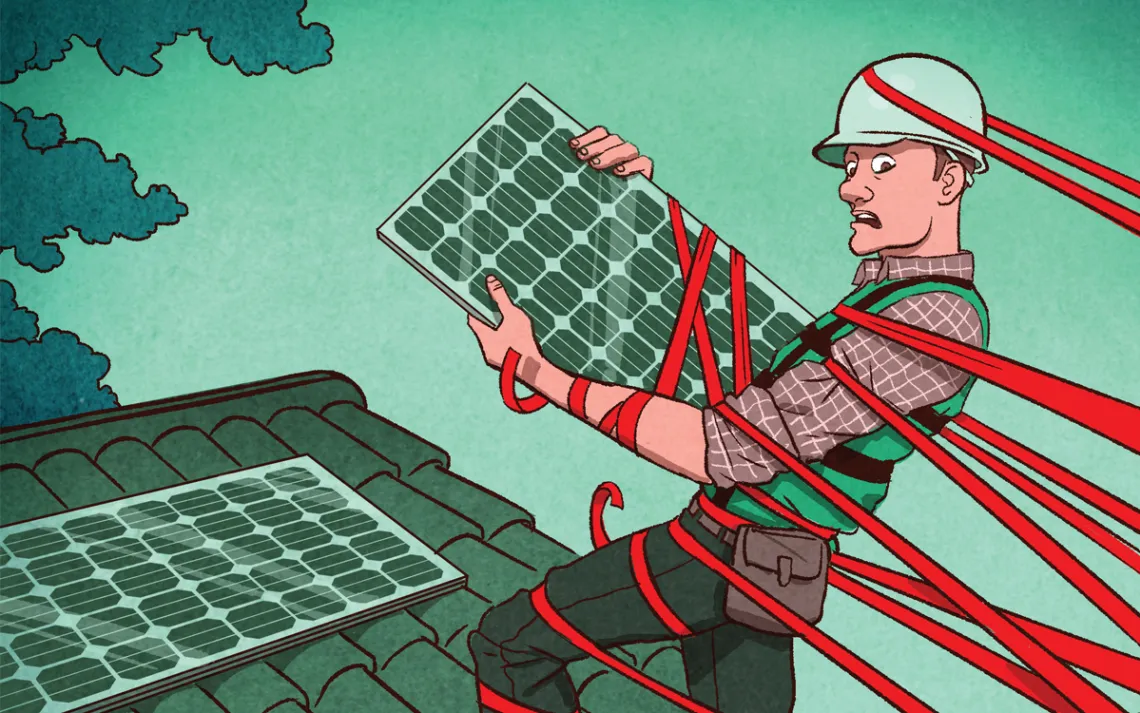
In the months that followed, the company had to wade through a tangle of fire and electrical codes to get permission from town officials to operate the devices. The process required several reviews and meetings, some of which had to be rescheduled. And new federal standards for battery storage were misinterpreted by local officials, according to Brian Sadler, vice president at Solaris Renewables. In short, red tape and confusion turned what should have been a speedy install into a yearlong endeavor.
Dale’s experience is not uncommon. The United States has more than 19,000 municipalities, each with its own building, fire, structural, and electrical codes. Solar installers must acquire permits, indicating compliance with these standards, before any panels or power walls can go up. The review process varies widely from state to state and even within counties.
In Massachusetts, at least 125 jurisdictions still require solar installers to apply for permits in person. In Illinois, each municipality interprets national electrical standards differently. Meanwhile, in Colorado, delays caused by staffing shortages in county permitting offices have resulted in nearly a fifth of solar customers canceling their projects.
The current regulatory landscape, with its ever-changing requirements for installers, makes it harder for people to go solar. Local jurisdictions, even in progressive states, are unintentionally throttling the country’s switch to one of the cleanest and most ubiquitous forms of energy: the sun.
“The patchwork approach to solar permitting means that the entire residential rooftop solar market has a wet blanket on it,” said Johanna Neumann, the senior director of Environment America’s 100% Renewable Energy campaign. “And at this moment, where we need to be transitioning to clean energy as quickly as possible and we’re not getting support from the federal government, this is a spot where localities and states can take action.”
At least two organizations, Symbium and SolarAPP Foundation, are working to make solar more accessible by offering software that enables municipalities to process permit applications quickly. Through these web-based platforms, solar contractors can verify that their projects meet local regulations by navigating a series of questions, much like completing an online survey. Installers get instant feedback on whether their projects comply with safety codes and standards, without needing to schedule in-person reviews. Rejected proposals include details on which requirements weren’t met. And with these online platforms, approvals are less dependent on municipal staffing levels.
Solar experts say this novel solution, called instant permitting, could be key to keeping residential solar accessible and affordable in the years ahead—by reducing the intangible costs, or soft costs, of securing permits. While individual permits may cost only a couple hundred dollars, the time installers spend learning new standards or redoing plans adds up. The most salient benefit of instant permitting is that it drastically shortens the review process. “It would have saved the Dales months,” Sadler said.
While individual permits may cost only a couple hundred dollars, the time installers spend learning new standards or redoing plans adds up.
In places where installers already use instant-permitting platforms, contractors are finishing solar projects faster than ever. Last fall, Doni Nicoll, a solar installer in Tucson, Arizona, needed a way to get municipal approval before the end of the year so that customers could take advantage of the now-extinct federal solar tax credit. He turned to SolarAPP Foundation’s platform, SolarAPP+, which his manager, Louis Woofenden, had tested in 2021 when Pima County and the City of Tucson first adopted it. Nicoll cut his projects’ approval times down from several weeks to one day.
Following the use of SolarApp+ in Pima County and the City of Tucson, solar installations increased by 140 percent in two years, according to an analysis by Permit Power, a renewable energy advocacy group. That’s more than double the rate of installations in surrounding jurisdictions that weren’t using the platform. “Just making all these things a little cheaper and a little faster—I think it’ll help on the consumer side,” Woofenden said. “If some of the other permits lag, or we have to move things around in the schedule, SolarAPP+ permits can be done very quickly.”
As of December 2025, SolarAPP Foundation was partnering with more than 520 jurisdictions across 17 states. In addition to automating the permitting process, SolarAPP+ allows installers to get instant approval to build battery storage. Next year, Matthew McAllister, the CEO of SolarAPP Foundation, expects to launch a tool for virtual inspections, making in-person final inspections obsolete.
“It’s like you go to the appliance store, you pay for the appliance, and a day or two later, the crew shows up with a refrigerator on a dolly and they install it,” Neumann said of her vision for the future of solar. “There’s no reason that can’t be the model for solar, and instant permitting helps make that the model.”
Americans' energy bills are rising at rates not seen in decades, with some community advocacy groups reporting that electricity bills have shot up by an average of 30 percent since 2021. As the Trump administration attempts to keep people hooked on fossil fuels, local leaders are approving multidecade contracts with oil, gas, and even coal companies. These de facto energy monopolies are expected to cost ratepayers millions.

Renewable energy, especially solar, has the potential to reduce these costs while allowing consumers to cut ties with fossil fuels—a crucial step for climate action. An analysis by the Acadia Center, a clean energy nonprofit, found that during a heat wave that engulfed New England last summer, residential solar saved ratepayers as much as $19 million on one particularly hot day by reducing the grid operator’s need to purchase expensive energy from oil and gas providers to meet peak demand.
Solar is also more than five times cheaper than it was a decade ago. This price reduction has spurred a quiet revolution across the United States. According to Environment America, nearly 5 million households now get at least a portion of their energy from personal solar arrays. And an additional 3.6 million are purchasing clean energy through their power providers.
“It’s important to keep the big picture in mind: The sun remains America’s most abundant and renewable energy source,” Neumann said. “Solar alone could power our nation, many, many, many times over.”
Elected officials from Montana to Florida have taken note of this potential, introducing bills that would ease access to solar. In some states, leaders have sponsored bills that would limit solar reviews to safety issues, preventing aesthetics or HOAs from dictating where panels should go. In Maryland and California, officials must now allow installers to work with instant-permitting platforms to hasten approvals. This past December, Massachusetts lawmakers advanced a bill that would add Dale’s home state to the list of places where municipalities must use instant permitting.
Dale finally flipped the switch on his upgraded system in January 2024. The panels and battery storage now power his family’s home along with two electric vehicles. During the summer, when the Dales produce more energy than they use, the system earns credits that carry over into the winter months, and they rarely pay for electricity.
“The panels are operating. They’ve been working fine ever since,” Dale said. “Life is good, but it was certainly a protracted process to get it all to happen.”