 The Magazine of The Sierra Club
Environmental Groups Vow to Stop Trump’s EPA From Revoking the Endangerment Finding
As global heating accelerates, the nation’s environmental watchdog is trying to muzzle its own ability to act
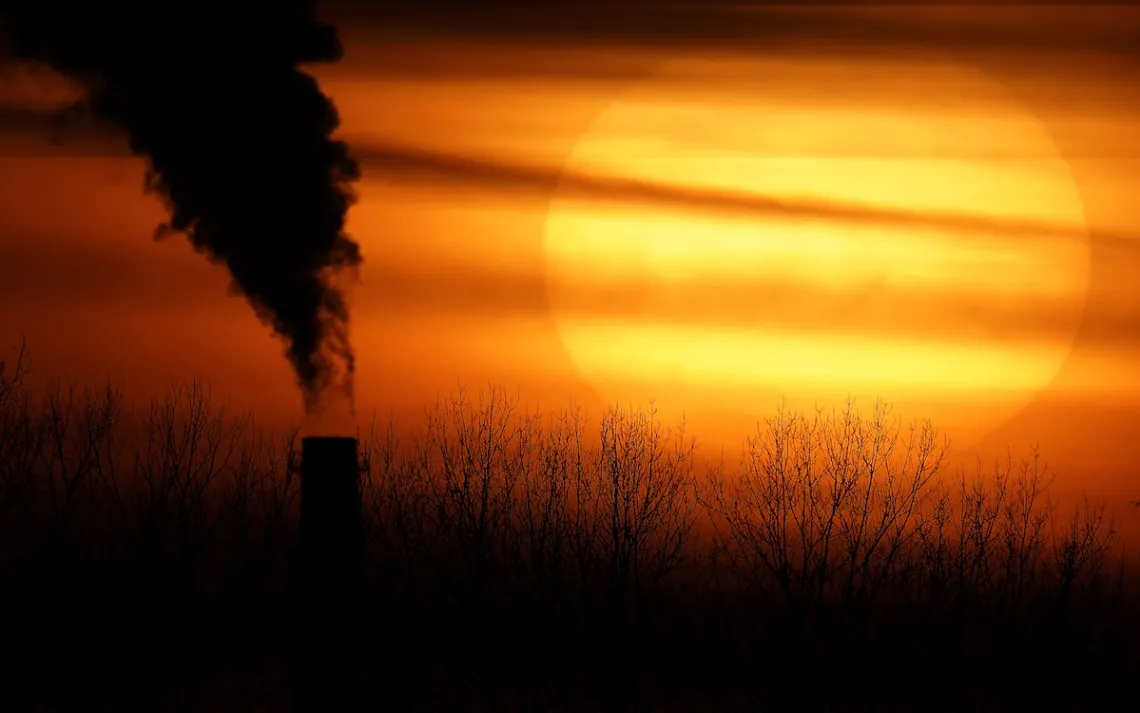
A coal-fired power plant in Kansas City, Missouri. | Photo by Charlie Riedel/AP
Donald Trump and his administration have taken their most sweeping action yet to completely gut the nation’s ability to rein in the dangerous greenhouse gas emissions that are imperiling the planet. On Thursday, Trump announced that the Environmental Protection Agency has finalized its repeal of the endangerment finding—a science-based determination that serves as the underpinning for the agency’s legal authority to regulate planet-warming emissions under the federal Clean Air Act.
The move, while not unexpected, drew swift condemnation from environmental advocates, climate scientists, public health experts, and Democratic public officials, all of whom promised a major legal battle to stop the move.
“The elimination of the endangerment finding is signed, sealed, and delivered,” EPA head Lee Zeldin said during a White House press conference joined by President Trump, who was presented with the "undisputed champion of beautiful, clean coal" award just the day before. Zeldin and Trump boasted that the action constitutes the single-largest deregulatory measure in US history and claimed it will save Americans over $1.3 trillion in regulatory costs.
“This move is a fundamental betrayal of EPA’s responsibility to protect human health,” said Joseph Goffman, former assistant administrator of the EPA’s Office of Air and Radiation. “It is legally indefensible, morally bankrupt, and completely untethered from the scientific record.”
The endangerment finding has served as the foundation for EPA rules limiting greenhouse gas emissions for the last 16 years. Its elimination deals an enormous blow to public health protection and the fight against climate change, experts say. The EPA issued the finding that greenhouse gases endanger public health and welfare in 2009 during the Obama administration. The finding came in response to a 2007 Supreme Court decision in Massachusetts v. EPA, in which the majority held that greenhouse gases fall under the definition of pollutants in the Clean Air Act. Per that decision, the EPA was then required to regulate them if it made a determination that they endanger public health and welfare.
The repeal comes as trends show global average temperature rise is accelerating. Scientists warn that the world could be heading toward a “hothouse Earth” trajectory where global heating and its consequences becomes unmanageable and irreversible. The last three years were the hottest years ever recorded. Extreme weather is on the rise and is costing billions of dollars in damage each year. The US has experienced 426 billion-dollar extreme weather and climate-related disasters since 1980 at a total cost exceeding $3.1 trillion, according to Climate Central.
“This move is a fundamental betrayal of EPA’s responsibility to protect human health. It is legally indefensible, morally bankrupt, and completely untethered from the scientific record.”
Andres Restrepo, a senior attorney with Sierra Club’s Environmental Law Program, said the Trump administration’s cost-savings justification for axing the endangerment finding does not add up.
“Any sort of economic benefit to industry or to consumers is obviously a drop in the bucket compared to the damage it will do,” he told Sierra.
In eliminating the endangerment finding, the EPA is also wiping away all greenhouse gas emissions standards from vehicles that were predicated upon it. Zeldin said this would result in greater consumer choice and savings in vehicle purchasing. “The forced transition to electric vehicles is eliminated,” he said during the press conference.
Electric vehicles, however, generally have a lower total cost of ownership compared to their gasoline counterparts, as there is less overall maintenance required. Used EVs currently have the lowest cost of ownership across all vehicle classes, according to research published last month from the University of Michigan.
The fossil-fuel-dominated transportation sector is also the largest source of US greenhouse gas emissions. Eliminating GHG emissions controls for vehicles will inevitably lead to even more climate pollution.
“By scrapping vehicle global warming pollution standards today, the Trump administration has co-signed the release of more than 7 billion tons of planet-warming emissions nationally in the decades ahead,” said Gretchen Goldman, president of the Union of Concerned Scientists. While the EPA’s action on Thursday specifically eliminates standards for vehicle emissions of GHGs, experts anticipate that the EPA will soon apply the same legal determination and eliminate GHG standards applicable to stationary sources of climate pollution, such as power plants.
States plus environment, public health, and other experts vow to stop the move
Health experts say that the climate crisis is also a public health crisis, and by repealing the endangerment finding, the EPA is abandoning its mission to protect human health.
“Instead of protecting the public’s health from the dangerous and deadly effects of air pollution, including greenhouse gases emitted by new cars and trucks, this action will exacerbate the health threats we are already seeing from climate change, including increased heat waves, more air pollution, and deadly wildfires,” said Georges C. Benjamin, executive director of the American Public Health Association.
“The American people deserve to live full lives in clean and healthy communities,” he added. “We expect EPA to fight for this, but it is abdicating its authority and losing sight of its mission to protect the American public from environmental health threats and to hold industry responsible for meeting these standards.”
The American Public Health Association, the American Lung Association, the Alliance for Nurses for Healthy Environments, and Physicians for Social Responsibility issued a joint statement saying that they “will challenge this unlawful repeal.”
Multiple other public interest organizations and several Democrat-led states have also said that they will go to court to challenge the EPA’s rollback.
“Two decades ago, the Massachusetts attorney general’s office led the fight to force the federal government to protect the American people from the proven dangers of greenhouse gas emissions, and we will lead once again against the Trump administration’s attempt to walk away from that responsibility,” said Massachusetts Attorney General Andrea Campbell. “I’ll see them in court.”
California Attorney General Rob Bonta said in a statement that his state, too, “will challenge this illegal action in court.”
A legal battle awaits
The Sierra Club, the Environmental Defense Fund, and other environmental groups also are preparing to bring legal challenges.
“We’re planning to join our NGO partners in suing over the rule,” Restrepo told Sierra. He said that the groups will promptly file suit with the DC Circuit Court of Appeals.
Restrepo noted that the Sierra Club has been involved in the legal fight to force the EPA to regulate climate pollution longer than any other organization. In 2002, the Sierra Club sued the EPA over an outstanding petition demanding that the agency update its vehicle regulations under the Clean Air Act to include greenhouse gas emissions. When the EPA agreed to review its vehicle standards but declined to regulate greenhouse gas emissions, further legal action ensued, initiated by states like Massachusetts and other plaintiffs including the Sierra Club. That case ultimately resulted in the Massachusetts v. EPA Supreme Court decision that held that the Clean Air Act covers greenhouse gases and ultimately led to the EPA issuing the endangerment finding.
The finding has overcome previous court challenges. In 2012, the DC Circuit rejected attempts from a coalition of industry groups to strike down the finding and related regulations, and the Supreme Court declined review.
The litigation over the endangerment finding repeal could wind up back before the Supreme Court, and it is unclear what the outcome will be. Three of the four conservative dissenting justices in Massachusetts v. EPA are still on the bench.
Restrepo said it would be extremely unusual for the Supreme Court to overturn its 2007 precedent. But court review would likely be several years away, and for now the challengers are focusing on the first round of the litigation.
“The first order of business is litigating this at the DC Circuit, and I think the odds are really stacked against EPA in that forum,” Restrepo said.
The Trump EPA is arguing that the Clean Air Act never explicitly authorized the agency to regulate global greenhouse gas emissions. “For years, unelected bureaucrats twisted the Clean Air Act into something it was never meant to be,” Zeldin said.
David Bookbinder, director of law and policy at the Environmental Integrity Project, who previously worked on the Massachusetts case as Sierra Club’s chief climate counsel, told Sierra that the Clean Air Act actually does specifically mention “climate” in its text, suggesting that Congress did intend for it to apply to climate pollution. The Clean Air Act’s definitions section states that “effects on welfare”—which is part of the statute’s endangerment language—include effects on “soils, water, crops, vegetation, manmade materials, animals, wildlife, weather, visibility, and climate, damage to and deterioration of property, and hazards to transportation, as well as effects on economic values and on personal comfort and well-being.”
“The Trump administration’s repeal of the endangerment finding for climate pollution is a direct assault on children’s most fundamental constitutional rights—including their rights to life, liberty, health, and safety.”
Fight for the future
Beyond the statutory challenges to the rollback, the nonprofit law firm Our Children’s Trust— which brings climate lawsuits on behalf of children and young people against governments—said that it will be challenging the Trump administration’s move as a violation of young Americans’ constitutional rights.
“The Trump administration’s repeal of the endangerment finding for climate pollution is a direct assault on children’s most fundamental constitutional rights—including their rights to life, liberty, health, and safety,” said Julia Olson, founder and chief legal counsel at Our Children’s Trust.
“Our Children’s Trust will file a petition on behalf of youth in the DC Circuit to reverse this unlawful action as unconstitutional,” Olson added. “The Clean Air Act requires EPA to rely on the best available science to protect public health and welfare and control pollution, not unleash it. Abandoning the endangerment finding violates EPA’s mandate from Congress and transgresses constitutional protections that safeguard children from government-created danger.”
While critics of the EPA’s move to undo the endangerment finding say that it is a gift to corporate polluters, some legal experts warn that the move could potentially backfire on big polluters by opening them up to greater liability risk for climate change under federal common law.
“The current administration favors the profits of the plutocrats and polluters they serve over the people they’re supposed to represent.”
Oil companies like ExxonMobil and Chevron are currently facing dozens of climate liability lawsuits brought by cities, counties, states, tribes, and individuals. The companies’ primary defense to these claims are that they are preempted by the Clean Air Act, arguing that since the EPA has the authority to regulate greenhouse gas emissions, lawsuits pertaining to climate change and emissions are not viable. That defense could crumble with the EPA now disclaiming it has such regulatory authority.
“Ironically, stripping away federal preemption leaves these fossil fuel companies more vulnerable to litigation for the harms their products cause,” Senator Chuck Schumer (D-N.Y.) and Senator Sheldon Whitehouse (D-R.I.) said in a statement responding to the EPA’s endangerment finding repeal.
“States, tribes, and local governments should take up the mantle and hold Big Oil accountable for the decades of devastation it has inflicted on the American people,” the senators said.
Michael Mann, a climate scientist and distinguished professor at the University of Pennsylvania, said that sabotaging efforts to rein in fossil fuel emissions has long been a goal of “polluters and plutocrats,” and that Americans should exercise their democratic muscle in pushing back.
“The current administration favors the profits of the plutocrats and polluters they serve over the people they’re supposed to represent,” Mann told Sierra. “And the only way we see things change is by Americans rising up, speaking up, turning out, and voting out the villains and voting in policymakers who care about our future. I hope voters are thinking about that going into the midterm elections.”