 The Magazine of The Sierra Club
Affordability and Race Play a Major Role in Whether People Live in Nature-Deprived Areas
A new report notes that access to nature is critical to human health and well-being
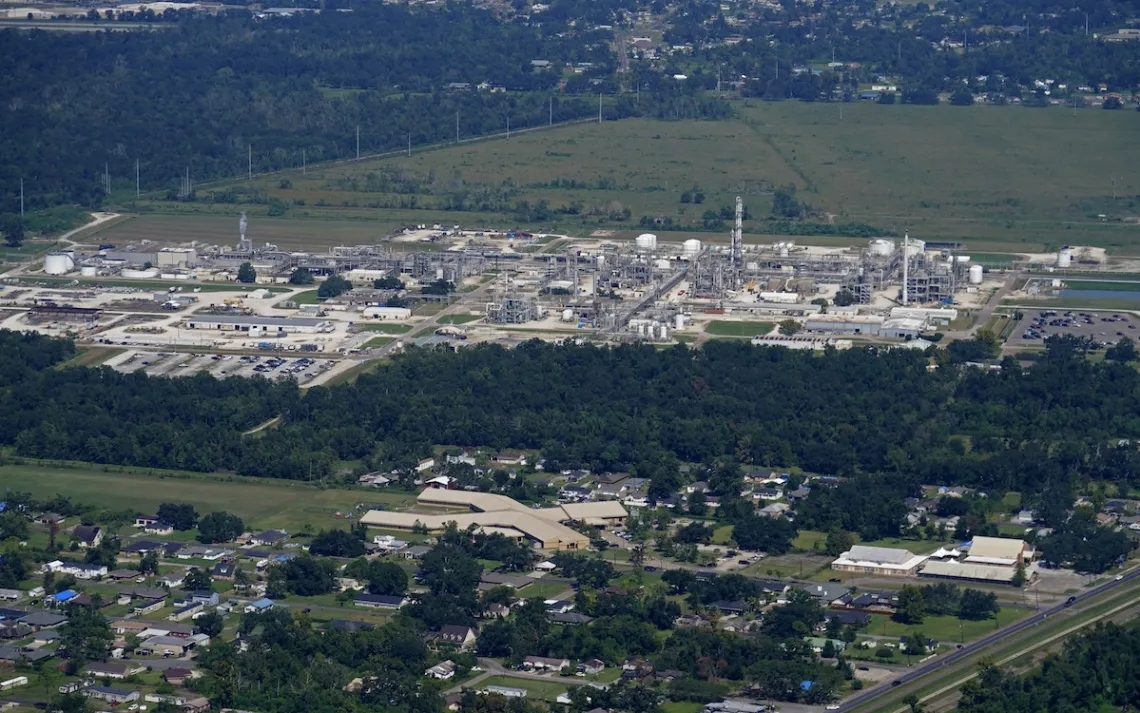
The Fifth Ward Elementary School and residential neighborhoods less than half a mile from the Denka Performance Elastomer Plant in Reserve, Louisiana, in 2022. The plant emitted chloroprene—a chemical linked to cancer—into the surrounding environment. In 2023, the Biden administration sued Denka under the Clean Air Act for presenting “an imminent and substantial endangerment” to public health or the environment. In 2025, the Trump administration dismissed the lawsuit. | Photo by Gerald Herbert/AP Photo
Communities across the United States have lost proximity and access to undisturbed natural spaces because of industrial development. But the experience and burdens of nature loss are not distributed equally. Communities of color and low-income individuals, for example, disproportionately live in nature-deprived areas.
This so-called nature gap, first identified in a landmark 2020 analysis by the Center for American Progress (CAP), is now at risk of widening under the Trump administration, according to a new report from CAP and partners.
The report, published in February, takes a more comprehensive look at contemporary environmental degradation across the contiguous United States and how it is distributed across socioeconomic indicators like race, ethnicity, income level, and housing affordability. Researchers used data from the 2020 US Census and the 2019–2023 American Community Survey and analyzed the data across more than 50 measures of climate risk, pollution, and infrastructure.
The analysis shows that communities of color are three times more likely than white communities to live in nature-deprived areas—defined as census tracts in the top 25 percent in terms of nature loss by state. Seventy-four percent of communities found in such areas are communities of color (compared with 26 percent that are white).
“These findings confirm that environmental racism is real, and it persists,” said Sam Zeno, senior policy analyst at CAP and coauthor of the report.
A similar disparity exists in terms of income level. Nearly three-quarters of people living in nature-deprived areas are low-income, and 60 percent live below the poverty line.
In terms of housing affordability, the vast majority of communities living in these areas, 83 percent, are renter-majority communities, and 70 percent are composed of households experiencing severe housing cost burdens in which housing costs account for more than 50 percent of their income.
“All Americans should have the right to readily access nearby nature. But because of centuries of development, energy buildout, agriculture, we’ve lost nature. And the way that we’ve lost it is inequitable.”
Communities located nearest to pollution sources are also almost twice as likely to be in nature-deprived areas, according to the analysis. This finding suggests that pollution and nature loss compound one another, posing even greater health risks to these communities, which tend to be nonwhite and low-income. “We also found, for communities with the most proximity to pollution and nature loss, 77 percent are communities of color and 75 percent are low-income,” Zeno explained.
The report notes that access to nature is critical to human health and well-being. Time spent outdoors in healthy environments improves physical and mental health, and nature provides important ecosystem services like filtration of air pollutants and drinking water purification and provision of shade and recreational spaces.
“We’re not just talking about the beauty of the scenery around us. We’re talking about the health, well-being, economic, housing, and educational benefits that all come from being surrounded by nature,” Rena Payan, report coauthor and chief program officer at the nonprofit organization Justice Outside, told Sierra.
“When we talk about educational benefits, we know that children who have tree canopy in their neighborhoods, for example, are able to concentrate better in school,” Payan added. “The stressors of life become less of a distraction when we have a connection to the outdoors. And close proximity to nature also increases property values. Nature really, really does touch every aspect of our lives.”
“All Americans should have the right to readily access nearby nature,” Zeno told Sierra. “But because of centuries of development, energy buildout, agriculture, we’ve lost nature. And the way that we’ve lost it is inequitable.”
The report argues that the problem is “not accidental” but is rooted in the country’s history of systemic racism, discrimination, and inequality. And it is resulting in real consequences today in terms of adverse health impacts and greater vulnerabilities to climate-fueled extreme weather.
“The nature gap is fundamentally a health gap because whenever nature disappears, community health declines,” the report says.
Nature-deprived areas also tend to be more vulnerable to climate change impacts such as extreme heat and flooding. As the report explains, “National analysis shows that areas with the most severe nature loss also face the highest climate dangers: more severe flooding, deadlier extreme heat, stronger storms, and increasing coastal hazards.”
The report arrives at a time when the Trump administration has rolled back environmental, public health, and public lands protections at an unprecedented scale. “The Trump administration is rapidly expanding efforts to drill, mine, log, and increase extraction on public lands,” Zeno said. “They’re selling off our public lands. And we will see those impacts on the nature gap and on the access that communities have to the outdoors.”
“The communities bearing the greatest burden are also the ones building the most powerful solutions.”
Community-based groups are leading solutions
Despite the persistent and systemic challenges, community-based organizations on the front lines of nature loss are working to combat environmental inequities. The CAP report spotlights these and other examples of groups that are striving to overcome the barriers of nature deprivation and environmental injustice.
In Chicago, for example, where 85 percent of communities are nature-deprived, an organization called Chicago Adventure Therapy offers outdoor recreation opportunities particularly for youths and families that have been excluded from these activities due to cost, access, or other barriers. The nonprofit focuses on expanding access to outdoor recreation for Black, brown, LGBTQ+, and low-income youths.
“They organize adventures like paddling, camping, hiking, rock climbing,” Zeno said. “By offering these types of programs, they provide safe spaces for communities that haven’t necessarily seen themselves [participating] in outdoor recreation and might not have the means to access these opportunities.”
Another organization in California called Black Surf Santa Cruz creates a safe space for people of color in the community to gather, experience surfing, and partake in ocean education and recreation.
“The communities bearing the greatest burden are also the ones building the most powerful solutions,” said Kim Bailey, report coauthor and president and CEO of Justice Outside. “This report is an invitation to policymakers and funders to follow their lead and ensure access to nature is a right, not a privilege.”
Payan echoed this call for policymakers to follow the lead of frontline communities when it comes to taking action to address the nature gap.
“Listen to the stories,” she said. “Listen to your constituents about what they want from you when it comes to their relationship with the outdoors.”