 The Magazine of The Sierra Club
Artificial Islands Are Turning Industrial Wastelands Into Thriving Ecosystems
Groups across North America are turning to the power of Mother Nature to revive waterways
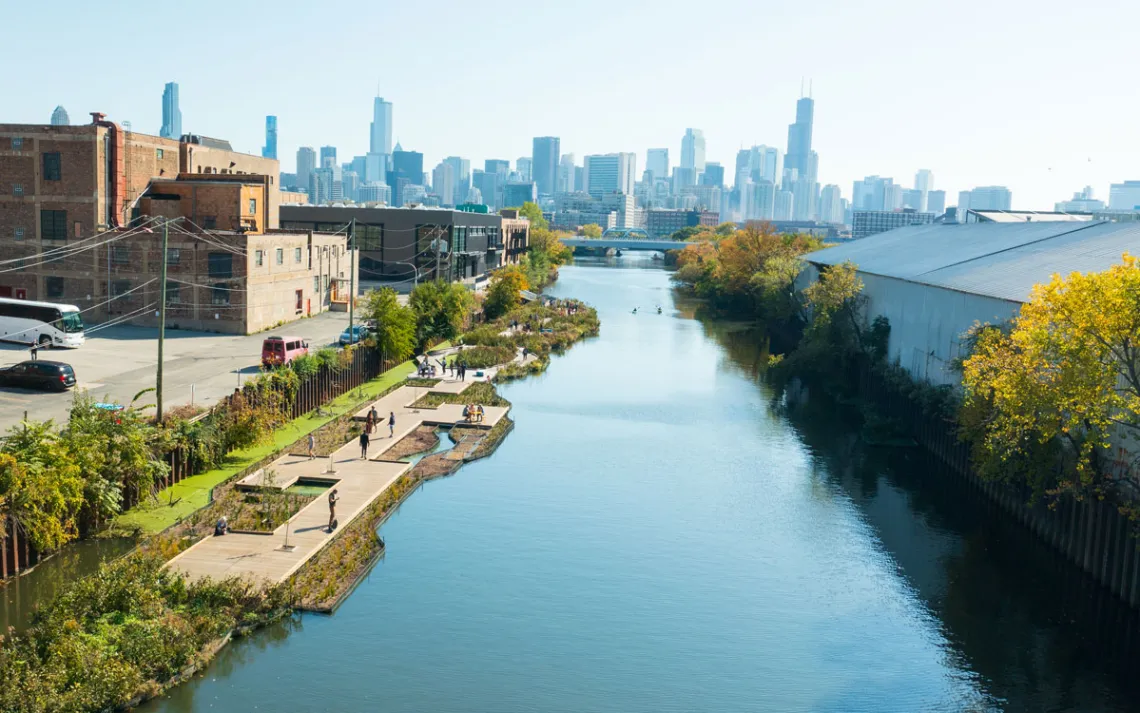
Chicago's floating eco-park on the North Branch Canal. | Photo courtesy of Nick Wesley @ Urban Rivers
Last summer, Sage Rossman, community outreach and programs manager for the nonprofit Urban Rivers, leaned over the edge of an artificial floating wetland in Chicago’s North Branch Canal. Reaching into the murky water, she attached a waterproof camera to the bottom of the pontoon. “It's very dark under the gardens, and the water turbidity is pretty intense. So it's really hard to see what's going on,” she said. “But it's a whole layer of habitat down there.” The camera’s imaging clearly revealed the roots of native sedges and grasses growing together as a grove of forested tendrils.
This underwater garden is one of the superpowers of the Wild Mile, a modular “floating eco-park,” as Rossman referred to it. The park has been open to the public since 2022, and in it, buoyant mats made from natural materials, such as straw or jute, have been linked together to create the first-of-its-kind floating ecosystem in North America. Stretching for 17 acres along the shoreline, the artificial wetland is planted with native shrubs and wildflowers, which grow through pockets in the substrate into the water below.
For much of its history, the canal was a dumping ground for sewage and the industrial waste expelled from factories that once lined the shoreline. Although those same factories have left the area, the waterway still carries the scars. It is defined by tall concrete seawalls and a riverbed of pollutants—a potent reminder of how industrialization kept the water contained and nature away.
Now, groups across North America are deploying these nature-based solutions to clean up waterways and help revive once-eradicated ecosystems. These artificial islands are creating habitat for wildlife and bringing urbanites closer to nature.
“A big part of our mission,” said Rossman, “is connecting people with nature.”
According to Rossman, cleaning up the area along the North Branch and turning it into a place where nature could thrive was always top of mind for community groups and city lawmakers, but they weren’t sure how to go about it. The answer: floating wetlands to create an above- and underwater ecosystem. There have been studies conducted on the effectiveness of submerged plant roots to filter pollutants in waste-water container ponds, but not a lot to support the same technology in open waterways. Urban Rivers, the product of a partnership between organizers and researchers at Illinois State University, has shown it can be done.
A small floating wetland upstream from the Wild Mile was the testing site for Eric Petersen, a professor in the Department of Geography, Geology, and the Environment. A common thread in polluted waterways is an excess of elements, such as nitrate, chloride, and phosphate. Peterson’s comparison of upstream and downstream waters showed a reduction in nitrogen-nitrate the closer he tested to the wetland. Ironically, nitrogen is something plants love. They will gobble up the nutrients, removing it from the water and restoring natural balance.
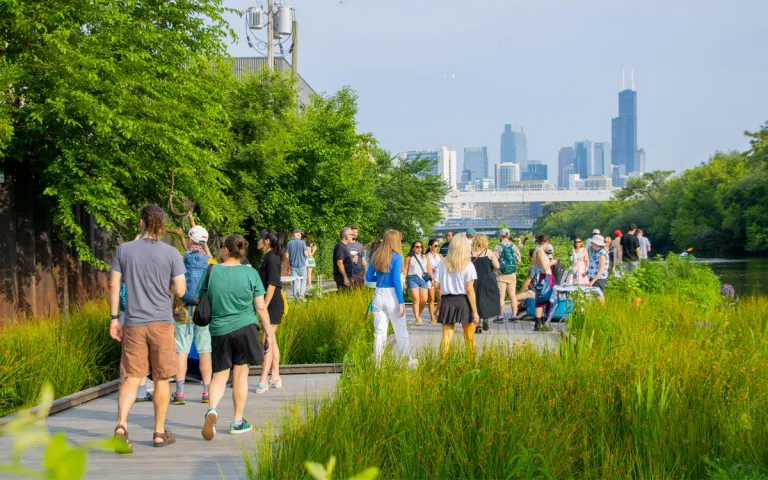
Strolling in the Wild Mile. | Photo courtesy of Sage Rossman @ Urban Rivers
Researchers at the National Aquarium in Baltimore are also learning about how plants work underwater to benefit the surrounding ecosystem. In the city’s Inner Harbor, the National Aquarium has installed a 10,000-square-foot tidal wetland. “The inspiration behind the project was to find a way to reintroduce a traditional Chesapeake Bay tidal wetland habitat to a postindustrial waterfront, where creating a living shoreline was not feasible,” said Charmaine Dahlenburg, the director of field administration. There is continuous monitoring of the water through a network of sensors. If the oxygen in the water falls in the rest of the harbor and kills fish, the water around the wetland remains oxygenized. This is all thanks to the growing roots of the plants under the wetland.
These habitats, though, are much more than just nature’s way of mopping up pollutants—they are also havens for wildlife above the waterline. Foxes, turtles, stingrays, and a variety of insects and birds have appeared in the harbor in recent years, but the most popular are the indicator species that signify a healthy wetland. “Our biggest surprise was the return of the American river otter,” Dahlenburg said. “This happened early, prior to the opening of Harbor Wetland. Since then, we’ve documented 101 species of wildlife utilizing the habitat.”
Of course, nothing is perfect, and despite these artificial wetlands attracting wildlife and fumigating waterways, they also have challenges. Urban Rivers spent two and a half years navigating red tape to finally gain permits to install the Wild Mile. It took so long because regulators had never before issued a city permit for a modular floating wetland.
They didn’t know where to start or what category to place it in. Baltimore’s team faced similar regulatory hurdles. “The National Aquarium is now collecting the science to support the benefits of these habitats in tidal waters,” Dahlenburg said. “We are hopeful that one day they will be certified as a best management practice and become more acceptable.”
There is also concern as to the lifespan of the pontoons and replacing them before they start to biodegrade. It is something that Chad Townsend, senior planner for environment and sustainability with the City of Vancouver Parks Board in British Columbia, worries about when it comes to the 200-foot floating habitat installed on an urban lake in 2022. “These things,” he said, “can have at least a 20-year lifespan.” When they do reach the end of their life, they do need to be removed from the waterway, and that can be costly as well as detrimental to the ecosystem that grew up around the wetland, both below and above the waterline.
These hurdles may be difficult to navigate, but they are not enough to dissuade interest. “We receive weekly inquiries about our habitat and how organizations can replicate what we have done,” Dahlenburg said. “We are currently in discussions with a potential project at Newtown Creek, in New York City.”
In 2022, Friends of Green Lake (FOGL), together with Herrera Environmental in Seattle, Washington, launched two Floating Ecosystems. The islands positioned near the Duck Island Wildlife Refuge provide habitat for native birds. One of their unique features is the sections that include submerged gravel beds. These provide habitat for amphibians, such as frogs, and turtles, as well as providing additional water filtration.
Back at the Wild Mile, when Rossman pulled her camera out of the murky waters of the Chicago River and reviewed the time-lapse footage, she was amazed. The roots had grown so much in such a short time. “I’ve seen pretty significant growth just looking at a couple side-by-side clips,” she said.
While significant strides have been made to de-pollute the waters of the North Branch canal system, such as enhanced sewage and stormwater run-off infrastructure, the entire North Branch River Watershed is still listed by Illinois’s Environmental Protection Agency as impaired.
The Wild Mile, though, proves what is possible. As Rossman leads school groups and volunteers onto the boardwalks and docks that surround the floating habitat, she can rest assured that this small portion of the canal is learning to exist free of its industrial scars. She has seen it with her own eyes, above and below the surface of the water. “You can see all these incredible creatures that are native to the area that are thriving in an urban space, whereas 10 or 20 years ago, it was really gross and terrible to interact with,” she said. “That’s cool to see.”