Is It Too Late for the Western Sandpipers of Roberts Bank?
A major expansion of a British Columbia port threatens the sandpipers' feeding grounds
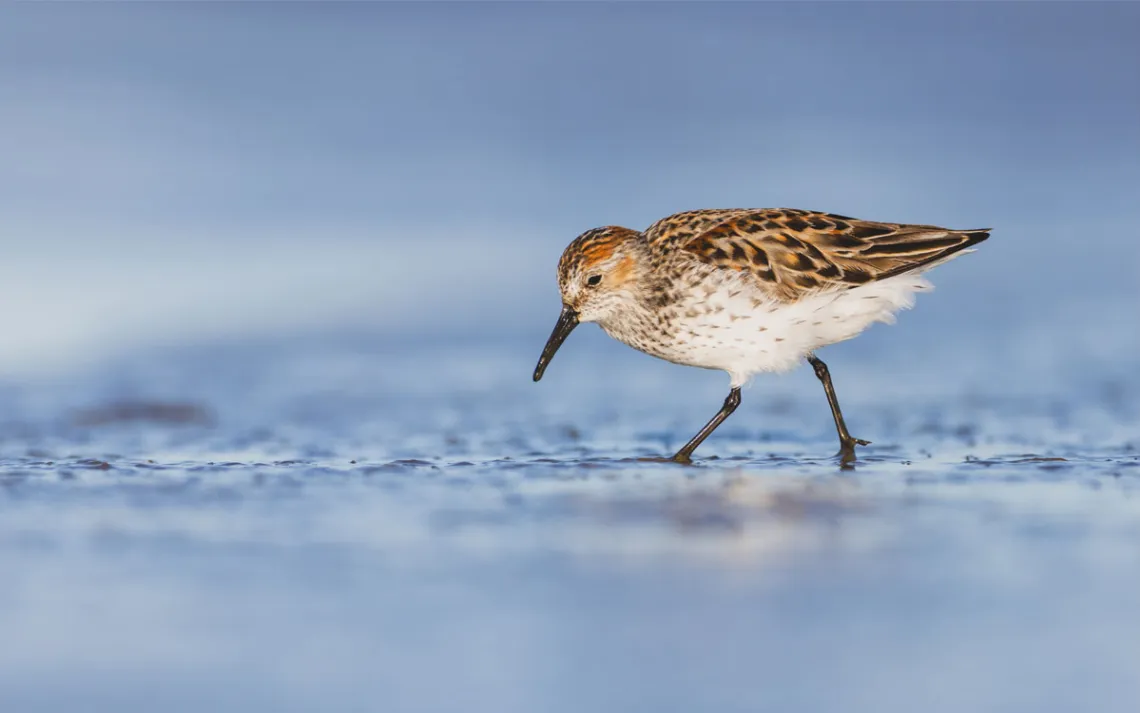
A western sandpiper wades through the shallows, looking for food. | Photo courtesy of Kris Cu
In southern British Columbia, where the Fraser River empties into the Salish Sea, an estuary of mudflats, tidal pools, and coastal wetlands stretches as far as the eye can see. At its heart is a strip of tidal marshes known as Roberts Bank. Close to the US-Canada border, the area feeds millions of creatures from both land and water. It is here, each spring and fall, that tens of thousands of migrating western sandpipers stop to rest and refuel.
With mottled brown-gray feathers that blend into the mud and a white belly that pops against it, the tiny bird— weighing barely an ounce—uses its toothbrush-like tongue to methodically slurp up the slime, a.k.a. biofilm. They’re able to digest up to 20 percent of their body weight per hour of the goopy elixir. It’s packed with omega-3 fatty acids that give them the calories and energy to complete their semiannual return migrations between South America and Alaska each year.
But now the biofilm at Roberts Bank is at risk and might vanish completely.
At the end of a 2.5-mile causeway that cuts across the mudflats where the sandpipers forage is the largest container shipping terminal on Canada’s West Coast. Here, large ships carrying containers filled with everything from clothing to household items arrive and unload their mega crates of goods. And now the existing port is going to get even bigger. The construction of Roberts Bank Terminal 2 (RBT2) is scheduled to begin in 2028 and will take six years to complete.
When completed, it will increase Canada’s West Coast trade capacity by more than 30 percent and will add 320 acres of usable waterfront industrial land. There’s going to be a large structure in deep water that will be made by piling up sediment. “This will alter the salinity distribution of water during tidal cycles,” Ronald Ydenberg, a biological sciences professor and biofilm expert at Simon Fraser University, said. And that could affect the biofilm, which relies on a combination of both sea and fresh water to grow.
It’s this threat that worries Beatrice Frank, the executive director of the Georgia Strait Alliance, an environmental group based in Vancouver. She has been vocal about how the industrial materials used during construction could impact Roberts Bank. “It's the cumulative effects,” she told Sierra. “It's not just what's happening today; it's now and into the future.”
On the other hand, the Vancouver Fraser Port Authority, the federal agency responsible for the shared stewardship of the lands and waters that make up the Port of Vancouver, points to a decades-long process of careful assessment by researchers and scientists on the impacts the expansion could cause. But despite their reassurances that all will be fine, it hasn’t been enough to quiet those upset about the project.
As far back as 2022, councilors for the municipality of Delta, where Roberts Bank is located, voted for more study and clarification on the impacts of RBT2. They based their unanimous motion on findings from Environment and Climate Change Canada (ECCC), the federal department responsible for coordinating environmental policies and programs in Canada.
The report’s authors indicated that some adverse effects of RBT2 will be immediate, continuous, and cannot be mitigated, and that impacts on biofilm could have species-wide impacts on migratory birds. While Ydenburg notes that biofilm could be affected, he disagrees with the dire assessment of federal officials. “I measured how much biofilm is actually there and calculated how much is regenerated on each tidal cycle, and how much the sandpipers eat,” he said. “Those measurements suggest that there's much more biofilm there than the sandpipers would eat even on peak days.”
Now, the Government of Canada has decided that RBT2 can proceed if stakeholders such as the Vancouver Fraser Port Authority adhere to 370 legally binding conditions that protect the environment. Among them is a requirement that they reduce impacts to the biofilm and create wildlife habitat for western sandpipers and other shorebirds.
It’s a hefty list that Frank doubts can be fulfilled. “It is really, really hard to believe this can happen,” she said. In keeping with the conditions, the port authority has been working with First Nations communities in the area, government scientists, and biofilm experts to assess sites in the Fraser River Estuary for a new intertidal biofilm habitat. Replicating Roberts Bank’s unique mix of fresh and sea water, though, may not be easy.
According to David Bradley, BC director for the national nonprofit Birds Canada, there are other sites that the sandpipers do use in proximity to Roberts Bank, such as the Boundary and Mud Bay tidal flats. But, he said, they don’t have the same quantity of freshwater that Roberts Banks gets from the Fraser River. “We know the conditions aren’t the same in these locations,” he said, ”and that influences the availability of biofilm.”
It’s a muddy quagmire of what-if scenarios and opposing scientific views, with the tiny western sandpiper caught in the middle. And now something else has been added to the mix: international politics. In light of ongoing tariff threats from the Trump administration, Canada is actively looking for new trading partners. Trade ports and infrastructure, such as RBT2, support these goals. This has made Frank lose hope that there will be an 11th-hour reprieve for the sandpipers at Roberts Bank. “I think that it is really hard to have hope that RBT2 will not go ahead at this moment,” she said. “Canada is trying to speed up all of these projects that are so important for Canadians in general.”
Currently, the western sandpiper is not listed as a species of concern and with an estimated population of over 3 million, appears to be thriving—but appearances can be deceiving. Between 1991 to 2019, researchers studied and counted the western sandpipers at Roberts Bank. The bird's population declined by 54 percent over the study period. Surveyors found that the counts for all shorebirds were lower at Roberts Bank when freshwater discharge from the Fraser River was high. This, they concluded, was the result of a complex interaction between the abrupt changes in salinity and the estuarine food web related to the quantity or quality of intertidal biofilm.
Without question, the western sandpipers who rely on Roberts Bank and the biofilm during their twice-yearly migrations could be the most affected by RBT2, but they are not the only ones. The Roberts Bank Wildlife Management Area provides critical wintering grounds for the highest number of waterfowl and shorebirds found anywhere in Canada.
Currently, 102 species that rely on the area are at risk of extinction, including the endangered southern resident killer whales, which feed at the plume of the estuary where it meets the Salish Sea. According to the Georgia Strait Alliance, in 2020, an independent and expert review panel concluded that estuary changes from the expansion of the shipping terminal will negatively impact the southern resident killer whale population by reducing the number of salmon they feed on and increasing marine noise, which interferes with their sonar.
“The importance of the Roberts Bank site is paramount. It is one of the few places along the BC coast where the western sandpiper can stop,” said Bradley. “At some point in their life, we think that all individuals will pass by this site.”
If the biofilm disappears, so could the sandpipers of Roberts Bank.