 The Magazine of The Sierra Club
How to Watch Dolphins Without Leaving the Shore
A rare feeding habit brings dolphins closer than ever and helps them live year-round in South Carolina
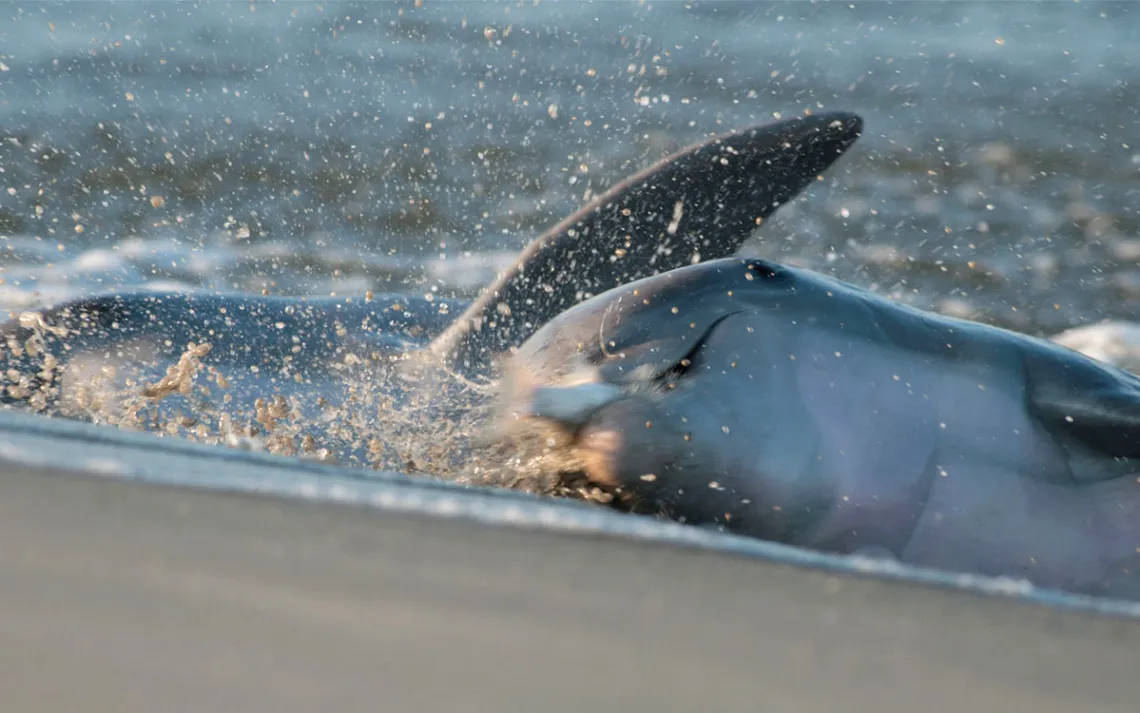
Dolphins hurling themselves ashore to catch fish. | Photo by Wirestock/iStock
The water at low tide was calm until it suddenly seemed to bubble from underneath. Four fins broke the surface, and mullet jumped through the air in every direction, flopping on the beach as the dolphins splashed and writhed, their jaws snapping for fish. I was on the banks of South Carolina’s Kiawah River, south of Charleston, to see one of America’s elusive eastern dolphin species. I almost forgot to breathe as the 10-foot cetaceans hurled themselves ashore, but the thrilling action ended just as abruptly as it began. Once the dolphins got their fill, they wriggled backward into the water to continue the hunt for food.
South Carolina’s Lowcountry region is one of the very few places in the world to witness dolphins engage in strand feeding. It occurs when a pod of dolphins works cooperatively to herd fish onto a beach or mudflat, then launch their bodies out of the water to feed before maneuvering back into the water. According to the Lowcountry Marine Mammal Network (LMMN), other dolphin populations practice this behavior in parts of northern Georgia, Louisiana, the Pacific Northwest (including Canada), Australia, Ecuador, and Mexico.
While bottlenose dolphins are considered a cosmopolitan species, living in all different types of environments all over the world, Tamanend’s bottlenose dolphins (Tursiops erebennus), named after the Nanticoke Lenni-Lenape chief known for his wisdom and peaceful nature, are the only resident marine mammal in South Carolina year-round. These dolphins, a separate species from their open-ocean counterparts, have vast ranges that extend across South Carolina’s estuarine system. The Charleston area is home to about 350 resident bottlenose dolphins.
“The unique thing here is that these dolphins are long-term residents,” said Lauren Rust, founder and executive director of LMMN. “They can live more than 40 years, and having the same neighbors for that long seems like a rare thing nowadays.”
In addition to this close-knit resident population, there are also transient and seasonal residents that pass through the region. But it’s the residents who have developed the habit of strand feeding. Researchers have found that this is a learned behavior, with dolphin mothers in the Lowcountry passing the practice to their young calves.
Researchers have also observed these dolphins shipside feeding—when dolphins use container ships and other non-natural barriers in Charleston Harbor to trap fish. Meghan Galipeau, dolphin researcher and educator at the South Carolina Aquarium, is one of the scientists studying both strand and shipside feeding. While both are unique behaviors, she notes, there differences between the two. “These dolphins are right here in the Charleston harbor, an urban estuary that’s popular with fishing and commercial shipping,” Galipeau said. “This feeding behavior [shipside feeding] is another example of the adaptive foraging tactics of dolphins. Unlike in strand feeding, it’s more likely to be exhibited among individuals of the population.”
While all cetaceans are federally protected under the 1972 Marine Mammal Protection Act, there have been long-standing issues between humans and Tamanend’s bottlenose dolphins. Boat strikes and entanglements in crab pot lines are common causes of mortality. Marine debris, such as microplastics, also poses a grave threat to dolphin populations in and around Charleston. In 2024 alone, 26 percent of stranded animals had signs of human interaction, which includes incidents of boat strikes, ingestion of foreign objects, and entanglements.
Additionally, the dolphins that engage in strand feeding face greater levels of disturbance from people, who often try to get close as the dolphins approach the beach. People have also been reported for trying to grab, jump, and stand on the animals. These types of negative experiences with humans can lead to a decline in dolphin abundance in an area. And they can also cause dolphins to alter their normal feeding behavior, say researchers from LMMN and the College of Charleston.
To keep local dolphins safe, the LMMN developed several public education programs. One, the Wildlife Awareness and Viewing Etiquette (WAVE) program, is a workshop geared toward commercial businesses that frequently operate on the water as well as recreational boaters and the public. And the other, the Strand Feeding Education Program, deploys volunteers to beaches throughout the Charleston area to teach visitors how to reduce disturbances while watching dolphins.
Programs offered by both the South Carolina Aquarium and LMMN aim to educate the public about the resident dolphins as well as provide guidance on how to responsibly view them without disturbing or harassing them. Local boat and kayak operators are also taught, either through the WAVE workshop and more involved training, to limit disruptions so that those who want to view the behavior from the water can do so at a respectful distance.
Walking on the beach toward the water line with Abbi Cochran, a WAVE ambassador working as a professional naturalist guide with Coastal Expeditions, we pass a "Protect Wild Dolphins" sign that instructs humans to view at least 15 yards from the water line; not to swim with, chase, tease, touch, feed, or grab dolphins; and to remain quiet while dolphins are hunting and feeding. “Researchers have noticed that strand-feeding dolphins tend to lean on their right side, and the theory is that it protects their heart and organs from getting crushed by their weight,” she said.
As we approached the water, a crowd had gathered behind a row of colored flags stuck in the sand to mark a safe distance from dolphins. Becky Krantz, an LMMN volunteer, introduced herself and told us that during her four-hour shift, she’s seen some strand-feeding behavior, but not recently. “We just watch and wait,” she said. “Sometimes the pelicans congregate, anticipating dolphin action, because they can swoop in and grab some fish for themselves. So keep an eye out!”
Krantz explained that the entire strand-feeding process is more involved than what the observers above the water see. The dolphins first must find a school of fish, then eyeball the beach to ensure that the location is safe. If it is, they work together to corral the fish and signal the moment to rush onto the bank and snap them up.
While we stood on the beach, I saw a few occasions when people edged past the flags, usually families with impatient young children and teens. Krantz wandered over and gently reminded them to leave a safe distance, and most of the people complied. A few returned to the water’s edge once Krantz turned her back. It was this moment when the power of public education became evident, as a handful of visitors waved the rebels back to the flagged zone.
There may not always be a volunteer everywhere Tamanend’s bottlenose dolphins strand feed, nor will all boaters and commercial outfitters take the WAVE workshops. But as more locals and visitors learn how to responsibly cohabitate with these water-bound neighbors, the longer the dolphins can thrive in the South Carolina Lowcountry.