Is This Bill the Future of Energy Permitting?
Controversial legislation advances despite opposition from tribes and conservation groups
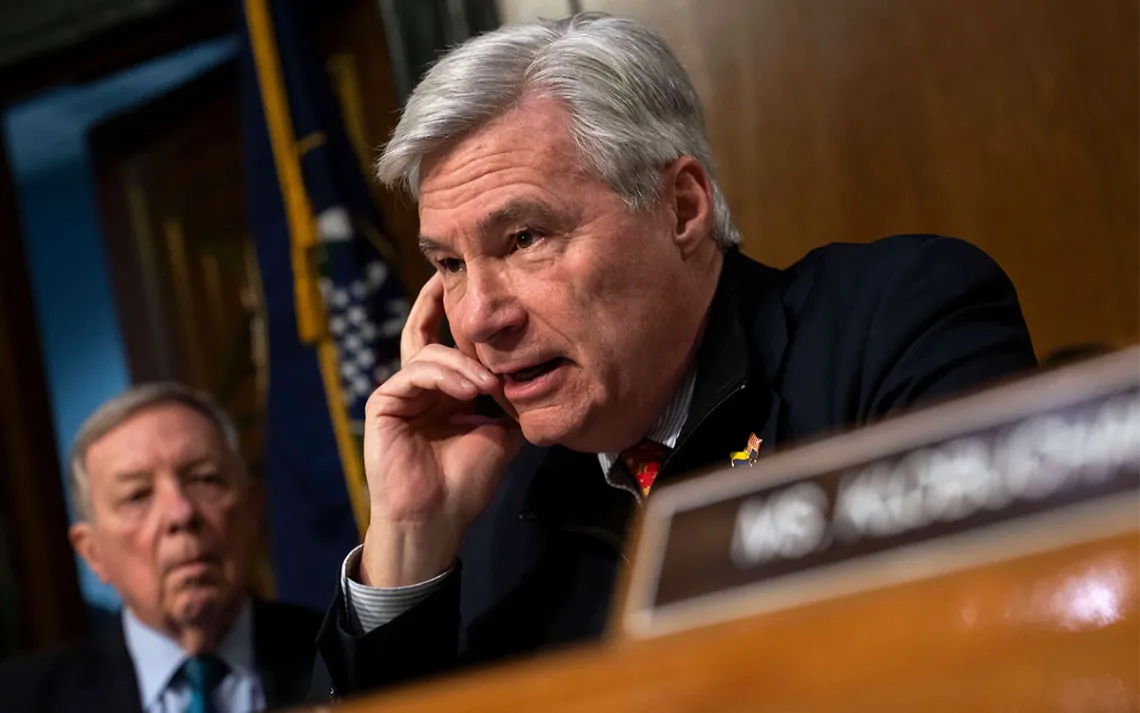
Senator Sheldon Whitehouse. | Photo by Craig Hudson/Sipa USA via AP
What do Senators Sheldon Whitehouse (D-R.I.) and Mike Lee (R-Utah) agree on? When it comes to environmental issues, not much. The former has excoriated fossil fuel companies for what he calls a “pollute-for-free business model.” The latter unsuccessfully tried to sell 3 million acres of public land last summer, sparking nationwide outrage.
So it’s been surprising for conservation advocates to see the pair in lockstep in recent weeks on a proposal that has the potential to reshape American energy development.
The duo, in addition to Senators Martin Heinrich (D-N.Mex.) and Shelley Moore Capito (R-W.Va.), are co-sponsors of the Bipartisan American Affordability and Jobs Act, or BAAJA. If it's enacted in its current form, proponents say, the bill would transform the federal permitting process for energy projects—potentially making it cheaper and faster for companies to build wind turbines, solar farms, and other forms of clean energy. However, it also could benefit fossil fuel projects.
Whitehouse and Lee aren’t the only strange bedfellows backing the bill. It’s the rare piece of legislation supported by both Citizens' Climate Lobby and CEOs from ExxonMobil and Halliburton. Meanwhile, other environmental groups, including the Sierra Club, and many tribal nations are fiercely opposed. They cite limits the bill would place on bedrock environmental and historic preservation laws, including the National Historic Preservation Act and the Endangered Species Act.
“The Sierra Club supports updating and expediting transmission and clean energy permitting, and have long advocated for a bill that will lower costs, reduce air, water, and climate pollution, protect communities, and expand America’s grid,” wrote Loren Blackford, the Sierra Club’s executive director, last week. “As written, this bill achieves critical wins on transmission and potential emissions reduction. However, this does not justify abandoning tribal consultation, clean water safeguards, and wildlife protections.”
Discussions for BAAJA lasted months, and the truce between lawmakers remains tenuous. The Trump administration’s repeated attempts to block wind development off the coasts of Maryland and New England have been a thorn in the side of negotiators, with Senator Whitehouse at one point threatening to end talks. On November 9, the president called wind turbines “a major loser” and said he would not approve new projects. Later that evening, senators voted overwhelmingly—73 to 25—to formally consider BAAJA on the chamber floor.
This time, Whitehouse said that the president’s words would not impact his support for the bill, citing “representations and promises” from federal agencies in a statement to reporters.
“We chalk that up to him being 80 [years old],” said Whitehouse.
In response to criticism, Whitehouse and his fellow negotiators released a manager’s amendment, altering key sections of the bill, including some rollbacks of the National Historic Preservation Act. So far, tribes have largely been unswayed.
"Tinkering with these harmful BAAJA provisions does not resolve their fundamental flaws,” wrote a coalition of more than half a dozen tribal groups, including the National Congress of American Indians. “Tribal sovereignty, meaningful consultation, and the protection of sacred places are not negotiable.”
The push for reform
One thing seemingly everyone in the energy sector agrees on: The current federal permitting system does not work as intended. They just don’t agree on what needs to change.
The process for obtaining a federal environmental impact statement, a required assessment for most federal projects, takes an average of 4.5 years. Completed projects then must wait in a queue, often for several more years, to connect to the country’s power grid—the vast network of transmission and distribution lines, transformers, and more moving electricity from energy sources to homes and businesses.
All of this is factored into project budgets and timelines.
The infrastructure slowdown comes at a time when the country’s energy demands are expanding. While some of that growth is driven by new development, including data centers, much of it is the result of households switching from fossil fuels to electricity, exchanging gas-powered furnaces for electric heat pumps and gas-powered cars for EVs.
In 2022, then-President Joe Biden signed the Inflation Reduction Act, a law offering more than $300 billion in tax credits and grants for renewable energy projects. But subsequent projections by the Princeton REPEAT Project found that slow grid expansion could blunt the law’s emissions-cutting efficacy by as much as 52 percent.
BAAJA proponents say the bill would address bottlenecks in the current process at multiple stages. It requires utilities to improve transmission lines when possible and speed up timelines for connecting infrastructure to the grid. It also includes language meant to ensure that transmission costs from data centers are not passed on to utility ratepayers. And, for developers, it offers a degree of assurance, preventing stakeholders from suing once a project is already under way.
“Reform is needed to protect the clean energy projects that often face litigation,” wrote the American Clean Power Association in a fact sheet supporting BAAJA. The industry group cited internal research suggesting that more than 100 gigawatts of clean energy projects were being stalled by permitting issues.
Amended protections
While clean energy proponents say BAAJA’s litigation-blocking measures could help rein in the Trump administration—preventing the kind of meddling it’s engaged in off the Atlantic coast—critics worry it would actually do the opposite. Rather than protecting renewables, the law could block future injunctions against the president’s preferred slate of fossil fuel projects.
“We believe that there needs to be a good-faith effort by this administration to treat clean energy fairly on a level playing field,” said Manish Bapna, president and CEO of the Natural Resources Defense Council. “Those should be table stakes for moving forward with this type of legislation.”
In October, Bapna’s nonprofit published an extended analysis of BAAJA without formally taking a position, lauding some of its components while warning that others would “benefit fossil fuel, mining, data center, and other industrial projects more than clean energy.” In a follow-up statement, published one day before the initial Senate vote, the organization announced that it “opposes the bill as currently written.”
In addition to his reservations about BAAJA’s regulatory certainty provisions, Bapna cited changes the bill would make to environmental laws, such as the Endangered Species Act (ESA), Clean Air Act, National Environmental Policy Act (NEPA), and the National Historic Preservation Act. Each serves as a guardrail on potential environmental harms and offers the public opportunities for input, such as extended comment periods. If enacted, BAAJA would narrow the scope of each of these statutes.
Under the ESA, developers whose projects could impact endangered wildlife must consult with federal agencies before proceeding. BAAJA would shift some of that responsibility to state governments and tighten timelines. Critics say the changes would encourage under-resourced state agencies to push through dangerous projects, without making the process any more efficient.
A seven-year study by Defenders of Wildlife found that informal consults, the most common kind, take just two weeks on average. And out of 88,290 consultations, only two projects were found to put species in jeopardy. Both were ultimately able to proceed with modifications.
According to Christoper Westfall, Defenders’ senior government relations legislative counsel, that small number of jeopardy findings is evidence of the law working as intended. When developers consider their impact on wildlife before consultation, he says, it saves them from dealing with more costly reviews and litigation down the road.
“We’re so confused that the ESA is in there,” said Westfall. “Because it’s not a roadblock to projects being built.”
A seat at the table for tribes
If enacted, BAAJA would also limit the consultation status of tribal nations. Currently, federal agencies must consult with tribes before issuing a permit for any project impacting “property of traditional religious or cultural importance.” The bill, however, would exempt development on non-federal land, many projects funded through federal loans, and work within a quarter mile of existing grid infrastructure and pipelines.
“It's a dramatic constriction of what projects we would ever look at to see if they have impacts on historic places,” said Marion Werkheiser, an attorney at Cultural Heritage Partners and an organizer of the [Section] 106 Strong campaign. An open letter distributed by the latter was signed by more than 1,200 tribes and historic preservation groups. The campaign’s name refers to the portion of the National Historic Preservation Act enshrining tribal consultation.
If lawmakers want to improve the consultation process, Werkheiser and Westfall both believe, they should start by restoring the agency funding cut early in the second Trump administration. The US Fish and Wildlife Service, the agency handling ESA consultations for the nation’s land animals, has lost more than a third of its staff since 2024.
“This bill will concentrate the entire workload of this process on federal agencies [that] have no people right now,” said Werkheiser. “That's not going to streamline projects.”