 The Magazine of The Sierra Club
Manatees Face an Uncertain Future Under These New Rules
The Florida manatee shows what a weakened Endangered Species Act could mean for conservation
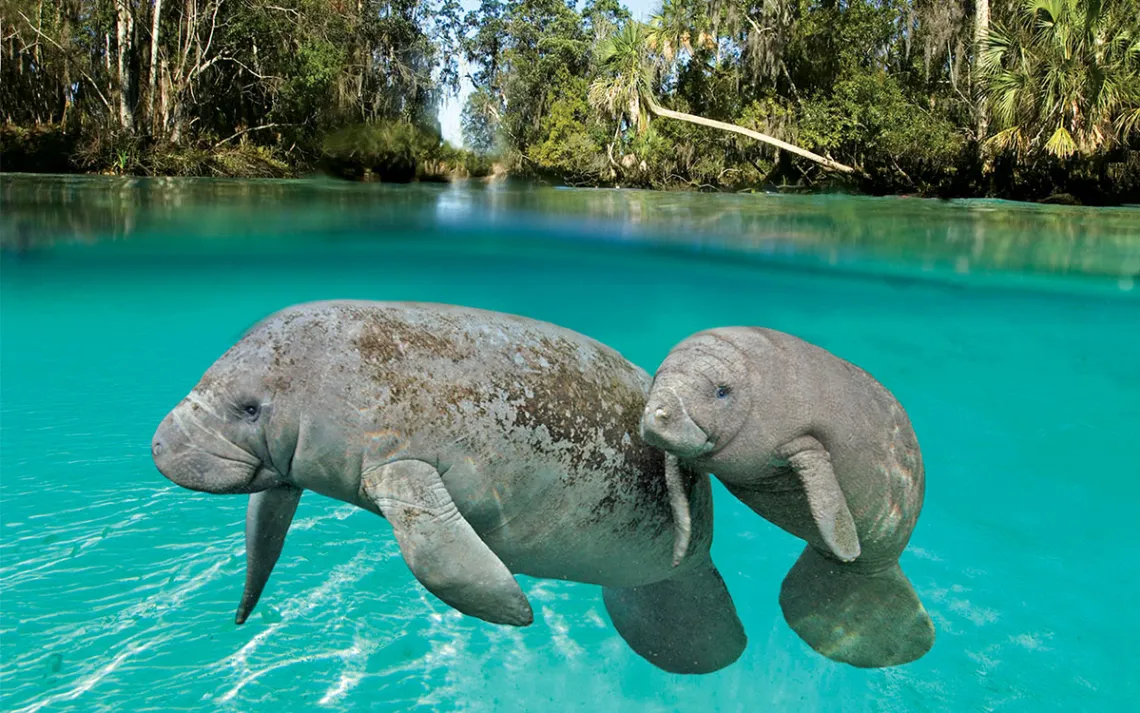
The manatee was one of the first animals listed on the Endangered Species Preservation Act of 1966, a precursor to the modern-day Endangered Species Act. In 1973, as the manatee population plummeted from boat strikes and lack of food, the federal government listed the species as endangered under the ESA. More recently, in 2017, the US Fish and Wildlife Service downlisted the species to threatened. But thanks to a section of the law known as the “blanket rule,” it kept most of its protections.
However, after the Trump administration finalized three major updates to how it enforces the ESA, the species faces a dark road ahead. One update removes the blanket rule for threatened animals; another allows the agency to give priority to economic decisions when designating critical habitat for listed species; and the most recent, finalized earlier last month, removes the regulatory definition of “harm” that included habitat destruction. Environmental lawyers, scientists, and conservation groups unanimously say these rollbacks are “unlawful.”
Each of the three rule changes, they argue, could put the nation’s wildlife icon in peril. But manatees are uniquely vulnerable to all three, said Ragan Whitlock, a staff attorney at the Center for Biological Diversity, which sued the FWS over the recent ESA revisions. “The manatee is really a fantastic case study here,” he said.
In January 2025, the FWS proposed relisting the species into its two subspecies: the Florida manatee and the Antillean manatee, the latter of which lives in the Caribbean. They face different threats, Whitlock explained, so the Center for Biological Diversity and some other groups agree with listing the species separately. Where they disagree is the designation itself: The government is proposing the Antillean manatee as endangered, but the Florida manatee as threatened. Even though currently listed threatened species will hold onto their blanket protections, lawyers such as Whitlock worry the federal government will use the new designation as an opportunity to declare the Florida manatee as a “new” listing, thus hitting the refresh button and subjecting it to the new regulatory change.
“We would argue that this is an existing protected species, and [the FWS is] just changing the categorization,” Whitlock said. “But I have no faith that this service and this administration won't try to take advantage of something like that.” The FWS is now nearly a year overdue its deadline to finalize the new listing designation, Whitlock added.
Regardless of whether the new designation puts the Florida manatee back at square one, it will still have to grapple with the effects of two other changes.
Prioritizing economic impacts when selecting “critical habitat”
Under the ESA, people and companies are prohibited from harassing, hunting, shooting, wounding, killing, trapping, capturing, collecting, or harming listed species. Collectively, this is considered “take,” a form of direct physical harm or indirect harm through habitat destruction. The ESA also gives the FWS the authority to create “critical habitat,” a designation that requires formal review of federal projects in areas where listed species are known to live.
For decades, the FWS has considered the impacts, including economic, of designating critical habitat. But the Trump administration’s new rule changes how the FWS decides whether to exclude areas from critical-habitat protections based on those impacts. Previously, the FWS retained discretion over whether it should weigh the benefits of excluding an area from critical habitat against the benefits of designating it. Under the new rule, an outside party can trigger that exclusion analysis by presenting information that supports the benefits of excluding an area. In other words, outside actors can influence whether the agency excludes areas from critical habitat in a way that would benefit their operations. The rule also directs the FWS to evaluate certain information concerning impacts outside the agency’s expertise, and it requires FWS to exclude an area when the benefits of exclusion outweigh the benefits of designation.
Critics say these changes make it easier for developers, permittees, and other interests to seek the exclusion of important habitat from federal critical-habitat protections.
“In my opinion, [this regulatory change] goes directly against the ESA statutory mandate to utilize the best scientific and commercial data available,” said Elizabeth Neville, director of environmental law and policy at the nonprofit Save the Manatee Club.
The ESA’s habitat protections are historically its strongest provisions, Whitlock told Sierra. Removing them is “gutting its very purpose,” he said.
In a written statement to Sierra, the US Department of Interior’s Office of Communications said that habitat conservation is still an important part of the law through agency consultations, critical habitat designations, and recovery efforts. “These regulatory changes do not alter the Florida manatee’s current protections,” a spokesperson wrote.
Lawyers still aren’t convinced. “Now the agency has opened the door to balancing its [scientific] experts against economic considerations submitted by developers and corporate polluters,” Whitlock said. “The Florida manatee is absolutely going to be a casualty of this.”
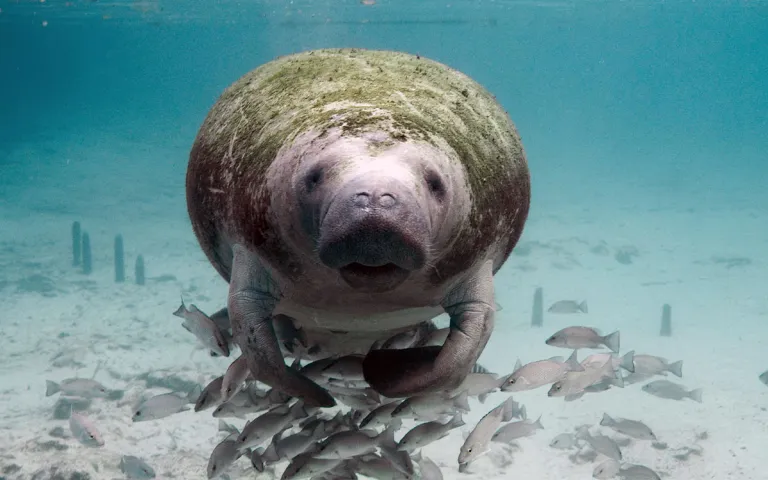
A manatee in the Crystal River National Wildlife Refuge. | Photo courtesy of Keith Ramos/USFWS
Removing habitat destruction as a form of “harm” to species
In a related rule change, the FWS has removed the legal definition of "harm" that previously included habitat destruction. Florida has witnessed a steep decline in seagrass over the past two decades, a trend consistent with increased nutrient pollution from agriculture, and septic and sewer runoff. This water carries chemicals and fertilizers into coastal waterways and freshwater springs, where manatees forage for food.
So, if polluters—such as power plants, phosphate mines, and farms—dump nutrients and chemicals into Florida’s waterways, they won’t be responsible for the downstream effects to manatees. When these nutrient loads get too high, they can trigger toxic algal blooms, which lower dissolved oxygen, kill seagrass, and ultimately starve marine animals such as manatees.
When the manatee was downlisted to a threatened status in 2017, the FWS declined to consider the possibility of a mass mortality event, Whitlock said, despite widespread seagrass die-off in Indian River Lagoon, a prime manatee hangout on Florida’s east coast. The steep decline in seagrass combined with other disruptions such as wastewater spills starved roughly 1,200 manatees over two years—just as scientists feared.
“That's a very striking example of how harm to habitat results in harm to species,” Neville said. “So, by removing that from the purview of the ESA, [the FWS is] taking away one of the most important long-term protections for the manatee.”
The stakes are even higher if “harm” precludes the downstream effects of overdevelopment degrading manatee habitat. Florida’s freshwater springs serve as important warm-water refuges for the cold-sensitive manatees during winter, with water temperatures remaining in the °70s year-round. But aggressive over-pumping from agriculture, municipal water supplies, private wells, bottled water companies, and continued nutrient pollution have eliminated many of those springs, pushing more manatees toward artificial warm-water discharge created by an unlikely source—power plants. “It's a really unsustainable situation,” Neville said.
Neville cautions that removing this definition of harm doesn’t mean people can now kill manatees. Accidental, direct harm to manatees is still illegal. While boat strikes are less common now than before the federal government put protections in place, reckless boaters speeding through slow zones still kill more than 100 manatees on average every year. But with the regulatory changes, Florida manatees will become even more exposed to harmful human behavior, she says.
An uncertain future
The function of the ESA isn’t to prevent development, Whitlock said. It’s to give vulnerable species a seat at the table in discussions about development projects that could alter their home. Florida ranks fifth in the number of ESA-listed species and second in overall growth.
Aside from the Endangered Species Act, Florida manatees still have two notable shields. The Marine Mammal Protection Act, a federal law, prohibits the harassment, harm, capture, or killing of any marine mammal. And the Florida Manatee Sanctuary Act, a state law, makes it illegal to feed, harass, harm, pursue, hunt, shoot, wound, kill, annoy, or molest manatees, a state wildlife agency spokesperson told Sierra.
“I'll be very blunt that neither of those are as workable as the Endangered Species Act,” Whitlock said, adding that the law has helped prevent the extinction of nearly all species listed since its inception in 1973. “The Endangered Species Act is the proven tool for protecting endangered and imperiled species. . . . It is incredibly effective at staving off extinction, but it has to be used the way that Congress intended it.”