Here’s Why You Might Hear More Motors on Your Next Hike
Updates to this little known rule could fragment four times as much land as revoking the Roadless Rule
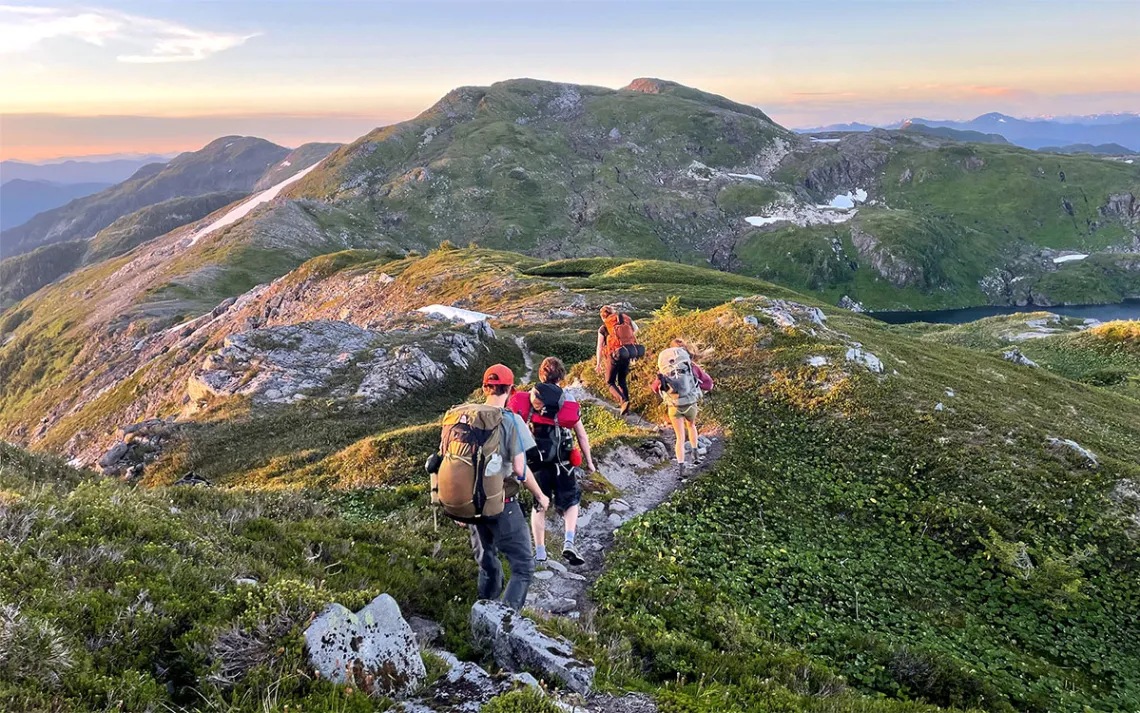
Visitors to the Tongass National Forest hike along a national recreation trail. | Photo courtesy of USDA Forest Service
When Dale Bosworth first visited northern national forest units 30 years ago, rangers raised concerns about a new hazard on their lands: off-road vehicles. Bosworth, a regional forester for the US Forest Service at the time, saw alpine meadows torn by cross-country tracks, stream banks eroded at trail crossings, and unofficial roads blazed through natural areas. Years later, in 2001, as chief of the Forest Service, he realized this was a nationwide issue.
“I was hearing from forest [managers] all across the country that had the same problem,” Bosworth, now retired, explained.
In response, he created the 2005 Travel Management Rule (TMR), a little-known policy that governs how the Forest Service manages motor vehicles and recreation on national forests. Before the TMR was put in place, all forest roads and trails were open unless explicitly closed, and off-road travel was unrestricted.
“[The TMR] flipped the presumption to ‘an area is closed unless explicitly open to off-road vehicle use’,” said Alex Craven, the Sierra Club’s forest campaign manager.
Yet, in August of this year, the Forest Service announced plans to revise the TMR. The Trump administration wants to reverse course, returning to an “open unless closed” model. If passed, the revision could fragment over 150 million acres of nonwilderness areas in national forests. That’s over four times as many acres as what revoking the Roadless Rule, which prohibits roads in wilderness areas, would impact.
Rather than a one-size-fits-all rule, the TMR provides guidelines for individual national forests. It requires managers to balance road use against other activities, such as hiking and environmental protection. It also requires forest managers to involve local authorities in decision-making, manage motorized vehicle use maps, and conduct environmental impact assessments before roads are opened.
Bosworth said that his job was made easier when roads were assumed closed rather than open. He believes revising the TMR will complicate things for Forest Service staff and motorized users alike, as the distinction between open versus closed or road versus trail becomes blurred.
“It just doesn't make sense to me,” Bosworth lamented. “It makes way more sense to show what's open.”
Supporters of the revision cite increased access to Forest Service land and accessibility for disabled visitors, who may require flat, stable surfaces, such as roads. Revising the TMR would indeed open more road miles for automobiles, ATVs, and other vehicles, but Forest Service road miles are already twice as long as hiking and biking trails. Moreover, the Forest Service estimates that 4,500 miles of trails comply with trail accessibility standards.
Still, some simply don’t want more vehicles in national forests. Closed roads are still open to hikers, bikers, and runners. As Runners for Public Land put it, “A nonmotorized trail is not a closed trail; it is a trail with a particular set of uses and a particular recreation setting.”
However, some claim that roads are being wasted by restricting vehicle access. Ben Burr, executive director of the Blue Ribbon Coalition, a pro–motorized vehicle group, said that vehicle travel is unreasonably restricted with the “closed unless open” guidelines. He also believes that many vehicle users become confused when following Forest Service maps, which only display open roads. Burr said he’s passed “closed roads” that have no sign indicating their closure, other than the fact that they don’t show up on a map.
“If you don't have route closure markers on the ground to let you know where you can and can't go, people could be inadvertently breaking laws and going places they shouldn't,” Burr explained. “Not because they're criminals, but just because the system isn't well designed.”
Bosworth acknowledged this dilemma and said he supports revisions that modernize and digitize maps for more efficient updates. However, he’s worried that completely reverting to pre-TMR rules would cause too much harm. “I'd like for us to make sure that we are listening to the motorized users, paying attention to that, but also let's not just go ... back to the way it was,” Bosworth said. “That's just not a good idea.”
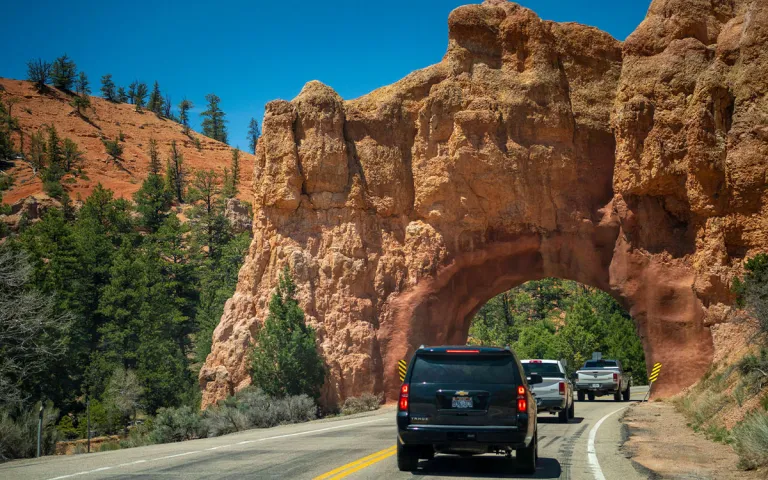
Red Canyon in Dixie National Forest. | Photo courtesy of USDA Forest Service photo by Preston Keres
Roads in forests are the primary driver of habitat fragmentation, according to Fraser Shilling, director of the Road Ecology Center at the University of California, Davis. But road impacts extend beyond the width of gravel. “The area impacted by the noise from traveling down those roads is hugely extensive; it's probably the most extensive impact. And so habitat fragmentation isn't just about losing that space between pieces of forest. It's about losing potentially wildlife space all around that road,” Shilling explained.
Roads, he cautioned, are especially harmful to popular big game and migrating species, including elk. Land Tawney, co-chair of American Hunters & Anglers, worries that changes to the TMR will adversely impact game populations in national forests. “Not only will that hurt the habitat security for these elk,” Tawney said, “but it'll also have an adverse impact on [hunting] experience, just because there'll be more people potentially in the backcountry.”
Shilling also said that forest roads can lead to soil erosion and sediment pollution in waterways. The Forest Service estimates that 20 percent of US freshwater originates from these lands, which it says is the “largest source of fresh water in the US under a single manager,” meaning revisions to the TMR could impact drinking water for millions.
Burr recognizes this and acknowledges that opening more roads could lead to environmental changes. But he said these impacts are overstated, and he’s adamant that most vehicle users don’t want to cause environmental damage. “Most of the people that I meet out recreating on public land recognize that the way that it's happening is to go use the existing road systems,” Burr said.
The TMR was supported through multiple administrations, including President Donald Trump’s first term. Dan Hartinger, a senior director of policy at the Wilderness Society, believes that broad support is due in part because the current TMR satisfies the Forest Service’s multiple-use mandate and benefits all public land users, regardless of how they recreate.
“In our view, our national forests are big enough to share; public lands are big enough to share,” Hartinger said. “And travel management rules and regulations sound wonky, but it's really how everyone can enjoy the forest in their way.”
Bosworth agrees, stating, “There's lots of access to national forests. It's just that they make it sound like the only legitimate access is if you can take a motorized vehicle.”
The general public also agrees. A September 2026 study by the Center for Western Priorities found that 99 percent of public comments opposed the proposed changes. Similar to repealing the Roadless Rule, Hartinger believes the revisions are part of President Trump's effort to cut regulations. The Forest Service said the update aligns with Executive Order 14408, which rescinded executive orders from the Nixon and Carter administrations that paved the way for the modern TMR.
Burr celebrates the proposed revisions as a win for backcountry vehicle users. But for Bosworth and others, the environmental, wildlife, and user conflict risks are simply too much to warrant this change. Hartinger also wonders how a reduced Forest Service staff will deal with these proposed changes, and how they’ll manage more roads with a nearly $9 billion maintenance backlog.
The official proposal is expected in the spring of 2027, with a final rule in early 2028.
“The situations that informed the need for these policies are about to be present again,” Craven said. “And we will see just why we needed these policies in the first place if we start to take them all apart.”