California Wolf Blazes New Trail
The epic journey of Bae has been a cause for celebration and highlights the need for road safety
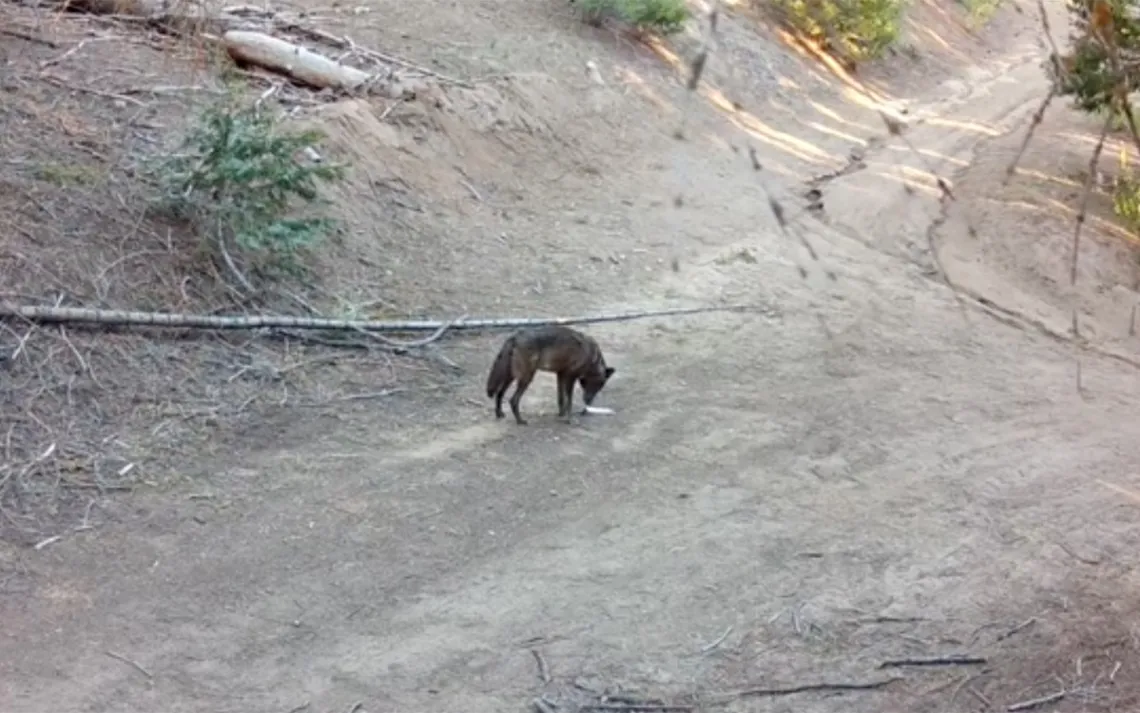
A trail cam image of Bae, the young female wolf who recently traveled to Los Angeles County | Photo courtesy of the California Department of Fish and Wildlife
Bae, like many ingenues before her, captured the hearts and minds of people across the globe when she showed up in Southern California just before Valentine’s Day. Over a five-day period, the three-year-old wolf toured the Golden State, crossing alpine meadows, roads, and oak woodlands. State officials call her by her government name, BEY03F, but admirers offer something with a little more heart, gesturing toward why she embarked on her 500-mile trek.
“Bae was looking for her bae,” said Paula Ficara, the cofounder of Apex Protection Project, a wolf and wolf-dog sanctuary, referring to the term of endearment often used by lovers.
Christopher DeTar, the gray wolf specialist at the California Department of Fish and Wildlife, agreed, albeit in more pragmatic terms. “Wolves will often disperse during the winter, which is driven by a search for a mate during the breeding season,” DeTar said. “Though BEY03F is unlikely to find a mate the further south she travels, her recent movements highlight how wolves can travel great distances in varied habitats in a relatively short period of time.”
With no other wolves in Los Angeles County, Bae turned north just two days after she arrived, leaving the suburban lights behind. Still, her legacy lives on in the people who marveled at her journey. Some of them, including Ficara and her partner, Steve Wastell, are using the young wolf's expedition, and the fan base she's garnered, to raise awareness about the plight of gray wolves throughout the state.
Together, Ficara and Wastell run the Apex Protection Project just 15 minutes from where Bae showed up. As many tracked the wolf’s whereabouts, Ficara and Wastell knew they had to get to work. “We already saw that she was here, and it was really exciting for us,” Wastell told Sierra. “We [asked], 'What can we do?' And we had a brainstorming session.”
They figured the biggest thing they could do was address Bae’s primary threat: roads. According to DeTar, BEY03F would have crossed several highways, including a major east/west highway at least four times. The last wolf who traveled as far as she did was OR93, a male wolf that was killed along Interstate 5 in Kern County, just north of where Bae sought respite.
To prevent her from succumbing to a similar fate, the Apex team worked with Amaroq Weiss, the senior wolf advocate at the Center for Biological Diversity. Their primary goal was to devise a campaign letting people know that the dispersing wolf was on the move. At first, they thought that putting up road signs might be a good idea. But with limited time and legal questions lingering, they scratched that idea. Instead, a quicker solution emerged—one with the potential to have a much broader reach.
One of the Apex Protection Project’s volunteers, Chelsea Shaffer, suggested the group distribute handheld wolf crossing signs, some of which they already had on hand at their sanctuary. The signs are yellow and black diamonds and resemble the animal crossing signs a homeowner might post in their driveway. A trio of jaunty wolves bound across the signs, like playful German shepherds.
Two hours after their initial call, they had a photo of a tour group giddy with excitement as they pointed toward their “wolf crossing signs” on the side of the road. By the next day, the Apex team was urging their over 1.9 million followers to put up signs, take pictures holding them, and spread the word to friends, neighbors, and leaders. Wastell said at one point, one distributor on Amazon had run out of signs.
Key to their effort is working with local youths to post, display, and showcase the signs across the state. Since its inception 17 years ago, the group has focused on activating kids through a volunteer program. Today, they work with local schools to introduce students to ambassador wolves so that they can learn about wolf behavior and acquire the skills needed to advocate for coexistence between carnivores and people. With that as their foundation, Ficara said, getting kids involved was both necessary and a great way to celebrate Bae’s story.
“It's really important that we help kids and understand that they have … a powerful voice, and to help them in finding ways of using their voices,” Ficara said. “We found this to be a really positive, creative, exciting way for them to use their voices and to really speak out in wanting to not just protect [Bae] but to protect wildlife.”
Wolves are recent arrivals to California in comparison to the state’s other charismatic megafauna. It was only in 2011 that the first wolf, since the 1920s, touched paws on the ground. So far, at least 70 wolves are living in the state, most of them cloistered in the far northeastern corner, where abundant Forest Service lands provide ample habitat and food and much-needed distance between them and people.
Still, Weiss said their recovery remains precarious. Last year, following a wave of cattle predations, the state euthanized four wolves. While incidents like this are extremely rare, it ignited a wave of anti-wolf sentiment that, Weiss said, could have been avoided if nonlethal tools were used before the wolves grew habituated to cattle. Absent direct conflict, at least five wolves have been fatally killed by cars in the last decade, dispersing from their home ranges, just as Bae did.
For its part, the State of California is trying to address some of the threats wolves face. Officials are currently considering at least 100 wildlife-crossing projects in various stages of planning, including one on Interstate 5, where OR93 was killed. And the Department of Fish and Wildlife is working with ranchers to let them know when wolves are in the area to reduce conflict and also provides some nonlethal tools, including fladry—electric fencing with strings of tape that discourage wolves.
In the meantime, Bae is back home in Northern California, where there are more wolves and fewer roads. And Ricarda and Wastell’s mission to get people to hold up wolf-crossing signs is also on the move. Hundreds of people from around the country have commented on social media posts, expressing support for Bae or the signs project. Other nonprofits, such as Team Wolf, a coalition of researchers and wolf advocates, are also starting social media campaigns. Even former Apex Protection Project volunteers, such as 19-year-old Grace Wiggins, are taking the effort to other states. Wiggins, who is pursuing a biology degree at Montana State University, says she plans on making her own signs.
“I think it's a really cool idea to get the word out there,” Wiggins said. [Bae] is “not just a predator roaming around. . . . She's looking for love. She's looking for a mate. . . . I think that it is still important for us to have that empathy.”